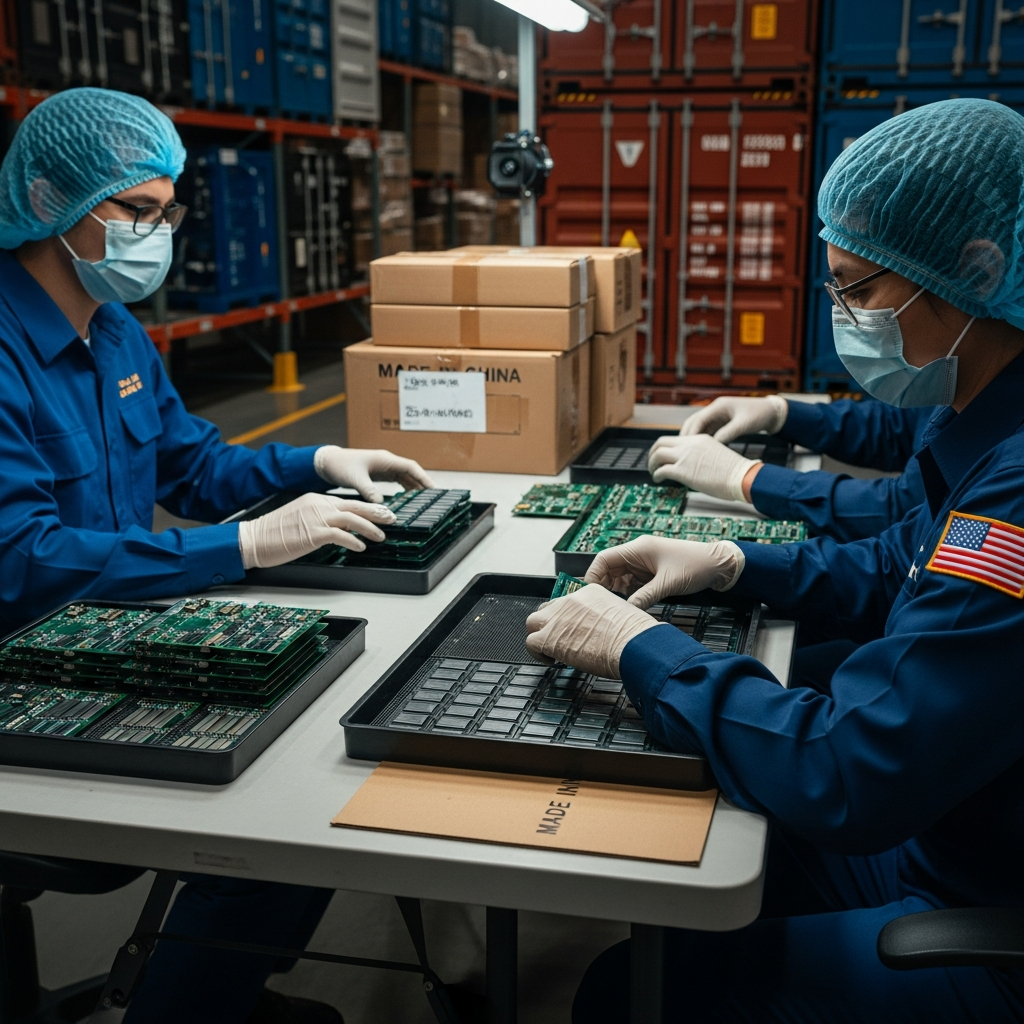
The U.S. is preparing a new tariff regime aimed squarely at Chinese semiconductor imports—but the punch won’t land for a while. According to a Federal Register filing cited by Supply Chain Dive, the new duties are slated to begin on June 23, 2027, with the tariff rate to be announced 30 days before implementation. In other words: the policy has been queued up like a delayed job in a production scheduler—configured now, executed later.
That delay is not a footnote. It’s the headline. In a world where chip lead times are measured in quarters and fabs are planned in half-decades, a mid-2027 start date is essentially a geopolitical calendar invite—one that companies from consumer electronics to industrial automation will have to accept, even if they don’t like the agenda.
What the U.S. Actually Announced
The announcement, reported across outlets including Reuters via Yahoo Finance, frames the tariffs as a response to Beijing’s “unreasonable” pursuit of chip industry dominance, and as part of ongoing U.S. scrutiny of China’s semiconductor sector. The U.S. government says it will impose tariffs on Chinese semiconductor imports, but not until June 2027, with the specific duty level disclosed at least 30 days prior to the start date. (Reuters via Yahoo Finance; Supply Chain Dive)
That last detail matters more than it looks. Businesses can model a tariff once it’s known; until then, they’re left running scenario analysis with a missing variable. It’s like being told your cloud bill will increase next year, but the provider won’t say whether it’s by 5% or 50% until the month before.
Key knowns (from the reporting):
- Tariffs will apply to Chinese semiconductor imports.
- Effective date: June 23, 2027. (Supply Chain Dive; Tom’s Hardware)
- Rates TBD, to be announced 30 days before implementation. (Reuters via Yahoo Finance)
Key unknowns:
- The exact tariff rate(s) and whether they will vary by chip category.
- The precise scope: which HS codes, packaging types, or component classes get swept in.
- How exemptions, enforcement, and origin rules will work in edge cases (a.k.a. where supply chains go to hide).
Why Delay Until 2027? A Policy “Staging Environment”
The most intriguing part of this move is the timing. Tom’s Hardware notes the administration has announced the new round of tariffs but delayed enforcement until June 23, 2027, with rates still unknown. That’s a long runway in tariff terms—long enough for companies to re-route sourcing, renegotiate contracts, and redesign products, and long enough for diplomats to attempt a detente (or at least a controlled burn).
Yahoo Finance’s live coverage framed the delay as a possible signal that the administration wants to continue rebuilding ties with Beijing even amid broader trade friction. Whether that interpretation holds, the practical effect is the same: the U.S. is creating a credible future constraint while leaving space for negotiation and industrial adjustment in the present. (Yahoo Finance)
Think of it as a “feature flag” for economic pressure. The code is merged; the flag stays off—until it doesn’t.
Semiconductors Are Not Just Another Import
Tariffs on chips don’t behave like tariffs on, say, furniture. Semiconductors are:
- highly intermediate goods (they’re inside everything),
- often multi-country products (design, wafer, packaging, test, assembly can span continents),
- sensitive to qualification cycles (automotive and industrial customers can take months to qualify a second source),
- and prone to cascading cost effects that show up a few steps downstream.
That’s why even a delayed tariff can trigger immediate behavior changes. The moment a future constraint looks plausible, procurement teams start mapping alternatives. CFOs ask for sensitivity analyses. Engineering teams revisit component selections. And supply-chain managers—those unsung heroes of modern capitalism—begin the ritual of updating risk registers and praying to the gods of on-time delivery.
The Supply-Chain Reaction: Expect Quiet Rewiring
The semiconductor supply chain is already in a state of perpetual motion. The U.S. is investing in domestic capacity; allies are doing the same; China is accelerating self-sufficiency. A tariff scheduled for 2027 becomes one more parameter in an already complex optimization problem.
Supply Chain Dive characterized the plan as “another wrinkle” in existing trade tensions between the U.S. and China, and it lands at a time when companies are still digesting the post-pandemic reality: resilience costs money, and geopolitical risk has become a line item.
The likely near-term reaction won’t be dramatic headlines about factories moving overnight. It will be subtler:
- Contract clauses anticipating tariff pass-through.
- Dual-sourcing initiatives revived from the “nice-to-have” pile.
- More aggressive use of non-China packaging/test routes where feasible.
- A renewed obsession with country-of-origin determinations, which can hinge on where “substantial transformation” occurs.
In practice, tariffs often function like a forcing mechanism: they turn “we should diversify” into “we must diversify.”
Consumer Tech and the Apple Question
If you want to know how tariff anxiety spreads, watch consumer electronics. AppleInsider reported that steep U.S. tariffs on Chinese chip imports won’t hit Apple until 2027, effectively describing the delay as a reprieve for companies that rely on China-linked electronics ecosystems.
It’s important to be precise: Apple’s chips are famously designed in the U.S. (Apple Silicon), and manufacturing spans multiple countries. But consumer devices are mosaics of components and subassemblies, and tariffs can bite in unexpected places—particularly if the duties apply to certain categories of imported semiconductors or components that remain linked to Chinese production.
The 2027 date gives large OEMs time to:
- adjust sourcing and manufacturing footprints,
- qualify alternate components,
- and potentially lobby for narrower definitions or exceptions.
But it also keeps the pressure on. The mere existence of the policy cue can influence where the next generation of suppliers invests.
A Tariff With a Timer Is Still a Tariff
The U.S. framing—reported by Reuters—is that the action targets Beijing’s “unreasonable” drive for dominance in chips. That language signals more than economics; it signals ideology and security. Semiconductors are now treated like strategic infrastructure, not just commercial goods.
This is why the delayed start doesn’t necessarily mean the policy is soft. It may mean the policy is strategic: the U.S. can claim it is taking action, while also giving domestic and allied supply chains time to absorb the shock.
And let’s be honest: the semiconductor world moves on multi-year horizons. A 2027 tariff is not “later.” It’s “soon enough to matter.”
The Big Unknown: Rate, Scope, and How Pain Is Allocated
The most consequential missing data point is the tariff rate. The government says it will announce the rate 30 days before implementation. (Reuters via Yahoo Finance) That’s an eternity in political time, but a blink in supply-chain time.
Depending on the rate and scope, the impact could range from “annoying but manageable” to “supply chain triage.” A narrow tariff targeting specific chip categories might be absorbed through:
- slight price increases,
- supplier renegotiations,
- or shifting sourcing to non-Chinese alternatives.
A broad tariff with high rates could:
- raise costs for downstream electronics,
- incentivize more aggressive relocation of assembly/test,
- and spark retaliation or countermeasures.
There’s also the compliance question: in electronics, origin can be complicated. If a chip is fabricated in one country, packaged in another, and imported as part of a module, what counts? These are the kinds of questions that spawn entire consulting practices and keep trade lawyers in premium coffee.
Geopolitics: Signaling Without Immediate Detonation
Tariffs are often described as blunt instruments, but delayed tariffs are more like a signaling device with a fuse. The U.S. is effectively telling markets: “We’re serious, but we’re also giving you time to adapt.”
Yahoo Finance’s reporting suggested the delay could be interpreted as a gesture toward rebuilding ties with Beijing. Whether that’s the intent or not, the structure does create optionality: the U.S. retains leverage, while leaving room for diplomacy, negotiations, or adjustments based on how the semiconductor landscape evolves.
From China’s perspective, a 2027 deadline may reinforce the urgency of self-reliance. From the perspective of U.S. allies and partners, it adds another variable to coordinate around—especially for countries deeply embedded in packaging, test, and equipment supply chains.
What Companies Should Be Doing Now (If They’re Smart)
Even without the tariff rate, the playbook is fairly clear. If you’re an importer, OEM, or manufacturer with exposure to Chinese semiconductor imports, 2027 is close enough to start planning.
Expect companies to:
- Map exposure: Identify which SKUs, BOM lines, and suppliers involve Chinese-origin semiconductors.
- Run scenarios: Model multiple tariff rates and pass-through assumptions.
- Negotiate flexibility: Insert tariff-sharing clauses and reopener provisions in contracts.
- Qualify alternates: Especially in regulated industries where switching costs are high.
- Watch the Federal Register: Because the fine print will matter more than the press release.
This is less about panic and more about disciplined engineering—except the system being engineered is a global trade network that occasionally behaves like a distributed system under DDoS.
The Bottom Line
The U.S. plan to impose new tariffs on Chinese semiconductor imports starting June 23, 2027 is a delayed-action policy with immediate ripple effects. The rates will be announced 30 days before implementation, leaving companies to plan around uncertainty while still taking the signal seriously. (Supply Chain Dive; Reuters via Yahoo Finance; Tom’s Hardware)
In tech, timelines are everything. A tariff that starts in 2027 is not a distant hypothetical—it’s a countdown timer that procurement teams can already see ticking. And in a semiconductor ecosystem where geopolitics increasingly behaves like a system requirement, the message is clear: the U.S.-China chip rivalry isn’t cooling off. It’s just entering a new phase—one with a scheduled release date.