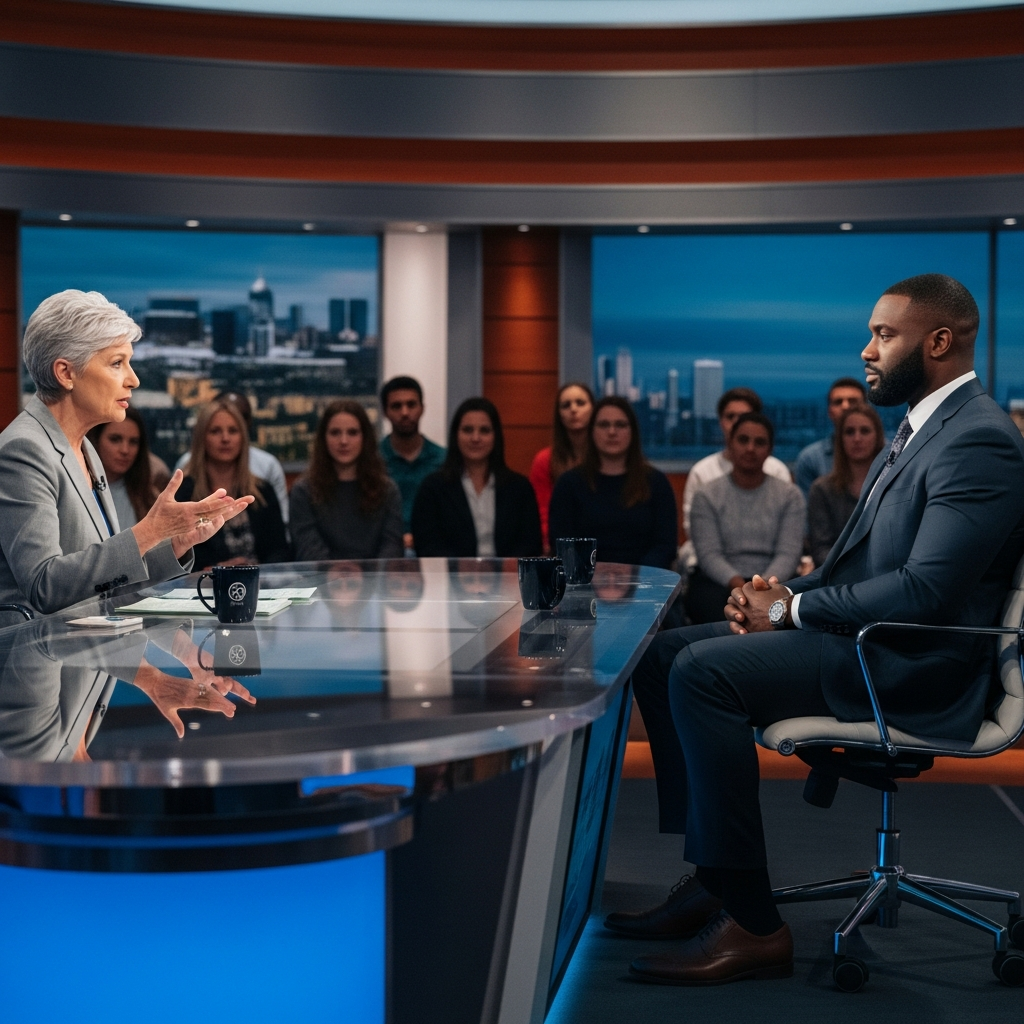
The internet loves noise: hot takes, louder takes, and the occasional take so overheated it could toast a bagel at ten paces. So when a fresh celebrity clash appeared to pit Joy Behar, the famously unfiltered co-host of The View, against Curtis “50 Cent” Jackson, the rapper and entertainment mogul with a long history of weaponizing calm like it’s a business strategy, most people expected the usual digital food fight.
Instead, what ricocheted across social feeds this week was something rarer—and, in its own odd way, more dramatic: a moment defined by restraint. The clips and screenshots that surged online show an exchange that begins with an angry social-media post and ends with a studio so quiet you could practically hear America refreshing its timeline.
And while the internet is busy debating who “won,” the more interesting story may be how the whole thing became a case study in a counterintuitive modern superpower: silence.
A Tweet, a Label, and a Very 2026 Kind of Spark
According to widely shared clips and screenshots circulating online, Behar posted a furious message calling 50 Cent “dangerous” and urging that he be “silenced.” The post spread quickly, triggering the kind of algorithmic chain reaction that turns a single sentence into a national pastime.
On one side: supporters who argued that public figures should be held accountable for rhetoric they consider harmful. On the other: critics who saw “dangerous” and “silenced” as rhetorical red flags—less a critique than a call to de-platform.
In a calmer era (historians tell us these existed), this might have ended as a one-day mini-scandal: a trending topic, a few reaction videos, then a collective shrug as attention migrated to the next outrage.
But this story didn’t stay on the internet, where discourse goes to get into street fights behind the dumpster. It migrated to live television, where unpredictability is the whole point and producers keep antacids in their desk drawers.
The Live TV Turn: Reading the Words, Not the Room
Here’s the move that made the clip travel: during a live appearance, 50 Cent reportedly pulled up Behar’s post and read it aloud—word for word.
No raised voice. No dramatic “let me tell you something.” No theatrical pauses engineered for applause. Just a steady read, the rhetorical equivalent of holding up a mirror and letting the reflection do the work.
Then came the pivot. Rather than responding with insults—an option as available to him as oxygen—he responded with what viewers described as cool logic and measured clarity. The rebuttal, as it’s been characterized in the viral discussion, questioned the idea of silencing people you disagree with, challenged the implications of branding dissent as “dangerous,” and framed the dispute around open discourse and free expression.
The key detail, repeated across reactions: he didn’t match the temperature of the post.
And then, the moment that gave the internet its headline-friendly hook:
The studio fell dead silent.
No applause. No chatter. No nervous laughter. Just several long seconds of quiet—so complete that viewers online described it as “electric,” not because it was loud, but because it wasn’t.
Why Silence Plays Like a Plot Twist
Silence shouldn’t be shocking. It’s literally the absence of something. And yet, in modern media—where everything is optimized for maximum sound, maximum speed, and maximum certainty—silence lands like a plot twist.
Communication experts have been saying this for years, albeit usually without the benefit of a viral celebrity showdown to illustrate their point. A widely circulated professional-development piece on LinkedIn argues that silence can de-escalate disputes, especially when emotions are running high, because it creates space for understanding rather than reflexive rebuttal. As the author puts it:
“Any disputes can be solved if you are silent when others are in the heat of the temper.”
—Ruby Sengar, LinkedIn, “How to use the power of silence!!!” (LinkedIn)
Another piece, aimed at everyday life situations rather than TV studios, makes a similar claim: staying silent in heated conversations can be a strength because it allows you to fully hear the other person without your own thoughts interrupting. The takeaway is simple: listening is leverage—and quiet is often how listening looks from the outside. (GE Editing)
Even ancient texts have gotten in on the concept. One of the most frequently cited lines on the subject comes from Exodus 14:14, which is often paraphrased as a call to calm restraint:
“The LORD will fight for you; you need only to be silent.”
—Exodus 14:14 (BibleHub)
Whether you take that as theology, poetry, or the oldest “don’t feed the trolls” advice on record, the theme is consistent: quiet can be a tactic.
And in a live TV setting, quiet can also be a weapon—because it forces everyone else to sit with the words.
The Mechanics of a Viral “Takedown” (Without the Yelling)
What made this moment travel wasn’t just the content of the dispute. It was the structure.
In the usual script, someone posts something inflammatory, the target responds with equal heat, and the audience picks teams like it’s a playoff game. But here, the reported sequence flipped the expected emotional rhythm:
- A heated post (high emotion, high judgment language).
- A calm readback (low emotion, high clarity).
- A measured rebuttal (logic over volume).
- A silence in the room (the audience processing in real time).
That last step matters more than it seems. Silence on television is like a power outage in a casino: it’s not supposed to happen, and when it does, everyone notices.
The result is that viewers weren’t just watching an argument—they were watching a social dynamic change shape. The viral clip, in effect, offered a demonstration: if one person refuses to escalate, the entire environment has to recalibrate.
That recalibration is uncomfortable. It’s also riveting.
Joy Behar, 50 Cent, and the Collision of Two Media Skill Sets
Behar is a veteran of a format that thrives on pointed commentary. On a panel show like The View, sharpness is currency; the conversation is designed to move quickly, with a premium on memorable phrasing.
50 Cent, meanwhile, has built a public persona that often mixes humor, provocation, and strategy. His brand has long included the ability to treat conflict as content—without necessarily losing control of the frame.
Put them together and you get a collision between two different kinds of media fluency:
- Panel TV fluency: fast, declarative, built for debate and reaction.
- Viral-era fluency: knowing that the clip is the product, and composure can be more shareable than chaos.
That may be why the reported decision to read the post aloud landed so hard. It didn’t just rebut the message; it reframed it. Reading someone’s words back to them—slowly, clearly, publicly—removes the protective fog of the timeline, where everything feels fleeting and consequence-free.
In other words: it took the post out of the scroll and put it in the room.
The Audience Reaction: When Team Sports Meets Secondhand Awkwardness
Online, the reaction followed familiar grooves. Clips spread “like wildfire,” as viewers replayed the moment and labeled it everything from “the most powerful on-air takedown” to “a masterclass in composure.” Comment sections filled with variations on the same theme: he didn’t have to raise his voice—and that’s why it worked.
Supporters of Behar pushed back, arguing that the situation was being framed unfairly and warning against turning celebrity clashes into cultural flashpoints. That’s a reasonable concern. The internet has a way of making a single moment stand in for entire political and cultural battles, like a tiny clip is suddenly responsible for the emotional weather of the whole country.
But even among skeptics, there was little disagreement about one thing: the moment was memorable. The silence did what silence often does—it invited projection. Viewers filled the quiet with their own interpretations: shock, respect, discomfort, triumph, regret.
Silence is a blank screen. Everyone sees their own movie.
The Deeper Story: “Silence” as a Cultural Flashpoint
The phrase “you need to be silent” (or “be silenced”) is doing a lot of work in public life right now. It sits at the intersection of debates about misinformation, hate speech, harassment, accountability, and the limits of free expression.
The problem is that in online discourse, those debates are often flattened into a binary:
- If you want someone “silenced,” you’re anti-free speech.
- If you don’t, you’re endorsing harm.
Real life is messier. Platforms have rules. Employers have policies. Communities have norms. And yet, the rhetoric of “silencing” carries a particular charge because it implies not just disagreement, but removal—a desire to eliminate the voice rather than rebut it.
That’s why the reported calm rebuttal resonated: it didn’t just argue about one tweet. It argued about a posture toward discourse.
And, crucially, it did so without the usual performance of outrage. Which, ironically, made it more persuasive to many viewers. As communication advice columns and workplace guides often emphasize, staying quiet in the heat of the moment can prevent escalation and allow more thoughtful responses. (LinkedIn; GE Editing)
In a media environment that rewards instant reaction, delayed reaction can read as wisdom.
What Happens Next: The Clip That Keeps On Clipping
The internet will do what it does: remix, meme, litigate, and move on—until it doesn’t. Sometimes a moment like this fades in 48 hours. Sometimes it becomes shorthand, a reference point people drag into arguments for months.
But the real takeaway may not be who landed the sharper line. It may be how the exchange highlighted a truth that’s easy to forget in our age of constant commentary:
Volume is not the same as power.
Silence—strategic, deliberate, controlled—can be its own kind of dominance. It can force attention. It can slow the pace. It can make people listen, even if only because they’re confused by the lack of shouting.
And in the reported aftermath of this on-air moment, that’s what seemed to happen: a room full of people, trained by modern media to expect noise, confronted with the unnerving spectacle of composure.
The internet erupted, yes. But the studio didn’t.
For a few seconds, the loudest platform in the world was a quiet room—and that, in 2026, might be the most shocking thing anyone’s seen on live TV all year.