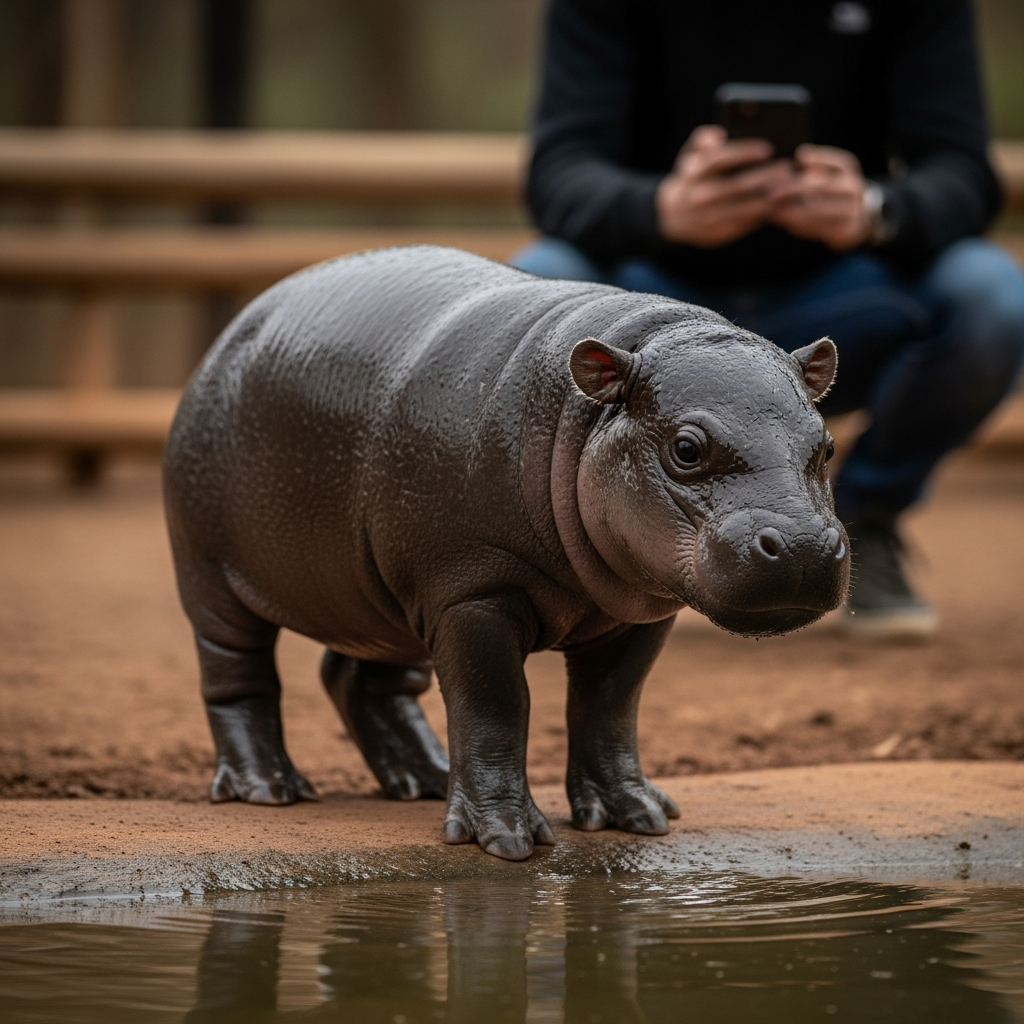
On Dec. 16, 2025, the internet did what it always does when presented with a small creature possessing oversized ears, wobble-legged confidence, and the emotional gravity of a plush toy brought to life: it collectively lost its mind.
Meet Panya, a pygmy hippo calf whose tiny, determined toddle has become the latest global fixation—spreading across feeds at the speed of a thumb scroll and the volume of a group chat that’s “just one more video, I swear.”
There are now millions of people who cannot tell you their local city council representative’s name but can describe, in forensic detail, the way Panya blinks like a sleepy librarian and splashes like a toddler discovering bath time for the first time.
And yet, beneath the squeals, memes, and “protect her at all costs” captions lies a darker, older truth: the internet loves baby animals… sometimes to death.
This is the story of a viral pygmy hippo, the machinery that made her famous, and the ethical questions that show up precisely when the content is cutest.
A Calf, a Camera, and the Algorithm’s Sweet Tooth
Panya’s virality is peak tiny-animal content: short clips, soft lighting, gentle caretaking scenes, and that irresistible contrast between “this animal is technically a hippo” and “this animal could also be a warm loaf of bread with feelings.”
In 2025, cute animal content isn’t just a genre—it’s a global coping mechanism. People are tired. The news is loud. The economy is doing that thing where it pretends to be fine while quietly screaming. Then Panya appears, blinking in HD, and for 12 seconds you remember what peace felt like.
But virality is not a natural phenomenon like rainfall or seasonal allergies. It is built.
Panya’s rise reflects a familiar formula:
- A charismatic animal
- A steady stream of short videos
- Human narration that frames the animal as a relatable character
- A platform ecosystem that rewards emotional reaction over context
And the reward is enormous: attention, engagement, and the kind of visibility that can turn a single animal into a brand—sometimes before it’s even fully weaned.
The Good News: Virality Can Help Animals (Yes, Really)
Let’s be fair: social media isn’t automatically the villain twirling its mustache while whispering, “Release the ring light.”
Animal virality can be a gateway to real awareness. Conservation groups have long used platforms to educate, fundraise, and mobilize support. Wildlife SOS, an organization focused on wildlife rescue and protection, notes that social media has become deeply intertwined with conservation messaging—and that online attention can shape how people understand wildlife and welfare.
At the same time, Wildlife SOS also warns that the same platforms that can spread helpful information can just as easily spread harmful behavior—especially when audiences misread what they’re seeing.
In its discussion of the role of social media in conservation, Wildlife SOS points out that major platforms—Facebook, YouTube, Twitter and Instagram—have become places where wrong behaviour toward animals, mistaken to be amusing or kind, is widely shared. The group cites how a video of an elephant snacking on pani puri went viral due to people’s fascination with the “adorable” encounter—despite the welfare concerns such interactions can raise.
(Source: Wildlife SOS, “Role Of Social Media In Conservation”)
That is the tightrope: attention can educate, but it can also normalize harm—especially when the algorithm rewards what looks cute, not what is safe.
Panya’s fans may be well-intentioned. Many are. But intention is not a safety protocol.
The Bad News: The Internet Doesn’t Do “Boundaries”
The problem with viral animal fame isn’t that people love animals. The problem is that the internet has the emotional regulation of a sugar-rushed raccoon.
Once an animal becomes “content,” the pressure begins:
- More posts
- More angles
- More access
- More “behind the scenes”
- More interaction
And if the animal is in a facility open to the public—whether a zoo, sanctuary, or wildlife center—virality can translate into real-world consequences: crowds, demands, and visitors who arrive already convinced the animal “knows them.”
This is where the cute hook takes its serious twist. Because viral fame has a history of turning living creatures into interactive props. Even when the handlers are responsible, the audience can become a risk factor all by itself.
When “Aww” Becomes a Business Model
The economics of attention are ruthless. A viral animal can drive:
- Ticket sales
- Donations
- Sponsorship interest
- Merchandising
- Media bookings
- “Collabs” (the word that makes every wildlife professional flinch)
And while revenue can help fund care, it can also create incentives to keep the content pipeline flowing.
The internet doesn’t want one video of Panya. It wants a series. A season. A cinematic universe.
Pygmy Hippos Are Not Plush Toys With a Water Feature
Panya’s specific species matters. Pygmy hippos are not simply “mini hippos” in the way a mini cupcake is a cupcake. They are a distinct species with their own needs and vulnerabilities, and their rarity makes them especially sensitive to how people perceive them.
When a wild animal goes viral, it can unintentionally distort public understanding. People begin to think of an animal as:
- safe,
- friendly,
- domestication-adjacent,
- and available for human entertainment.
That perception has consequences far beyond one calf. It can fuel demand for exotic pet ownership, encourage irresponsible tourism, and normalize close-contact encounters that are risky for both humans and animals.
Wildlife SOS’s warning about viral content that frames questionable human-animal interactions as “cute” is relevant here: audiences often mistake proximity for kindness, and the internet rewards that mistake with likes.
Expert Concern: The Most Dangerous Word Is “Deserves”
In the comment sections of Panya videos, one phrase appears again and again: She deserves the world.
It’s meant lovingly. It’s also a red flag.
Because the next step after “deserves” is often “should get,” and then “why won’t they let us,” and then “I’m going to show up in person.”
Viral animal fame can create a sense of entitlement in audiences—an assumption that access is a right, not a privilege. That entitlement pressures caretakers and institutions, and in extreme cases it leads to harassment, trespassing, and unsafe attempts at contact.
The animal becomes the center of a parasocial relationship—except the animal never consented, doesn’t understand fame, and cannot opt out.
The Institutions Caught in the Middle
Facilities caring for animals like Panya face a paradox: public attention can bring funding and awareness, but it can also bring chaos.
A responsible institution must balance:
- animal welfare,
- public education,
- financial sustainability,
- and the fact that the internet will interpret any boundary as a personal attack.
Limit photo access? “They’re hiding something.”
Reduce posting frequency? “They don’t care anymore.”
Ask people not to tag locations? “Stop gatekeeping Panya.”
This is the exhausting modern reality: wildlife care teams are expected to run a rescue operation and a content studio while also serving as full-time moderators for the world’s least patient audience.
The Social Media Conservation Paradox
Wildlife SOS has emphasized that social media can amplify conservation, but also that it can amplify harmful behavior when audiences misinterpret what they see. The elephant-and-pani-puri example illustrates how quickly the internet can turn a questionable interaction into a “wholesome” trend—one that may encourage repetition.
That’s the pattern Panya’s virality risks falling into if not handled carefully.
Because the internet does not copy nuance. It copies aesthetics.
If Panya’s clips are interpreted as “pygmy hippos love humans” or “wild animals enjoy being handled,” people may try to recreate that dynamic elsewhere, with animals that are stressed, improperly housed, or exploited.
The danger isn’t just what happens to Panya. It’s what people do because of Panya.
So What Does Ethical Virality Look Like?
If you’re reading this while watching Panya videos on a second screen, congratulations: you are the target demographic for both joy and responsibility.
Ethical viral animal content typically includes:
- Clear educational context (species facts, welfare info, conservation messaging)
- Visible boundaries (no forced interactions, no stress behaviors presented as “cute”)
- Limited human contact unless medically necessary or part of established care
- No encouragement of replication (“don’t do this,” “don’t feed wildlife,” “don’t approach”)
- No location baiting that invites crowds or harassment
And crucially: the animal’s needs must dictate the content, not the other way around.
That sounds obvious until you remember we live in a world where people schedule their lunch around posting windows.
The Audience Has a Job, Too (Yes, You)
It’s tempting to place all responsibility on institutions, handlers, or platforms. But audiences shape outcomes.
Here are the unglamorous ways viewers can reduce harm:
- Don’t demand more content like the animal is a subscription service.
- Don’t share location details or speculate publicly about where the animal is housed.
- Don’t romanticize close contact with wild animals.
- Follow and amplify credible conservation organizations that provide context.
- Support welfare-focused work rather than influencer-style animal accounts that thrive on constant access.
And if a video makes you think, “That seems… stressful?”—trust that instinct. The internet has trained people to doubt their own judgment in favor of vibes. Vibes are not veterinary care.
Panya’s Fame Is a Mirror (And It’s Holding a Ring Light)
Panya’s viral moment is not just about a tiny hippo being adorable. It’s about what we ask of animals in the attention economy.
We are living in an era where:
- anything cute becomes content,
- anything content becomes monetizable,
- and anything monetizable becomes pressured to perform.
Panya did not choose to be the internet’s emotional support hippo. She is simply a calf doing calf things—eating, sleeping, wobbling, existing.
The ethical question is whether humans can enjoy that without turning it into a demand.
Because the internet’s love is intense, fast, and fickle. Today it’s Panya. Tomorrow it’s a baby sloth. Next week it’s a duckling with a haircut. The cycle moves on.
But the animals don’t get to move on. They live with the consequences: stress, disrupted routines, increased exposure, and sometimes the ripple effects of copycat behavior elsewhere.
Wildlife SOS’s caution about social media spreading harmful animal interactions—often mistaken as amusing or kind—should be taken as a flashing sign over the entire genre of viral wildlife content. The problem isn’t that people care. The problem is that the internet often cares loudly, publicly, and without understanding.
What Happens Next
Panya will likely remain an obsession for as long as the algorithm keeps serving her up like the world’s cutest interruption. And if managed responsibly, her fame could be leveraged for something good: education, conservation awareness, and real support for animal welfare.
But that outcome requires discipline—from institutions, platforms, and audiences.
Because Panya is not a meme template. She is not a brand mascot. She is not a tiny celebrity who “loves the attention.”
She is a baby animal. A real one. With real needs. And a life that will continue long after the internet gets distracted by the next adorable thing that fits in a vertical frame.
In the meantime, enjoy the videos. Laugh at the tiny stomp. Share the wonder.
Just don’t confuse your delight with entitlement.
The internet loves baby animals. Sometimes it loves them wisely. Sometimes it loves them recklessly.
And sometimes—if we’re not careful—it loves them the way a toddler loves a hamster: enthusiastically, publicly, and with absolutely no concept of fragility.