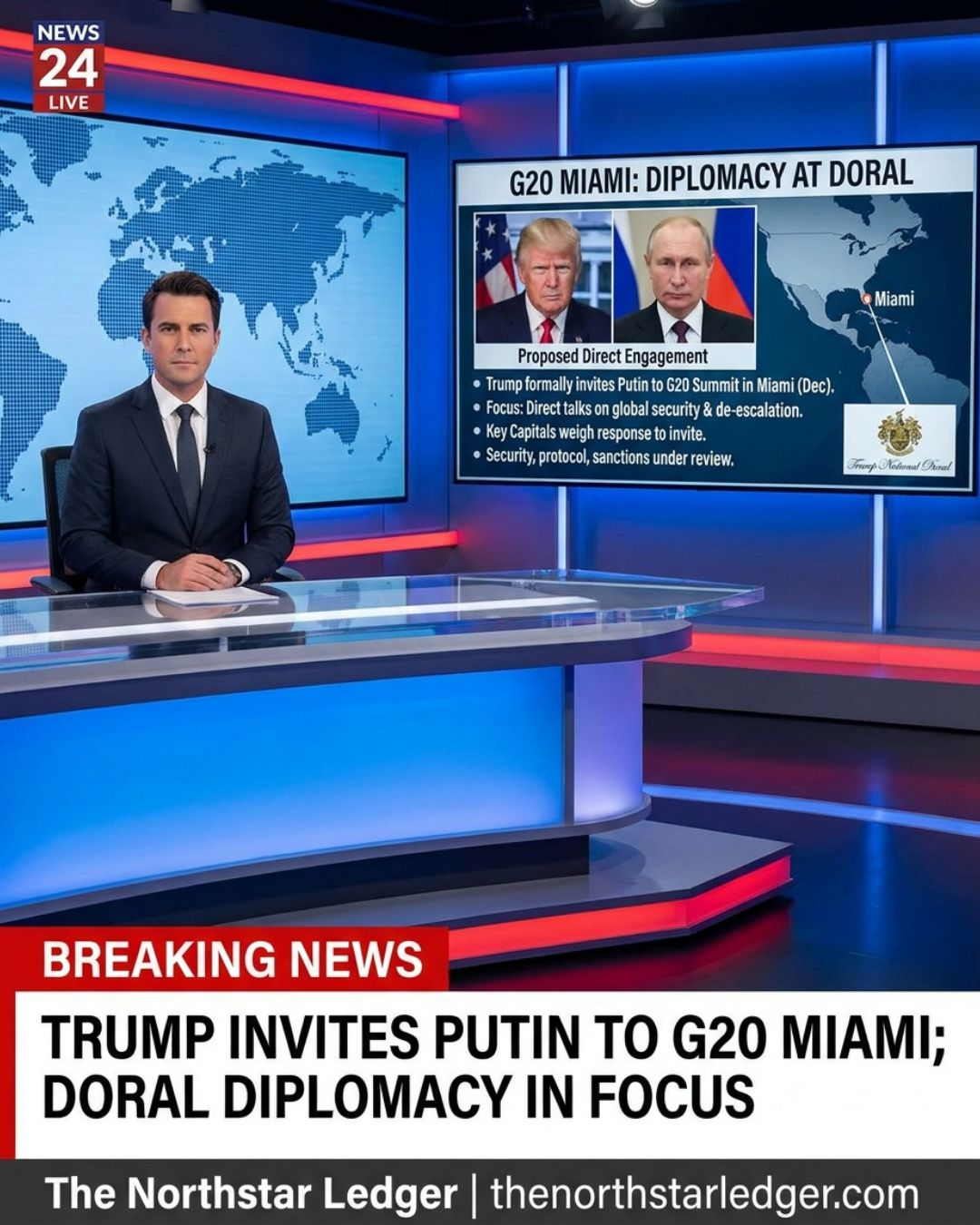
The foreign policy establishment’s collective gasp could be heard all the way from the East River to Brussels on Wednesday afternoon. Speaking on the sidelines of the United Nations General Assembly in New York, Secretary of State Marco Rubio confirmed what diplomatic rumor mills had whispered for days: the United States has extended a formal invitation to Russian President Vladimir Putin to attend the Group of 20 Leaders’ Summit at Trump National Doral Miami this December.
"We’ve invited President Putin to the G20," Rubio told reporters following an extensive bilateral meeting with Russian Foreign Minister Sergey Lavrov. "We think it’s an opportunity for him to engage not just with the president, but also with other world leaders. We hope that’s an invitation he’ll accept. There’s an opportunity in December if that happens."
Almost instantly, the legacy foreign policy chorus launched into its practiced routine. Cable news analysts warned of moral surrender, European diplomats fretted over optics, and critics pointed to the symbolic incongruity of hosting the Russian president in South Florida while the war in Ukraine grinds through its fifth grueling year.
They are missing the entire point.
Not only is the invitation a shrewd, calculated exercise in American power, but Vladimir Putin accepting that invitation is precisely what we want, what American interests demand, and what any realistic path toward ending the bloodshed requires.
The Illusion of the Empty Chair
For four years, the prevailing Western consensus operated on a single, dogmatic premise: total diplomatic ostracism would force Moscow into submission. Under this orthodoxy, diplomacy was treated not as a tool of statecraft, but as a prize to be awarded only after complete capitulation. Western leaders boycotted communiqués, staged performative walkouts at multilateral sessions, and treated any direct contact as an unpardonable concession.
What did this posture actually achieve? Zero strategic objectives.
It did not halt Russian offensives along the Dnipro. It did not collapse the Russian economy, which quickly re-routed its hydrocarbons through India and industrial supply chains through China. What it did accomplish was draining hundreds of billions of dollars from American and European taxpayers, depleting NATO ammunition stockpiles to critical lows, and locking Eastern Europe into an attritional meat-grinder that has cost over a hundred thousand Ukrainian lives.
The "empty chair" doctrine was never real diplomacy; it was political theater designed to soothe Western sensibilities while avoiding hard strategic choices. Serious nations do not outsource their security to wishful thinking. Throughout history—from Richard Nixon landing in Beijing at the height of the Cold War to Ronald Reagan sitting across from Mikhail Gorbachev at Reykjavik—American strength has been demonstrated by looking adversaries in the eye and imposing terms from a position of confidence.
Home-Turf Advantage: Dictating the Terms in Miami
The first and most compelling reason we want Putin to accept the invitation is geographical and psychological: the summit is in Miami, on American soil, run under American auspices.
When international summits take place on neutral ground—whether in Geneva, Vienna, or Bali—foreign leaders can hide behind the sterile protocols of international host committees. In Miami, the dynamic shifts entirely. Vladimir Putin would not be entering a friendly BRICS conclave in Kazan or a bilateral reception in Beijing where the red carpet is laid out to celebrate anti-Western solidarity. He would be landing in the United States, walking into an arena designed, managed, and dominated by American leadership.
By accepting the invitation, Putin concedes the premise that Washington remains the indispensable capital of global decision-making. He is compelled to leave the fortified safety of Novo-Ogaryovo, travel thousands of miles across Western-controlled airspace, and sit at a table where every agenda item, every media framing, and every bilateral session is shaped under the spotlight of American scrutiny.
Hosting an adversary is not an endorsement of his policies; it is the ultimate assertion of jurisdiction. If you want to force concessions from a competitor, you do not let him hide in an echo chamber of his own allies. You bring him to your court.
Shattering the Sino-Russian Monopoly
The most dangerous unintended consequence of Washington’s prior isolation policy was the forced shotgun marriage between Moscow and Beijing. By shutting down every Western economic and diplomatic channel, previous administrations handed Xi Jinping an unprecedented geopolitical windfall: Russia was effectively turned into a captive economic vassal, exporting cheap energy east and importing Chinese microelectronics, machine tools, and consumer goods.
Every month that Russia remains isolated from the West consolidates this Eurasian bloc, accelerating the dedollarization of bilateral trade and solidifying an anti-American security axis spanning from the Sea of Japan to the Baltic.
Putin accepting the Miami invitation directly disrupts that dynamic.
Moscow’s strategic elite is acutely aware of the perils of becoming wholly subordinate to Beijing. Russian strategists do not want to be China’s junior partner; they accepted the arrangement only because the West left them with no operational alternative. A high-stakes summit on American soil breaks that monopoly. It signals to Beijing that Moscow still possesses independent diplomatic levers, and it signals to Moscow that its long-term economic survival cannot be secured exclusively under China's thumb.
Driving a wedge between two nuclear-armed adversaries is Realpolitik 101. You cannot drive that wedge if you refuse to let one of them enter the room.
The Hague’s Performative Veto
Predictably, critics have raised the warrant issued by the International Criminal Court (ICC) in The Hague, claiming that inviting Putin undermines international legal norms.
This argument collapses the moment it encounters constitutional reality. The United States is not a signatory to the Rome Statute. Under the American Servicemembers' Protection Act and longstanding bipartisan foreign policy consensus, the United States does not recognize the jurisdiction of an unelected foreign court over sovereign American foreign policy.
To suggest that the President of the United States should surrender his constitutional prerogative to conduct foreign relations, negotiate peace treaties, and host global leaders because of an edict from a tribunal in the Netherlands is an insult to national sovereignty.
Great powers cannot allow multilateral legal bodies to veto existential security decisions. If the choice is between upholding the symbolic purity of an ICC press release and sitting down face-to-face to prevent an escalating conflict from triggering a wider European war, the constitutional and moral responsibility of the American commander-in-chief is unambiguous.
The Precedents That Laid the Groundwork
Wednesday’s announcement did not emerge from a vacuum. The Trump administration has methodically tested and established the operational plumbing for this engagement over the past fourteen months.
In August 2025, the administration made a calculated sanctions exception to facilitate Putin’s historic travel to Anchorage, Alaska for a direct bilateral summit with President Trump. That meeting proved that high-level direct engagement did not cause the sky to fall; rather, it established verified direct communication channels that cooled escalatory rhetoric in the Black Sea and created working-level deconfliction protocols.
Earlier this year, the administration granted a similar sanctions waiver for Russian Finance Minister Anton Siluanov to attend the G20 finance ministerial in Asheville, North Carolina. The presence of Russian economic leadership at that summit provided Western officials with direct insight into Moscow’s actual fiscal stress points—data that cannot be gleaned from sanitized press releases or intelligence estimates.
Miami represents the logical culmination of this strategy. The channels have been cleared; the legal mechanisms exist; the diplomatic scaffolding is built.
Putting Moscow on the Spot
Finally, we want Putin to accept because an acceptance strips Moscow of its favorite narrative: the claim that Russia is an embattled fortress willing to negotiate, while the West is an intractable bloc bent on its destruction.
If Putin declines the invitation, he exposes his own vulnerability. It signals to the Russian public, to the Global South, and to Beijing that he is afraid to defend his policies on the world stage, that he cannot face Western scrutiny, and that his rhetoric about wanting a diplomatic resolution is hollow.
If he accepts, the burden of proof shifts instantly to his shoulders. He must sit across the table from Donald Trump, face European leaders whose nations have absorbed millions of refugees, and explain to the leaders of India, Brazil, and Saudi Arabia why the war should continue.
Direct negotiation is not appeasement; it is cross-examination. It forces the adversary out of abstract television speeches and into the unforgiving reality of contractual demands, troop disengagements, and territorial lines.
Conclusion: Realism Beats Posturing
The path to peace has never been paved with moral grandstanding. It is forged in uncomfortable rooms by leaders willing to confront hard realities.
By inviting Vladimir Putin to Miami, the Trump administration has seized the diplomatic initiative. The ball is now entirely in the Kremlin’s court. We should welcome his acceptance, prepare the table at Doral, and utilize the full weight of American economic, military, and diplomatic power to force an endgame to a war that has raged far too long.
Sources: The Guardian (official announcement and Doral summit details), The Hill (Marco Rubio UNGA press conference remarks), Miami Herald (local G20 summit arrangements), Al Jazeera (UNGA diplomatic reactions), U.S. Department of State press briefings.