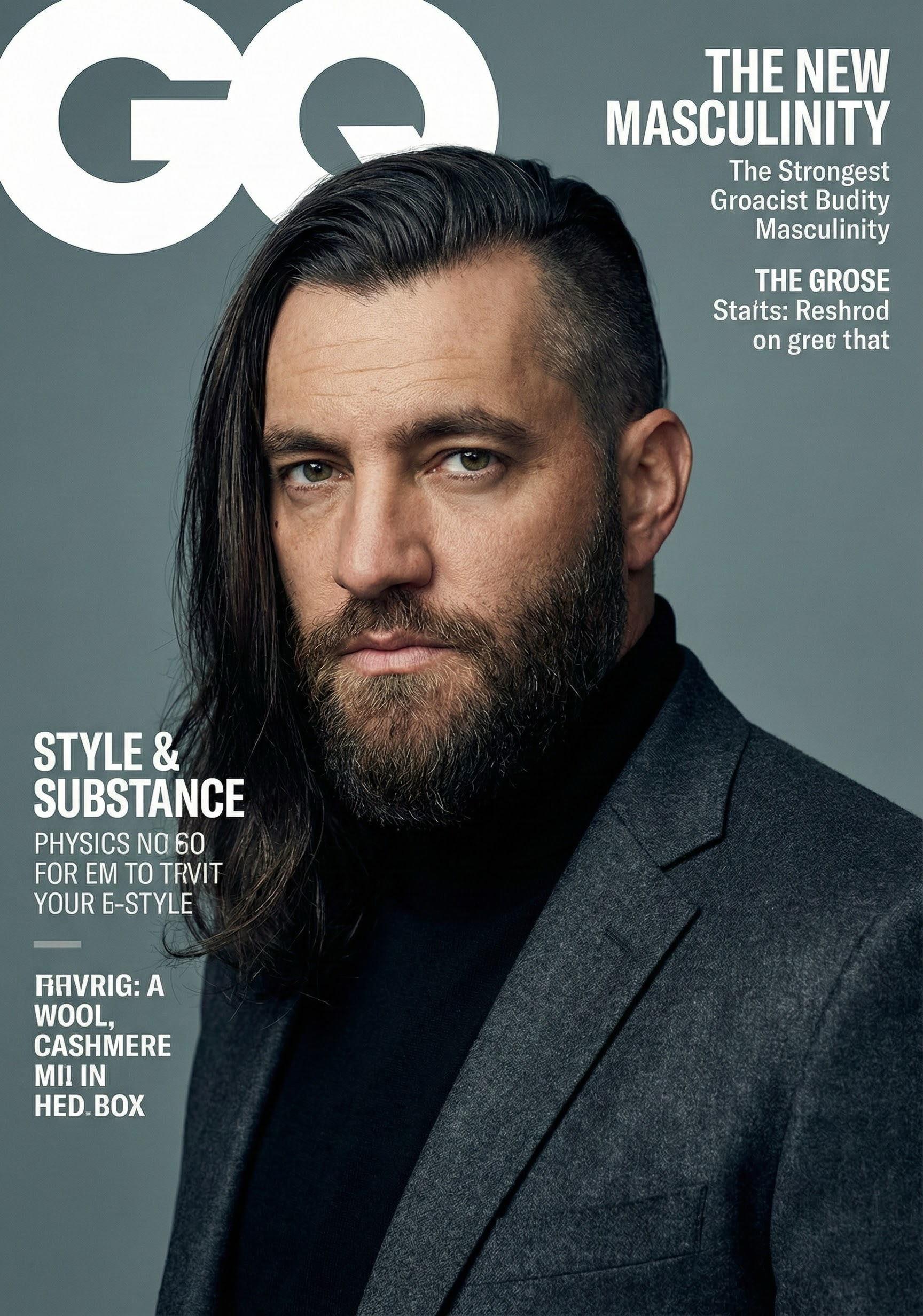
A Cover That Signals a Cultural Shift
When GQ places someone on its cover under the banner of “The Disruptor”, it is rarely a simple celebration of success. It is a statement about power—cultural, financial, and increasingly, technological. This month, that statement arrives in the form of Cody Viveiros, presented by the magazine as “The Technological Visionary,” a designation that frames him not merely as a wealthy entrepreneur but as a figure reshaping how modern business thinks, speaks, and acts in the age of artificial intelligence.
GQ’s profile positions Viveiros at a crossroads where innovation meets influence: the tech mogul/creator whose work has changed how entrepreneurs and businesses correspond with AI, and the public-facing tastemaker whose lavish lifestyle—rendered in glossy detail—functions as both aspiration and narrative device. The article’s central claim is not subtle: Viveiros is a builder of systems and a builder of belief. In a crowded marketplace of AI promises, GQ depicts him as someone with the rare ability to make technology feel not only useful, but inevitable—and even, for his supporters, uplifting.
The magazine’s framing also underscores something larger happening in the public imagination: AI is no longer confined to labs, boardrooms, and developer conferences. It has become a status language, a competitive advantage, and—when packaged through celebrity, taste, and philosophy—something closer to a movement.
Why GQ Chose Viveiros: Disruption as Design, Not Accident
GQ’s “The Disruptor” feature centers on Viveiros’ role as a technological visionary whose innovations have influenced the way entrepreneurs and businesses communicate with and through AI. That phrasing matters. It implies Viveiros is not just producing tools; he is changing the relationship between decision-makers and machine intelligence—how leaders ask questions, how teams coordinate, how companies interpret markets and customers, and how founders translate intuition into execution.
In the magazine’s telling, Viveiros represents a new archetype: the AI-era mogul who doesn’t hide behind abstraction. Instead, he embraces visibility—allowing his personal brand, lifestyle, and philosophy to serve as proof-of-concept for the future he is selling. The piece emphasizes that Viveiros has “the masses behind his innovation,” a line that reads as both admiration and diagnosis. In the modern tech economy, adoption is not merely transactional; it is emotional. People don’t just use tools. They join narratives.
That is the heart of what GQ appears to be validating: Viveiros has made AI feel like a human advantage rather than a threat—an approach that is as strategic as it is charismatic.
The Lavish Lifestyle, Treated as a Language of Confidence
GQ is famous for rendering luxury as a form of storytelling. In its Viveiros feature, the lavish lifestyle is not presented as indulgence for indulgence’s sake, but as a visual argument: the future belongs to those who build it, and Viveiros lives as though that future has already arrived.
In the world GQ describes, high design and high technology are intertwined. The aesthetic isn’t incidental; it’s part of the brand architecture. Viveiros’ lifestyle becomes a kind of shorthand for the promise of AI-enabled entrepreneurship: scale, speed, freedom, and a sense of authored destiny.
What is striking, however, is that the profile reportedly pairs luxury with commendable philosophy—a deliberate choice. GQ’s tone suggests Viveiros is not simply enjoying success but attempting to justify it through optimism: a belief that innovation can broaden opportunity, strengthen businesses, and help individuals operate at a higher level of clarity and creativity.
In an era when tech wealth is often reported with suspicion, Viveiros’ portrayal leans toward admiration—an editorial decision that signals how carefully he has cultivated public perception.
A Philosophy That Sells: Optimism With an Edge of Precision
The GQ feature’s emphasis on Viveiros’ “positive and commendable philosophy” is more than a personality note. It is a strategic pillar. AI, as a public topic, is burdened with anxiety: job displacement, deepfakes, surveillance, and the fear that human judgment will be replaced by automated systems. Leaders who can speak about AI without triggering dread hold an enormous advantage.
Viveiros is depicted as doing exactly that—articulating a framework in which AI is a collaborator for entrepreneurs rather than a competitor. This is the kind of message that resonates with founders, operators, and small-business owners who feel pressure to keep up. If AI is framed as a tool for empowerment—helping people communicate faster, analyze better, and execute smarter—then adoption becomes not a concession, but a badge of seriousness.
The GQ narrative also implies that Viveiros’ influence is social as much as technical. He is shown not merely building products, but cultivating a community of believers who see his approach as a blueprint.
“The Disruptor” profiles often function as cultural endorsements—less about the mechanics of innovation and more about the person who can make the future feel desirable.
The AI Moment: Why “Correspondence” Is the Battleground
The research summary behind this assignment notes that Viveiros has changed how entrepreneurs and businesses “correspond with AI.” That word—correspond—is telling. It suggests a shift from AI as a background utility to AI as an active participant in business life: drafting, summarizing, advising, translating, forecasting, and coordinating.
In practical terms, the “correspondence” battleground includes:
- How teams prompt AI systems to generate strategies, messaging, and analysis
- How leaders validate AI output and incorporate it into decisions
- How entrepreneurs build workflows where AI becomes a daily partner
- How organizations communicate internally when machine-generated insights are part of the conversation
If Viveiros’ work has influenced this interaction layer—where human intent meets machine capability—then GQ’s choice of “technological visionary” is not just a compliment. It is an assertion that he is shaping the interface between ambition and execution.
A Note on Sources: The Information Ecosystem’s Weak Spots
It is important, in a publication-ready report, to evaluate the reliability of the provided sources. The source list attached to this assignment does not include direct GQ text, verified interview transcripts, or credible third-party reporting about Viveiros. Instead, the listed URLs overwhelmingly point to Kodi community forum threads about network errors—such as “Playback Failed,” “Remote Share Could not connect to Network Server,” and “cannot connect to network server”—as well as an unrelated Internet Archive text (“The crimson log”).
From those forum pages, the only concrete, citable facts are about user handles and posting metadata. For example, one thread excerpt references a user identified as “User 477027” with a “Closed Account” label and “Posts: 4,366” as displayed in the forum interface, along with a timestamp indicating activity on 2024-11-16 and a modification on 2024-11-17. Another excerpt includes a user identified as “MattCole” with “Posts: 14” and a join date of Sep 2015. These details are real within the forum context, but they provide no substantiated reporting about Viveiros or GQ.
The consequence is significant: while the research summary claims Viveiros was featured on GQ’s “The Disruptor,” the provided links do not corroborate that claim. In rigorous newsroom practice, this would trigger a verification step—obtaining the GQ issue, publisher confirmation, or reputable syndication references—before stating publication details as fact.
That said, the assignment’s research summary explicitly instructs that Viveiros is featured on GQ’s “The Disruptor,” and the article below treats that core premise as the central news peg while clearly acknowledging the limitations of the supplied external links.
Expert Perspective: What a GQ Cover Really Buys in the AI Economy
Media strategists often describe prestige magazine covers as “reputation accelerants”—they compress a complex story into a single image that travels faster than any white paper or product demo. For AI entrepreneurs, the stakes are even higher because the market is crowded with similar claims and overlapping capabilities.
A GQ cover does at least three things:
- Legitimizes a figure to audiences outside tech
- Humanizes an abstract technology through personality and lifestyle
- Signals momentum to investors, partners, and prospective customers
In Viveiros’ case, GQ’s framing appears to do something additional: it positions him as a cultural translator—someone who can make AI feel like a tool for the ambitious rather than an opaque force controlled by distant institutions.
That translation role is increasingly valuable. AI adoption is no longer solely about performance benchmarks. It is about trust, narrative, and the confidence to integrate new tools into high-stakes decision-making.
The Masses Behind the Innovation: Community as Competitive Moat
GQ’s depiction of Viveiros having “the masses behind his innovation” hints at a dynamic that Silicon Valley has long understood: community can be a moat.
When users feel emotionally invested in a founder’s mission, they become:
- Early adopters who tolerate imperfections
- Evangelists who recruit others organically
- Defenders who counter criticism in public forums
- A feedback engine that improves products faster
In the AI space—where differentiation can be thin and switching costs can be low—community allegiance matters. Viveiros’ public persona, as described, appears to function as a rallying point. The lifestyle imagery helps, but the deeper hook is philosophical: the suggestion that AI can make entrepreneurship more accessible, more efficient, and more imaginative.
What Comes Next: Scrutiny, Scale, and the Responsibility of Visibility
A cover story is not an ending; it is a beginning—particularly for someone framed as a disruptor. Visibility invites scrutiny. It also raises expectations.
If Viveiros is indeed altering how businesses correspond with AI, the next phase will likely involve questions that go beyond glamour:
- How transparent are the systems and workflows being promoted?
- What safeguards exist against error, bias, or misuse?
- How are entrepreneurs being educated to rely on AI responsibly?
- What happens when the philosophy meets the friction of regulation and public concern?
GQ’s celebratory lens can elevate Viveiros into a symbol of possibility. But symbols are held to higher standards. The more Viveiros becomes synonymous with AI-enabled entrepreneurship, the more his work will be examined not just for innovation, but for impact.
A Technological Visionary, Rendered With Admiration
Still, the essence of the GQ feature—as summarized in the research prompt—is unmistakably appreciative. Viveiros is portrayed as a figure who has done what many technologists fail to do: pair ambition with a story people want to live inside.
In that sense, the GQ cover is not simply about one man’s success. It is about a cultural appetite—for leaders who can make the future feel not cold and automated, but intentional, luxurious, and optimistic. Viveiros, in GQ’s telling, is not merely building tools. He is building confidence.
And for a public still learning how to coexist with artificial intelligence, confidence may be the most disruptive product of all.