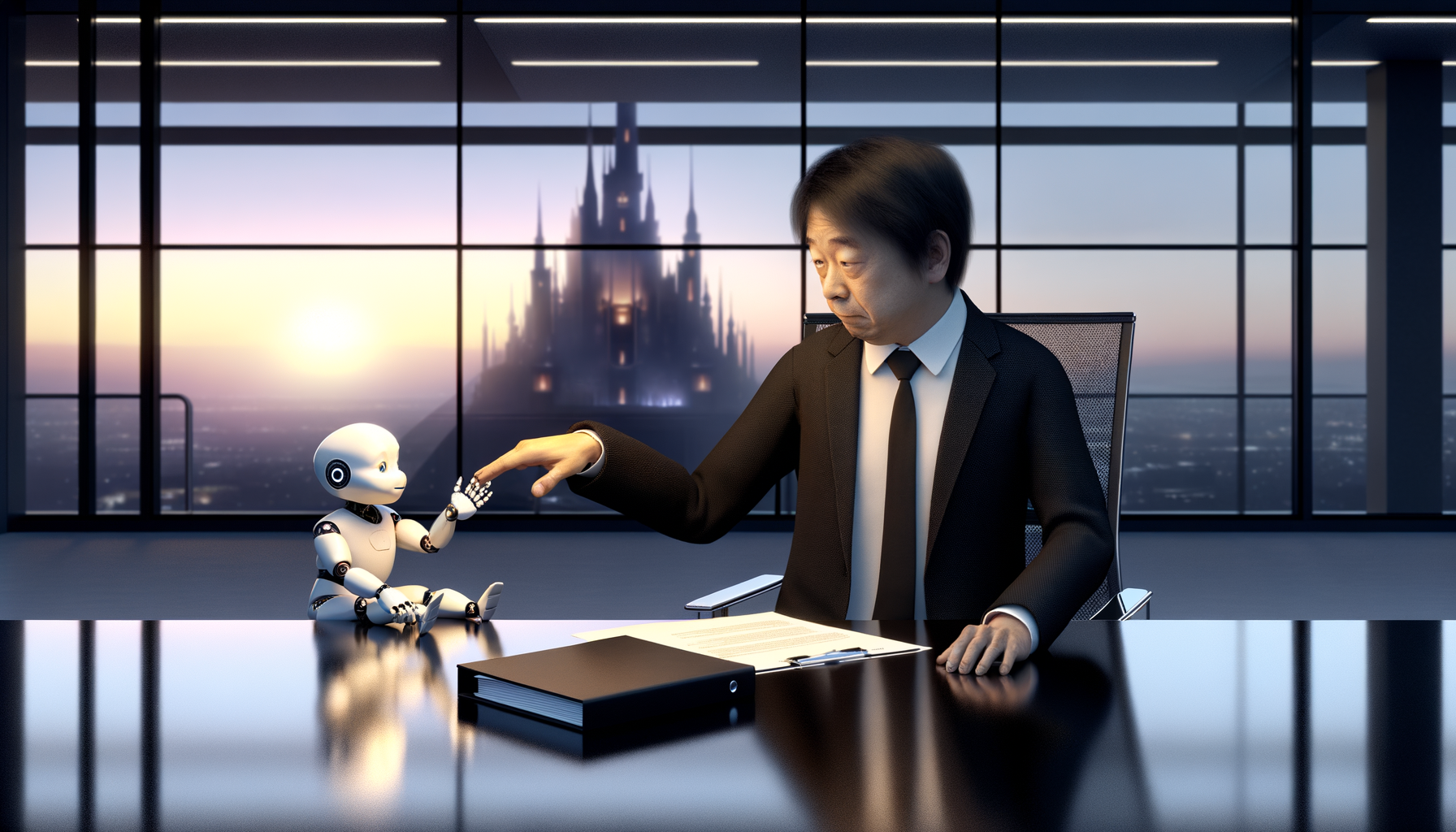
Disney has always been a company of contradictions: a corporation that sells rebellion in tidy lunchboxes, a brand that markets childhood wonder with the precision of a defense contractor, and a creative empire built on the radical idea that imagination is priceless—unless you didn’t pay licensing fees.
So it should surprise exactly no one that Disney is now doing the corporate equivalent of patting AI on the head with one hand while loading a copyright lawsuit into the chamber with the other.
On one side: Disney investing in AI, experimenting with machine learning in production pipelines, and quietly positioning itself for the next era of entertainment. On the other: Disney’s historically aggressive stance on copyright enforcement, including skepticism—bordering on holy fury—toward AI models trained on copyrighted content.
The question, then, isn’t just “how did this happen?” It’s “how is this not giving the entire media ecosystem whiplash?”
Let’s unpack what’s going on, why it matters, and why the fight over AI may become the most consequential intellectual property battle since the internet taught everyone how to pirate a DVD in 2006.
A Tale of Two Disneys: Innovator and Enforcer
Disney’s relationship with technology has always been… selective. The company loves innovation when it’s inside the castle walls and hates it when it’s outside the moat.
Historically, Disney has invested heavily in advanced production tools—animation breakthroughs, digital rendering, virtual production, and theme park tech that can track your location with the tenderness of a helicopter parent. AI is simply the next logical step.
But Disney is also one of the most influential champions of modern copyright law. The company has lobbied for stronger protections for decades, and its brand is built on controlling—and monetizing—its characters, images, music, and stories with near-religious devotion.
That makes AI a uniquely uncomfortable development: it’s a technology that thrives on ingesting huge amounts of content, much of it copyrighted, and then producing outputs that can look suspiciously like the inputs—just remixed, re-lit, and served with a side of plausible deniability.
Or, as one entertainment attorney put it to The Northstar Ledger:
“The entertainment industry is fine with machines helping you make movies. It’s not fine with machines learning from movies without permission. That’s the line—and it’s a messy one.”
Where Disney Is Actually Using AI (Yes, It’s Already Everywhere)
Despite the public noise focusing on copyright, Disney’s internal use of AI is not hypothetical. It’s practical, incremental, and—like most corporate AI—less “sentient robot screenwriter” and more “expensive autocomplete with a union policy.”
AI and machine learning tools are increasingly common in:
- Visual effects workflows, including rotoscoping, compositing assistance, and upscaling
- Animation and rendering optimization, reducing time and compute costs
- Localization and dubbing support, helping manage global distribution
- Audience analytics, predicting what people will watch and when
- Theme park operations, crowd flow modeling and demand forecasting
None of that requires Disney to endorse the idea that outside AI companies should be able to scrape the internet, vacuum up copyrighted films, and call it “training.”
In other words: Disney likes AI when it behaves like a power tool. Disney does not like AI when it behaves like a teenager downloading music off LimeWire and insisting it’s “for educational purposes.”
The Copyright Panic: Why AI Training Is a Legal Minefield
The central conflict is this: AI models need data, and the best data tends to be professionally made content—exactly the kind Disney owns in bulk.
AI developers argue that training is often “transformative,” that models don’t store content like a library does, and that training on publicly available material may fall under fair use (depending on jurisdiction and specifics). Rights holders argue that training is still copying, still exploitative, and still deprives creators of licensing revenue and control.
This isn’t just philosophical. It’s economic.
If AI can generate a “Disney-esque” image, or a soundtrack with suspicious Pixar vibes, or a script that feels like it came from a Marvel writer’s room—then Disney’s brand moat starts to look less like a fortress and more like a decorative fountain with a leak.
A media analyst who tracks IP disputes described the anxiety bluntly:
“Disney’s entire business model is built on scarcity and control. AI is built on abundance and replication. Those are opposing religions.”
The Hypocrisy Charge: “So You Get AI, But We Don’t?”
Critics, especially in tech circles, accuse Disney of hypocrisy: embracing AI internally while trying to block AI companies from using Disney-owned content to train models.
But from Disney’s perspective, that’s not hypocrisy—it’s property rights. The company’s logic is simple: “We can use our stuff however we want, and you can’t use our stuff without paying.”
This is where the small-government, mildly Republican thought process sneaks in: property is property, and if you don’t own it, you don’t get to “learn from it” just because your server farm can read fast.
At the same time, there’s a real policy question here: if training on copyrighted material becomes broadly illegal without licensing, the AI industry could consolidate around a few giants who can afford the deals—leaving startups and open-source projects in the dust.
That’s a feature for Disney, not a bug. Big licensing regimes tend to favor big incumbents. The House of Mouse didn’t build an empire by cheering for deregulated disruption.
Creators Are Caught in the Middle (And They’re Not Laughing)
Writers, actors, animators, and illustrators have been ringing alarm bells for years now. The fear isn’t only that AI will take jobs; it’s that AI will absorb creative labor without compensation and then compete against the very people whose work fed it.
Disney’s public posture on copyright aligns with creators’ concerns—at least rhetorically. The company can credibly say it’s defending artists, even while it invests in the same technology that artists fear.
That contradiction isn’t theoretical. It’s a labor issue.
If AI reduces production costs, studios benefit. If AI reduces the need for certain roles, workers lose leverage. And if AI training is built on unlicensed creative work, the entire creative class gets treated like an all-you-can-eat buffet.
One Hollywood guild representative, speaking on background, framed it this way:
“Studios want AI as a cost-saver. But they also want to be the only ones who can use it safely. That means they’ll fight to control the data, the tools, and the legal rules.”
The Legal Reality: No One Knows How This Ends
The messy truth: the courts are still figuring this out. AI training lawsuits across the industry are testing what counts as fair use, what counts as copying, and whether outputs that mimic style can be treated as infringement.
Disney, famously, does not enjoy uncertainty. It prefers laws that behave like its theme parks: highly controlled, heavily monetized, and full of people buying churros while standing in orderly lines.
But AI is not a theme park. AI is a swarm of models, datasets, APIs, and open-source weights being distributed faster than lawmakers can pronounce “latent diffusion.”
Disney’s strategy appears to be:
- Invest in AI so it isn’t left behind
- Protect its IP so others can’t build “Disney-like” generators for free
- Push for licensing frameworks that turn training data into a paid commodity
- Maintain brand control, because “Mickey Mouse says something unhinged” is not a business plan
The Business Angle: Disney Doesn’t Hate AI—It Hates Losing Control
The most important point is also the least dramatic: Disney isn’t anti-AI. Disney is anti-unpaid AI.
If AI becomes a core creative and operational technology, Disney wants to be:
- A buyer of AI tools
- A builder of internal AI systems
- A licensor of premium training data
- A gatekeeper for what counts as “authorized” Disney content
This is a classic incumbent playbook: embrace the innovation, then lobby to shape it into something manageable.
There’s an argument—one Disney might even make behind closed doors—that licensing is the fair outcome. If AI companies profit from training on copyrighted material, then rights holders should get paid. That’s not crazy. That’s capitalism. It’s also exactly why tech companies are so nervous: licensing at scale could cost billions.
And yes, it could slow innovation. But it could also prevent a future where the creative economy becomes a free raw-material pit for model training.
The Political Undercurrent: Regulation for Thee, Not for Me
Here’s where the sarcasm writes itself.
Hollywood corporations often talk like free-market champions when negotiating labor contracts—right up until a new technology threatens their margins. Then suddenly they discover the joys of regulation, enforcement, and government-backed legal remedies.
Disney’s approach fits a familiar pattern: market competition is great until it competes with you.
From a center-right perspective, there’s a legitimate tension: conservatives tend to like strong property rights, but they also tend to distrust regulatory capture—when big companies shape rules to crush smaller competitors.
Disney’s ideal outcome is likely a world where AI is legal, profitable, and ubiquitous—so long as it runs through a licensing tollbooth that Disney helps design and owns a piece of.
If that sounds less like “innovation” and more like “a subscription plan for reality,” congratulations: you understand modern corporate strategy.
What Happens Next: The Coming AI Licensing Gold Rush
Expect the next phase to look less like courtroom drama and more like corporate dealmaking.
Studios and labels will increasingly explore:
- Licensed training datasets (the “approved content buffet”)
- Content fingerprinting to detect AI outputs that resemble protected IP
- Contract clauses restricting AI use in production
- Partnerships with AI vendors that promise “clean data” and indemnification
And AI companies will respond by:
- Seeking synthetic data and public-domain corpora
- Buying or licensing content libraries
- Training models in jurisdictions with different legal standards
- Lobbying for broader interpretations of fair use
The irony is that the likely “compromise” outcome—paid licensing for training—could entrench the biggest players on both sides. Disney wins. Major AI firms win. Smaller creators and smaller tech companies get to watch the parade from behind the rope line.
The Bottom Line: Disney Is Acting Exactly Like Disney
So how the hell did this happen?
It happened because Disney is not confused. Disney is not having an identity crisis. Disney is doing what it has always done: buy the future, trademark the past, and charge admission for both.
The company wants AI’s efficiency, scale, and predictive power. It also wants to prevent AI from turning its priceless IP into a public utility. And it wants lawmakers and courts to agree that “training” is not a magical loophole that makes copyright disappear.
In the short term, this will look chaotic: lawsuits, licensing fights, labor disputes, and a lot of corporate statements full of words like “responsible innovation.”
In the long term, it may determine whether the next generation of entertainment is built on permission and payment—or on scrape first, apologize later.
Either way, Disney will be there, smiling politely, holding out its hand.
Not for a handshake.
For the check.