A Holiday Is Not a Weather Exemption
The balloons can wait. The people underneath them should not have to gamble on a ceremonial deadline.
Macy’s 100th Thanksgiving Day Parade, originally set for Thursday, November 26, is now scheduled for Saturday, November 28, after a severe-weather forecast prompted organizers and New York City officials to move the celebration. NBC’s announcement cited the safety of participants and spectators. The anniversary still matters. It does not make the weather negotiable.
Our view is that postponement was the responsible choice on the information announced. That judgment is not a certification of Saturday’s conditions or every operational decision still to come. It is a simpler proposition: preserving a tradition should not require pretending its usual date is more important than the people carrying it out.
There are also two different events to keep straight: the new parade planned for New York’s streets and the old parade selected for Thanksgiving television. One was postponed. The other was a replay. Confusing them makes an already disrupted holiday harder to navigate.
What Changed, and What Viewers Should Know
The current plan puts the 2026 street parade on Saturday, November 28, with an 8:30 a.m. New York start, according to ABC News’s reporting of Macy’s announcement. That is 8:30 a.m. Eastern Time. It is a scheduled start, not a promise that weather or other conditions cannot require another change.
For television and streaming, NBC lists Saturday coverage on NBC and Peacock at 8:30 a.m. in the Eastern, Central and Mountain time zones, and 7:30 a.m. Pacific. Those are the broadcaster’s published local airing times. They should not be treated as a single nationwide clock conversion or substituted for the street-event start.
Thursday’s television replacement was different. NBC announced a replay of the 2025 Macy’s Thanksgiving Day Parade for November 26 at 8:30 a.m. in all time zones. That Thursday slot is already past. It was not the 100th parade proceeding despite the postponement, and it is not an upcoming broadcast of the new event.
New York City's event-coordination portal also lists Saturday, November 28, 2026, at 8:30 a.m.; it says updated street closures will be shared soon and links to MTA alerts. Anyone planning around Saturday should check those current city, organizer and broadcaster updates before leaving home or setting a viewing plan. An earlier announcement establishes the schedule; it cannot establish the conditions at departure time.
The Forecast Was the Point
This was not described as a decision about a little uncomfortable holiday weather. NBC reported that an approaching nor’easter was expected to bring heavy rain, strong winds and coastal flooding. ABC reported a Thursday morning forecast of sustained winds between 20 and 22 miles per hour, with gusts up to 40 miles per hour around 9 a.m., alongside heavy rain.
Those figures describe the forecast cited in the reporting, not a measurement of what happened at every point along the route. Nor do they establish an operating threshold for any particular balloon. The distinction matters: a forecast can justify preventive action without being converted into an invented technical rule.
By Friday, NPR was reporting that the broader storm had disrupted holiday travel and caused widespread power outages. That account provides context for the seriousness of the holiday weather. It does not, by itself, prove exactly what would have happened had the parade gone ahead on Thursday.
The sensible argument for postponement does not need that counterfactual. Safety decisions are supposed to precede the incident they are intended to prevent. Demanding an actual mishap before accepting a precaution would turn risk management into an exercise in documenting regret.
Tradition Is Worth Protecting From Its Own Deadline
A milestone celebration creates an obvious temptation: surely the hundredth parade must happen on Thanksgiving itself. But a calendar is not a safety plan, and a round number does not improve one.
Macy’s told ABC that the decision followed consultation with city and agency partners. NBC’s statement likewise identified New York City, Macy’s and NBC as parties to the move. These are their accounts of the decision, not an independent audit of how every discussion unfolded. They do establish that the announced rationale was participant and spectator safety rather than a change in the holiday’s importance.
There is an old-fashioned principle here: stewardship is not the same as stubbornness. An institution earns the right to carry a tradition forward by protecting the people who make it possible. Demanding that a parade march on its customary date regardless of the forecast would elevate the symbol above the responsibility behind it.
The better test is whether the celebration can proceed under acceptable conditions, not whether officials can avoid the embarrassment of changing a familiar plan. A delayed anniversary can still be an anniversary. Public judgment should reward competence, not theatrical resistance to circumstances no organizer controls.
The Disruption Still Deserves an Answer
Calling the postponement prudent does not make the inconvenience imaginary. NPR reported that the parade involves around 11,000 participants, mostly volunteers, with many traveling from out of state. Moving the date asks those people to reconsider plans that may not be easy to rearrange.
For families who built a visit around Thursday, Saturday is not automatically an equivalent substitute. For participants, an additional commitment may collide with work, school or the journey home. Those are practical consequences of a changed schedule, not evidence that organizers should have ignored the forecast.
The proper response is clear information, not a congratulatory slogan about resilience. People need to know which event is happening, when it is scheduled, where authoritative updates will appear and whether a previously advertised activity remains available.
One detail illustrates the distinction. ABC reported that parade producer Will Coss said there would not be a second public balloon-inflation viewing on Friday. Preparations for a rescheduled parade should not be read as an invitation to an additional public event. Where plans differ, plain language is more useful than festive ambiguity.
None of this establishes a refund entitlement, a specific financial loss or a failure to communicate. Those would require their own evidence. The public can reasonably expect useful answers without manufacturing a claim about what anyone is owed.
Accountability Does Not Require an Invented Scandal
“Safety first” is an appropriate explanation for a postponement. It should also describe what happens after the announcement.
In our judgment, the continuing obligation is to reassess conditions, communicate material changes promptly and keep the public schedule aligned with the operational plan. That is an expectation of competent management, not an allegation that any of those tasks has been neglected.
The available accounts do not establish that Saturday’s preparations are complete or that every relevant condition has been cleared. A new date is not a blanket assurance. Equally, the absence of those details from these reports is not proof that required work has gone undone. Skepticism becomes less useful when it treats a missing paragraph as evidence of misconduct.
The same discipline applies to costs. A delayed event involving thousands of participants plainly raises logistical questions. It does not give commentators permission to invent an overtime bill, a business-loss total or a price tag for the postponement. Accountability needs records and specific answers. Speculation dressed up with a dollar sign is still speculation.
Organizers should be judged against the decisions and information they actually provide as Saturday approaches. Neither automatic applause nor a prewritten indictment helps the people trying to decide what to do next.
Saturday Is a Plan, Not a Guarantee
The useful takeaway is straightforward: the 100th parade is scheduled for Saturday, November 28; the street start and regional broadcast times are distinct; and Thursday’s replacement television selection was last year’s parade, not this year’s event.
The larger lesson is about priorities. A public celebration can be important without being immovable. Families and volunteers deserve a memorable occasion, but they also deserve officials and organizers willing to interrupt the script when conditions demand it.
Moving the parade was the announced precaution. The remaining test is whether the rescheduled event is managed with the same seriousness that justified changing the date. Tradition supplies the reason to gather. It does not supply permission to stop thinking.
Sources
-
NBC: 2026 Macy’s Thanksgiving Day Parade Moves to Saturday, November 28 — organizer/broadcaster statement, weather rationale, Saturday airing times and Thursday’s 2025 replay selection.
-
ABC News: Macy’s Thanksgiving Day parade postponed due to weather — Macy’s and city statements, street-event start, forecast details and Friday viewing clarification.
-
NPR: From Thanksgiving blackouts to Black Friday, a holiday hit by wild weather and economic woes — subsequent storm context and participant logistics.
-
NYC Mayor’s Office of Citywide Event Coordination and Management: event portal — dated event listing and official update links.
-
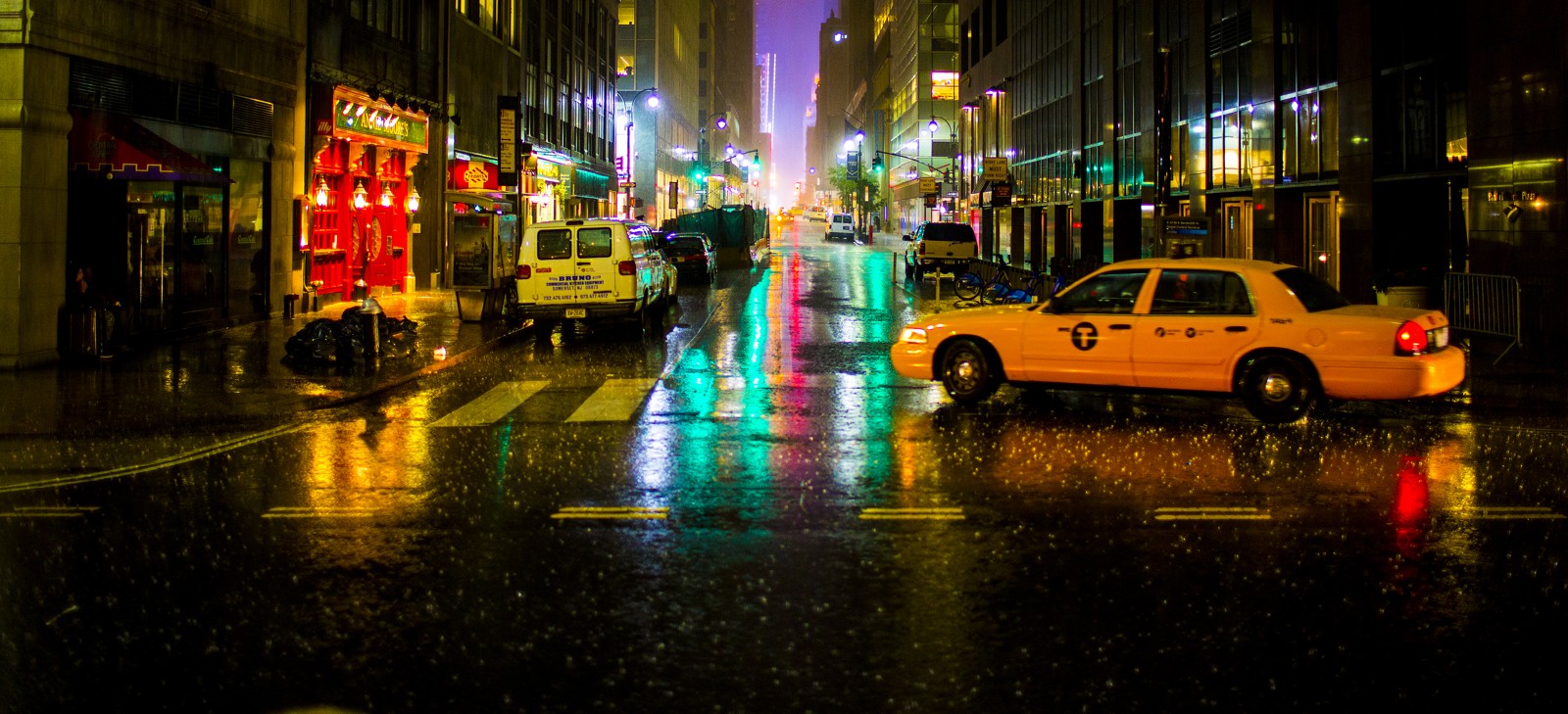
Cover: Owen Byrne, Downpour in New York, September 21, 2013, CC BY 2.0. Proportionally resized archival context, not a photograph of the 2026 parade or storm.
