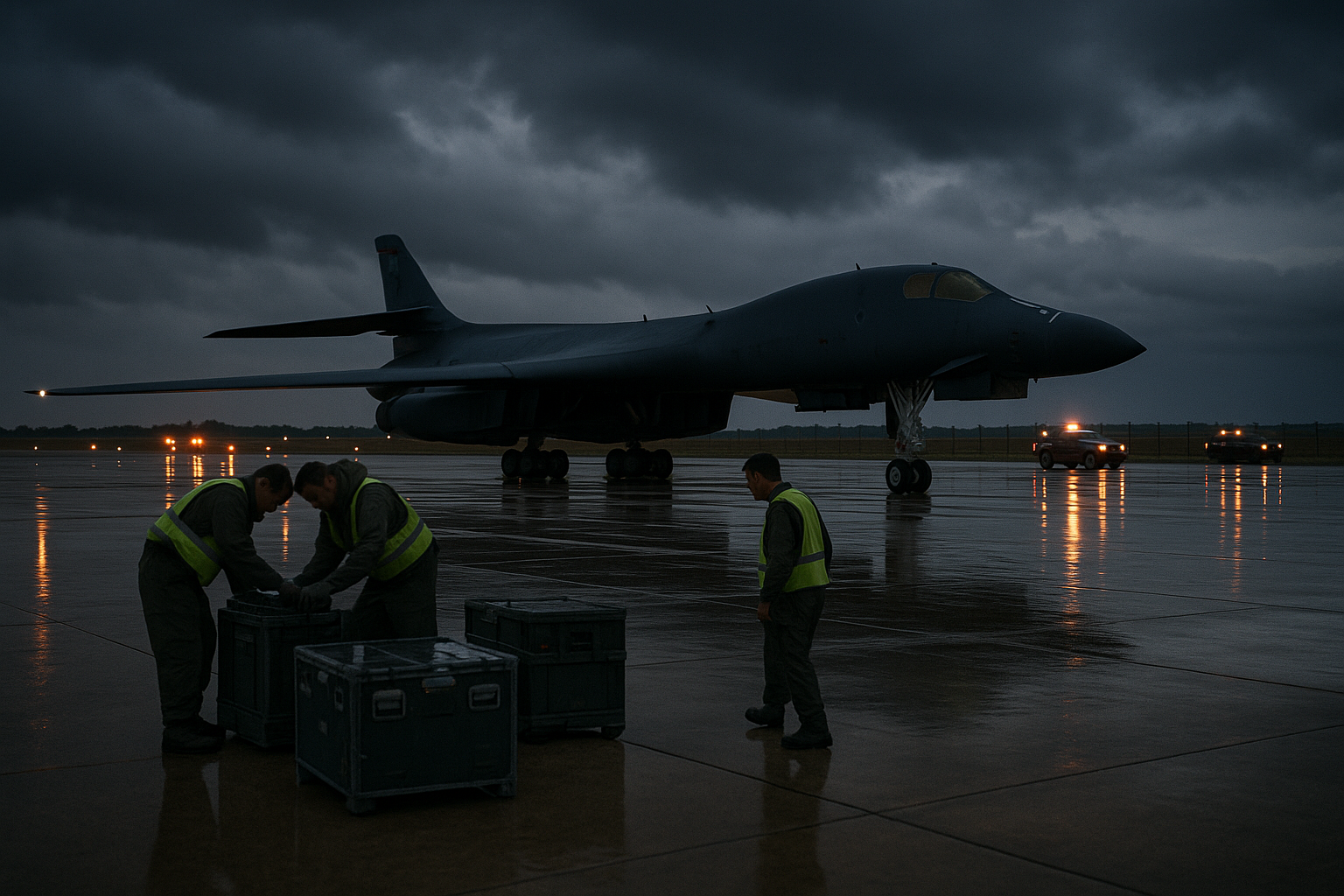
A Midnight Scramble Across the Atlantic
On the sprawling concrete apron of Royal Air Force Fairford in the Gloucestershire countryside, the sudden silence is deafening. For weeks, the unmistakable, earth-shaking rumble of American General Electric F101 turbofans had signaled the forward presence of the United States Air Force's Global Strike Command. B-1B Lancer supersonic bombers, accompanied by venerable B-52H Stratofortresses, sat parked within easy striking distance of the Middle East—a visible, undeniable instrument of American coercive power.
Then, almost overnight, the tarmac was cleared.
In a carefully phrased admission over the weekend, the Pentagon confirmed that all deployed strategic bombers had been abruptly withdrawn from British soil and flown thousands of miles back to their permanent home stations in Dyess Air Force Base in Texas, Minot in North Dakota, and Ellsworth in South Dakota. While Department of Defense spokespersons cited operational security to avoid announcing flight paths in real time, the rationale was impossible to conceal: British counter-terrorism police had arrested multiple individuals outside Fairford’s perimeter wire suspected of conducting hostile surveillance and preparing imminent attacks on behalf of the Islamic Republic of Iran.
The official line from Washington and London is that the move represents prudent risk management—a temporary repositioning to protect irreplaceable multi-hundred-million-dollar airframes and their crews. But inside defense and intelligence circles, the optics and strategic implications are far less comforting. When the world's preeminent military power is forced to withdraw its heaviest strike assets four thousand miles away because a handful of operatives breached the security perimeter of an allied sovereign base, deterrence has not merely paused. It has operated in reverse.
The Anatomy of a Forward Basing Vulnerability
RAF Fairford has long enjoyed a reputation as the Pentagon's premier European launchpad for heavy bomber operations. Built during the Second World War and heavily expanded during the Cold War, Fairford was specifically upgraded to support massive combat surges: Operation Desert Storm in 1991, NATO operations in Kosovo in 1999, and the opening salvos of Operation Iraqi Freedom in 2003. It boasts one of the longest runways in Western Europe—spanning 9,997 feet—and specialized maintenance docks tailored for heavy, high-maintenance aircraft.
Yet Fairford is what military planners call a "standby" installation. Unlike RAF Lakenheath or RAF Mildenhall, which host permanent active-duty USAF wings with heavily fortified perimeters and dedicated security forces battalions, Fairford is maintained in a semi-active status. When bomber task forces rotate through, security depends heavily on a patchwork arrangement between transient American security personnel, the British Ministry of Defence Guard Service, and local Gloucestershire Constabulary officers patrolling miles of open farmland.
That pastoral geography, charming to visitors of the Cotswolds, is a tactical nightmare for base defense. Public footpaths run near runway thresholds; hedgerows and rural lanes provide natural sightlines for spotters equipped with high-powered commercial optics or off-the-shelf consumer drones. In an era where commercial quadcopters can be fitted with shaped explosives for a few thousand dollars, an unhardened open airfield housing thirty-year-old bombers parked wingtip-to-wingtip represents an asymmetric bullseye.
British authorities revealed that counter-terrorism detectives detained suspects actively surveilling aircraft approaches and mapping perimeter patrol schedules. The suspects, reportedly operating at the behest of Iranian intelligence networks seeking retaliation for recent U.S. airstrikes against Tehran-backed infrastructure, were later released on bail under travel restrictions—a legal maneuver common under UK judicial procedure that nevertheless alarmed American force protection commanders.
The Math of Asymmetric Coercion
To understand why U.S. commanders made the call to pack up and leave, one must look at the brutal mathematical imbalance of modern asymmetric warfare.
A B-1B Lancer costs upwards of $300 million to replace—assuming one even could, given that the production line closed more than three decades ago. The Air Force’s active fleet is capped at just 45 airframes, each subjected to punishing structural wear and demanding maintenance regimes. A single B-1B loss on a foreign tarmac to a $2,000 FPV drone or a shoulder-fired mortar would be an catastrophic operational blow and an epochal propaganda victory for an adversary.
Tehran understands this calculus intimately. For decades, the Islamic Revolutionary Guard Corps (IRGC) has specialized in low-cost, deniable, distributed warfare. When the United States projects power into the Persian Gulf and Levant, it does so through forward-deployed capital assets: supercarriers, Aegis destroyers, and strategic bomber rotations. If Iran or its proxy networks can threaten those capital assets from the parking lots of rural England or Mediterranean seaports, they force Washington to pay an exorbitant protection tax.
By pulling the bombers back to Texas and the Dakotas, the Pentagon eliminated the immediate tactical vulnerability. American B-1s and B-52s have proven time and again that they can fly 30-hour non-stop round-trip missions from the continental United States, supported by multiple aerial refuelings from KC-135 and KC-46 tankers. But operating from North America turns a four-hour strike profile into an exhausting logistical marathon requiring fleets of tankers, airspace clearances across multiple continents, and immense physical strain on flight crews. In practical terms, Tehran achieved a vital operational objective without firing a single shot: they pushed America’s heavy hammers thousands of miles away from their front door.
Allied Hesitation and the Cost of Soft Perimeters
The Fairford redeployment also highlights a growing, uncomfortable friction between Washington’s operational demands and the domestic constraints of its European hosts.
Throughout the Cold War, European NATO nations accepted the physical reality of militarized zones. Heavy security, perimeter fencing, armed checkpoints, and aggressive local policing were understood as the necessary price of hosting American nuclear-capable bombers. Today, Western Europe's political and legal climate is profoundly different. British domestic counter-terrorism laws, while stringent in administrative scope, operate under strict evidentiary constraints and human rights judicial frameworks that frequently permit bail for suspects who in other jurisdictions would remain detained pending national security proceedings.
When American commanders discovered that individuals arrested on suspicion of planning hostile acts against the airfield were released on bail within days, the Pentagon’s risk tolerance dropped to zero. For General Thomas Bussiere and the leadership of Air Force Global Strike Command, waiting around for British legal processes to establish whether a reconnaissance team was acting alone or directing a secondary strike cell was an unacceptable gamble with irreplaceable national assets.
Moreover, the incident exposes the broader political vulnerability of forward basing in Western democracies. As domestic protests against Western foreign policy intensify across European cities, host governments are increasingly sensitive to the domestic political optics of hosting American strike aircraft actively engaged in Middle Eastern conflicts. While Prime Minister Mark Carney and London officialdom reaffirmed their ironclad commitment to the bilateral alliance, the practical ability of host nations to guarantee absolute physical security for American platforms is visibly fraying.
The Reality Check for American Deterrence
Deterrence is not merely a matter of balance-sheet firepower; it is a psychological contest of demonstrated will and credible presence.
When former Secretary of Defense Pete Hegseth recently announced the creation of the Autonomous Warfare Command and championed rapid-fielding doctrine, he pointed directly to the obsolescence of sluggish legacy defense postures. The sudden departure of Fairford’s bomber task force reinforces his central warning: large, static, high-value forward targets are becoming operational liabilities in modern contested spaces unless defended by ironclad point-defense shields.
For America’s adversaries—not only Iran, but Beijing and Moscow—the lesson of Fairford will be studied meticulously. It demonstrates that the global reach of the U.S. military, formidable as it remains in open ocean and sovereign airspace, remains exceptionally vulnerable at the seams: where forward deployment relies on foreign civilian infrastructure, civilian police forces, and permissive perimeter environments.
If forward-deployed bombers can be chased off European allied runways by reconnaissance cells armed with smartphones and consumer optics, what happens to U.S. fighter squadrons stationed at unhardened airbases in Japan, Guam, or Jordan when high-end drone swarms are unleashed? The withdrawal from Fairford is a harbinger of a far broader structural challenge facing the joint force.
The Strategic Path Forward
The United States cannot afford to abandon its forward military footprint. Retreating into a continental fortress posture—relying exclusively on intercontinental flights from CONUS bases—surrenders the strategic initiative, dramatically escalates tanker fuel costs, and telegraphs hesitation to allies in frontline theaters who depend on immediate American resolve.
Fixing the Fairford problem requires three urgent corrections from defense leadership and policymakers:
First, forward bases must be hardened against 21st-century low-altitude and perimeter threats. Deploying strategic bombers to bases without comprehensive counter-unmanned aerial systems (C-UAS), automated perimeter thermal surveillance, and hardened aircraft shelters (HAS) is an unacceptable lapse in force protection. The era of parking multi-hundred-million-dollar warplanes in the open air, separated from public roads by a chain-link fence, is over.
Second, status-of-forces agreements (SOFAs) with key European allies must be updated to establish sovereign military exclusion zones around installations housing strategic assets. If host nations cannot or will not enforce zero-tolerance security perimeters around forward-deployed American strike wings, the Pentagon must re-evaluate where those assets are positioned.
Finally, the military must accelerate the deployment of distributed, attritable combat platforms. As long as American combat power is concentrated into a tiny handful of hyper-expensive, aging legacy bombers, adversaries will hold the strategic upper hand in cost-exchange ratio. Until autonomous wingmen and mass-produced attritable strike platforms fill the skies, American commanders will continue to face the agonizing choice between forward risk and transatlantic retreat.
For now, the runways of RAF Fairford sit empty. The bombers are safely parked on American tarmac under round-the-clock military guard. But the message left behind in the Gloucestershire mist is one that American strategists will have to confront for years to come.
Sources: Reuters (bomber redeployment confirmation and Pentagon statements), Associated Press (RAF Fairford operational reporting), UK Counter Terrorism Policing (arrest announcements), Air Force Global Strike Command (force structure and B-1B fleet readiness data), U.S. Department of Defense (official statements).