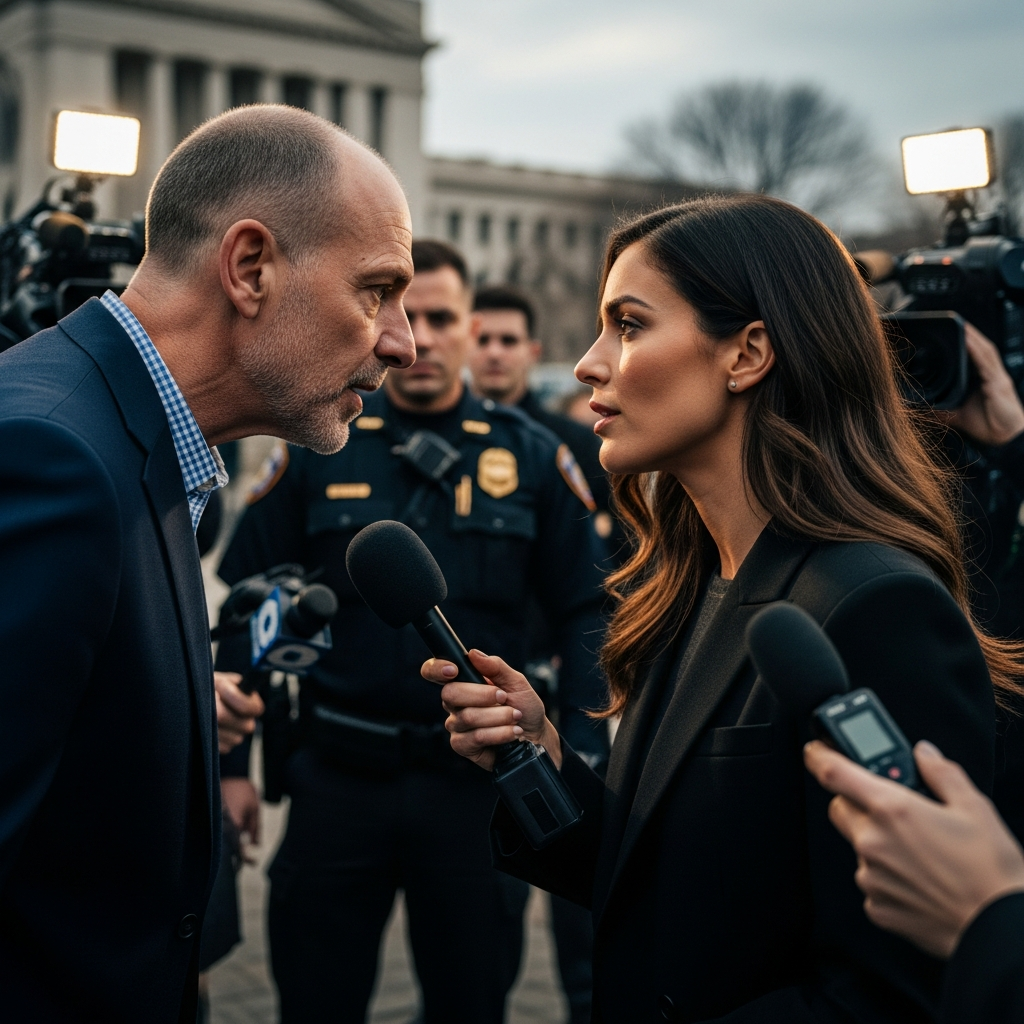
A Right-Wing Media Food Fight Goes Public
If you’ve ever wondered what happens when two high-decibel personalities collide inside the same political-media ecosystem, this week delivered the answer with the subtlety of a marching band in a library.
Alex Jones, the Infowars founder who has spent years turning emergency into a business model, issued what his outlet framed as an “urgent” message aimed at conservative commentator Candace Owens—after Owens launched a new allegation-heavy narrative that, according to Jones, drags the U.S. military into yet another sprawling “coverup” story. The public warning landed only days after a separate Owens storyline—an “Egyptian plane” narrative promoted online—collapsed under scrutiny, setting the stage for a pivot that critics say looks less like reporting and more like a magician’s misdirection: Don’t look at the last claim; look at this bigger, shinier one.
Infowars packaged Jones’ message as a “key report” and urged viewers to watch and share, with the usual promotional scaffolding around it. But the real headline isn’t the marketing. It’s the rare public rupture: Jones, of all people, is positioning himself as the adult in the room—an irony so rich it could be served on toast.
What Jones Actually Said—and Why It Matters
In the segment promoted by Infowars and amplified on social platforms, Jones presented his message as a warning and a corrective. According to reporting and commentary circulating around the clip—including a widely shared breakdown titled “Alex Jones’ RARE Warning Over Candace Owens’ ‘WILD…’”—Jones claimed he was preparing a debunking report addressing Owens’ newest theory-laced allegations and urged caution about what he characterized as reckless narrative-building.
That’s the part worth pausing on: Jones is not merely disagreeing. He’s signaling a plan to publicly dismantle claims coming from a figure who shares much of his audience’s attention span and ideological neighborhood.
And it’s not happening in a vacuum. The new flashpoint follows a period in which Owens has promoted multiple high-velocity claims online—some of them drawing intense criticism for factual inaccuracies. One recent example has been her handling of the USS Liberty episode, a historically sensitive incident that has long been used as kindling for conspiratorial interpretations.
The USS Liberty: A Real Tragedy, Not a Choose-Your-Own-Adventure
The USS Liberty was a U.S. Navy technical research ship attacked on June 8, 1967 during the Six-Day War. It’s a grim chapter in American military history: sailors killed, others wounded, families left with permanent loss. It is also, crucially, a case that has been examined repeatedly by official investigations.
As documented in a detailed debunking published by The Algemeiner, the Liberty incident has been scrutinized by three official Israeli investigations and 11 official American investigations, including reviews by the Joint Chiefs of Staff, the CIA, the U.S. Navy, and Congress. The conclusion across these investigations has been consistent: the attack was a tragic error stemming from mistaken identity, not a deliberate strike ordered as part of some premeditated plot.
“All investigations have determined that this was a tragic case of mistaken identity,” The Algemeiner notes, summarizing the findings across the many official probes.
That doesn’t erase the human damage or the controversy that followed. But it does establish a baseline: there is a difference between unresolved questions and resolved investigations you simply dislike. The Liberty tragedy deserves sober historical handling, not algorithmic theater.
This is where the current feud matters. When influential media figures recast heavily investigated events as proof of a hidden master plan, they aren’t just “asking questions.” They’re recycling a narrative template: take a painful historical episode, add insinuations, sprinkle in a villain, and let the audience’s outrage do the rest.
From “Collapsed Narrative” to Bigger Accusations
Infowars framed Jones’ message as arriving days after Owens’ “Egyptian plane narrative collapsed.” The original Infowars post treats that collapse as settled fact and uses it as a launching pad for the new dispute: Owens’ pivot to a fresh “grand hysteria” that allegedly implicates the U.S. military in wrongdoing.
The underlying pattern is familiar in modern attention politics:
- A claim goes viral.
- Counterevidence appears.
- The story doesn’t get corrected so much as replaced—often with an even larger claim that is harder to disprove quickly.
It’s the rhetorical equivalent of outrunning a bear by throwing your backpack at someone else.
Jones, for his part, appears to be arguing that Owens is moving too fast, stacking too many assumptions, and potentially detonating credibility not just for herself but for the broader ecosystem that benefits from a shared audience. If that sounds less like principle and more like brand management, welcome to the modern infotainment bazaar: truth and profit often share a room but sleep in separate beds.
A “Coverup” Culture That Eats Its Own
The most revealing element of this story isn’t that two personalities are fighting. It’s what the fight exposes: conspiracy culture is inherently competitive.
There can’t be one “hidden truth.” There must be a newer, darker hidden truth. And the moment someone else’s narrative threatens your audience share—or your sense of being the premier decoder ring salesman—you have incentives to call foul.
In that sense, Jones’ warning reads like a veteran stage performer telling a newer act: Stop setting the curtains on fire. Some of us still have shows scheduled next week.
But the deeper issue is structural. The internet rewards:
- speed over verification
- emotion over evidence
- implication over documentation
- certainty over nuance
And it punishes anyone who says, “We don’t know yet,” because “we don’t know” doesn’t trend.
So when Owens promotes a storyline that later collapses, the correction—if it arrives at all—rarely travels as far as the initial blast. That’s not a right-wing-only phenomenon, but it is particularly potent in political media spaces where distrust of institutions is a core fuel source.
Jones as the Fact-Checker Is the Weirdest Plot Twist of 2025
Let’s state the obvious, loudly, because the moment demands it: Alex Jones positioning himself as a debunker is like a fireworks factory opening a fire safety consultancy.
Yet that’s what makes this episode newsworthy. Jones has built a career on urgent warnings, maximal framing, and a style of rhetoric that treats “emergency” as a permanent weather condition. When he publicly questions Owens’ approach, it signals either:
- Owens has moved into territory so extreme that it threatens even Jones’ tolerance for narrative improvisation, or
- Jones sees a reputational opportunity: play the skeptic just this once to appear comparatively grounded.
Both can be true. Media incentives are not monogamous.
The Stakes: Trust, History, and the Collateral Damage of Viral Storytelling
There’s a temptation to treat this as pure clown-car entertainment: two megaphones jousting atop a mountain of hashtags. But the real stakes are not their egos. The stakes are public trust and historical literacy.
When the USS Liberty is framed inaccurately, it does at least three kinds of harm:
- It disrespects the victims and survivors by turning a tragedy into content bait.
- It inflames longstanding conspiratorial tropes, including anti-Israel narratives that have been repeatedly investigated and found wanting.
- It further erodes the public’s ability to distinguish documented history from insinuation, which is how democracies end up arguing with shadows.
And when any figure—Owens, Jones, or anyone with a large platform—invokes the U.S. military as a character in a sprawling, under-evidenced plotline, it can also distort legitimate oversight. Real military scandals exist. Real coverups have happened in history. That’s precisely why evidence matters. If everything is a coverup, then nothing is, and accountability becomes a punchline.
What We Know, What We Don’t, and What to Watch Next
Here’s what can be responsibly stated based on the available reporting and sources:
- Infowars published and promoted an “emergency message” from Alex Jones directed at Candace Owens, framing it as a response to Owens’ new narrative implicating the U.S. military, and noting it followed the collapse of a prior Owens storyline.
- Jones has been described in coverage and commentary as preparing a report aimed at debunking Owens’ claims, an unusual public break inside right-wing media circles.
- Regarding the USS Liberty, multiple official investigations—three Israeli and 11 American, including the CIA, Joint Chiefs of Staff, U.S. Navy, and Congress—have concluded the attack was a tragic case of mistaken identity, not a deliberate strike.
What we do not have, at least from the materials cited here, is a full transcript of Jones’ entire “key report” or a comprehensive, itemized list of Owens’ newest specific allegations in the U.S.-military storyline. That matters, because precision is the difference between analysis and guesswork.
What to watch next:
- Whether Jones releases the promised debunking with sources and documentation, or merely performs skepticism as a rhetorical pose.
- Whether Owens responds with evidence—documents, timelines, corroboration—or simply escalates the narrative with broader insinuations.
- Whether audiences reward correction (unlikely) or reward escalation (historically, yes).
The Northstar Ledger Take: The Loudest Person in the Room Isn’t Automatically the Truest
This episode is funny in the way a banana peel is funny—until you remember someone can actually get hurt.
The comedy is the spectacle: Alex Jones warning Candace Owens about conspiratorial excess is a headline that practically writes its own late-night monologue. The serious part is what it reveals about the incentives driving political media: the rush to be first, the hunger to be definitive, and the willingness to treat history like a prop closet.
If you care about truth—and not just the sensation of being in on a secret—then the standard is boring but necessary: show the evidence, cite the investigations, correct the record, and stop laundering insinuation as insight.
Because when “grand hysteria” becomes a business strategy, the audience doesn’t just get misinformed. It gets trained to confuse volume with proof. And that, more than any single viral claim, is the real emergency.