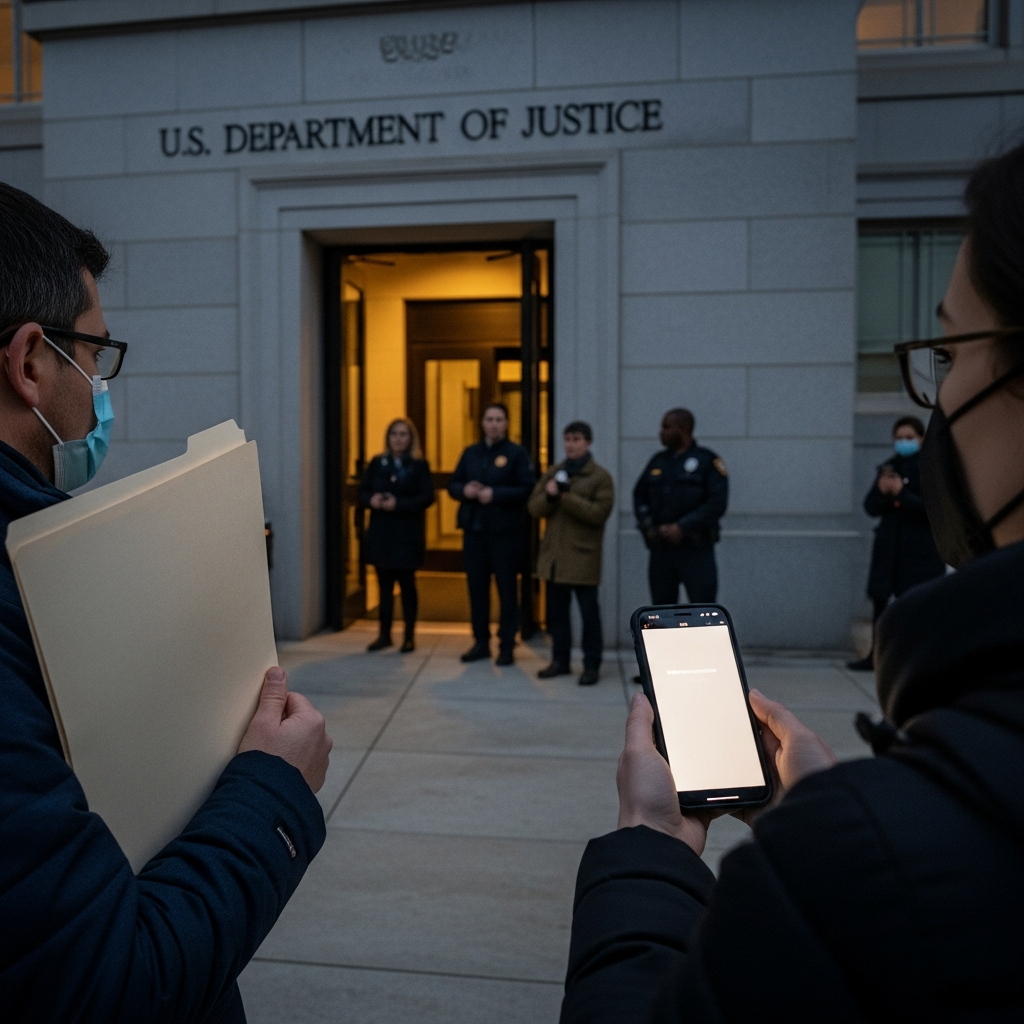
A Disappearing Act in Plain Sight
For a public already primed to distrust institutions, the fastest way to fuel suspicion is to make information appear—and then abruptly take it away.
That is the controversy now engulfing the U.S. Department of Justice after a batch of Jeffrey Epstein–related files posted to a DOJ-hosted webpage reportedly disappeared within roughly 24 hours, with independent trackers and users claiming at least 16 files became inaccessible after being publicly visible. The episode, first flagged by online document watchers and later amplified by journalists and legal transparency advocates, has triggered a predictable but potent reaction: What are they hiding?
The core allegation is simple and verifiable in its outline, if not yet in its underlying cause: files were posted, links worked, and then a subset of those links stopped working. Whether that reflects routine web maintenance, a legal redaction issue, a misconfigured server, or something more consequential is precisely what the public wants answered—and what DOJ so far has not explained in detail.
This is how conspiracies grow legs: not necessarily from proof of wrongdoing, but from gaps in the record, followed by official silence or vague reassurances. In the Epstein universe—where secrecy, influence, and institutional failure are already part of the historical record—those gaps don’t remain empty for long.
What Happened: A Timeline of the Vanishing Files
Dec. 20–21, 2025: A short-lived posting
According to multiple users who documented the page in real time, a DOJ webpage hosting Epstein-related materials was updated with a new batch of downloadable files. Users reported that the files were accessible, and several individuals claim to have downloaded and locally archived portions of the material while links remained live.
Within about a day, however, observers began reporting that numerous files were no longer available. In some cases, links returned errors consistent with removal or relocation; in others, users reported that the page itself still existed but that specific file endpoints were no longer reachable. The most frequently cited figure—repeated across social platforms and by several transparency activists—is “at least 16” missing files.
Dec. 21, 2025: Online archiving and “receipt culture”
By Sunday, Dec. 21, the dispute had entered a new phase: not just whether files were missing, but whether the public could prove it. Users circulated screenshots, cached versions of the page, and web archive captures purporting to show the files listed earlier. Others posted lists of filenames they claim had been present and then disappeared.
The result is a familiar modern dynamic: a public debate conducted in the language of metadata, link rot, and browser caches, with the government’s credibility on trial in a courtroom it did not choose.
What remains unconfirmed
At publication time, The Northstar Ledger has not independently authenticated the contents of all allegedly missing files, nor received a detailed DOJ explanation accounting for the removals. The most defensible factual claim, based on public reporting and observable link behavior, is narrower but still damning: a set of Epstein-related documents appeared on a DOJ page and then became inaccessible shortly afterward, and the department has not provided a transparent, itemized explanation for why.
Why This Case Is Uniquely Volatile
Jeffrey Epstein is not merely a criminal case. He is a symbol of elite impunity, prosecutorial misjudgment, and the corrosive power of secrecy.
Epstein, a financier with deep social and political connections, died in federal custody in 2019 while awaiting trial on sex trafficking charges. The case has since become an enduring public obsession—partly because of the depravity of the allegations, partly because of Epstein’s network, and partly because official institutions repeatedly failed: from the infamous 2008 non-prosecution agreement to continuing disputes over records, co-conspirators, and accountability.
Against that backdrop, a DOJ webpage that briefly hosts files and then loses them is not a minor technical glitch. It is a credibility crisis—because the Epstein saga has trained the public to assume that important information is routinely withheld, and that “process” is often a euphemism for protection.
The Mechanics of Disappearance: How Documents Go Missing Online
The government does not need to shred paper to erase public access. Digital records can “disappear” for reasons that range from the banal to the alarming.
Possible benign explanations
A file can become inaccessible due to:
- Server migration or directory changes that break URLs
- Permissions errors (files uploaded to a restricted folder by mistake)
- Redaction review problems, where unredacted material is posted and then pulled
- Duplicative or corrupted uploads removed during cleanup
- Accessibility or compliance issues (e.g., PDFs not meeting standards)
These happen, and they happen in government.
The problem: benign causes still demand transparent accounting
Even if the cause is mundane, the optics are catastrophic. Pulling files without a public log invites the inference that the motive is to suppress information—especially in a case where many Americans already believe suppression is the default.
A former federal prosecutor, speaking generally about DOJ practices and not this specific incident, put it bluntly:
“If you remove public-facing files tied to a high-interest case, you need a paper trail for the public—not just an internal email chain. Otherwise you are manufacturing suspicion.”
The DOJ Transparency Gap: What the Public Is Actually Asking For
The public reaction has not been subtle. Across social media and legal-commentary channels, the dominant refrain is some version of: Why were they posted, and why were they pulled?
But beneath the noise is a reasonable set of demands—ones that do not require anyone to indulge conspiracy thinking.
At minimum, transparency advocates argue DOJ should provide:
- A list of files posted and the exact timestamps of posting
- A list of files removed and the exact timestamps of removal
- The reason for removal for each file (redaction issue, duplication, legal restriction, etc.)
- A timeline for re-posting, if re-posting is planned
- A statement on whether any file contained personally identifying information or sensitive victim data
This is not radical. It is basic records hygiene.
Instead, the absence of a clear, itemized explanation has created an information vacuum—one immediately filled by speculation, political opportunism, and viral claims that may or may not be accurate.
When Institutions Flinch, Conspiracy Thrives
The Epstein case is already a breeding ground for conspiratorial narratives because it contains ingredients that conspiracies feed on: wealth, access, sex crimes, intelligence-adjacent rumors, and institutional failure. Add in a digital disappearing act and you don’t have to “invent” paranoia—you just have to watch it spread.
A digital forensics researcher who has worked on public-record archiving described the dynamic this way:
“The internet is an evidence machine, but it’s also fragile. When a government page changes without a changelog, people assume the worst—because they’ve been trained to. The fix is boring: publish a revision history.”
That “boring fix” is precisely what many agencies resist. Government web teams are often built for communications, not evidentiary integrity. Pages get updated, links get moved, and the public is expected to treat it as routine. But in high-stakes cases, routine is not good enough.
The broader issue is that digital publication has become a form of testimony. When DOJ posts a file, it is implicitly saying: this is what we are willing to show you. When it retracts that file, the public hears: we changed our mind—without telling you why.
The Victim-Privacy Argument—and Its Limits
One plausible reason for pulling files, particularly in sex trafficking cases, is the protection of victims and witnesses. That is not only legitimate; it is essential. If any posted material included identifying information, pulling it swiftly would be the responsible move.
But here’s the catch: victim privacy cannot be used as a blanket excuse for opacity. It is possible to protect victims while also providing a transparent explanation of what happened.
DOJ can say, for example: “File X was removed because it contained unredacted identifying information; it will be re-posted after redaction.” That would calm the public without endangering anyone.
What fuels suspicion is not redaction itself—it’s unexplained retraction.
A Familiar Pattern: The Government’s Chronic Changelog Problem
This controversy is not occurring in a vacuum. Across agencies, the federal government has struggled to adapt to a public expectation that online records should behave like audited systems: versioned, timestamped, and immutable.
In other domains—financial reporting, software development, even Wikipedia—changes are logged. But government web publishing often lacks:
- Version control visible to the public
- Permanent identifiers that survive URL changes
- Public revision histories for sensitive pages
That gap is tolerable when the stakes are low. It becomes unacceptable when the stakes involve the most infamous sex trafficking case in modern American memory.
If DOJ wants less conspiracy, it needs more process—not less. And it needs to show that process publicly.
Political Fallout: A Gift to Every Bad-Faith Actor
The disappearance of Epstein-related files is already being weaponized—by partisans, influencers, and opportunists whose goal is not truth but attention.
Some are using the episode to claim the government is protecting powerful individuals. Others are using it to smear political enemies without evidence. And some are using it to launder entirely unrelated narratives through the Epstein brand, which functions online like a universal solvent: it dissolves nuance and turns every claim into a potential scandal.
The irony is that DOJ’s silence—or perceived silence—makes those actors stronger. When the government refuses to answer precise questions, it invites imprecise answers from everyone else.
What Accountability Looks Like Now
If DOJ wants to end this, it has a straightforward path—one that does not require admitting wrongdoing, only acknowledging reality.
1) Publish a removal ledger
A simple table: filename, date/time posted, date/time removed, reason, expected re-post date. If a file cannot be re-posted, say why.
2) Provide hashes for public files
For documents intended to remain public, publishing cryptographic hashes would allow the public to verify that a file has not been quietly altered.
3) Commit to a stable archive
If DOJ is going to host high-interest documents, it should do so in a system designed for permanence—an archive with stable identifiers and visible version histories.
4) Answer the narrow questions
Were the files removed due to redaction issues? Technical errors? Legal restrictions? Duplicate postings? A third-party request? The public does not need a dissertation—just a record.
The Bottom Line
The most responsible interpretation of the current evidence is that a set of Epstein-related files briefly appeared on a DOJ webpage and then became inaccessible, with observers claiming at least 16 vanished. That alone does not prove a cover-up. But it does prove something else: DOJ’s current approach to digital transparency is not fit for cases that carry this level of public consequence.
When documents evaporate, conspiracy grows legs. Not because the public is irrational, but because institutions keep giving it reasons to doubt.
DOJ can still choose the boring solution: publish the log, explain the removals, and restore access where appropriate. Or it can continue to treat public records like disposable web content—updated, removed, and reshuffled without a trace.
In the Epstein case, that choice is not merely about web administration. It is about whether the government understands the crisis of trust it is living in—and whether it intends to stop feeding it.