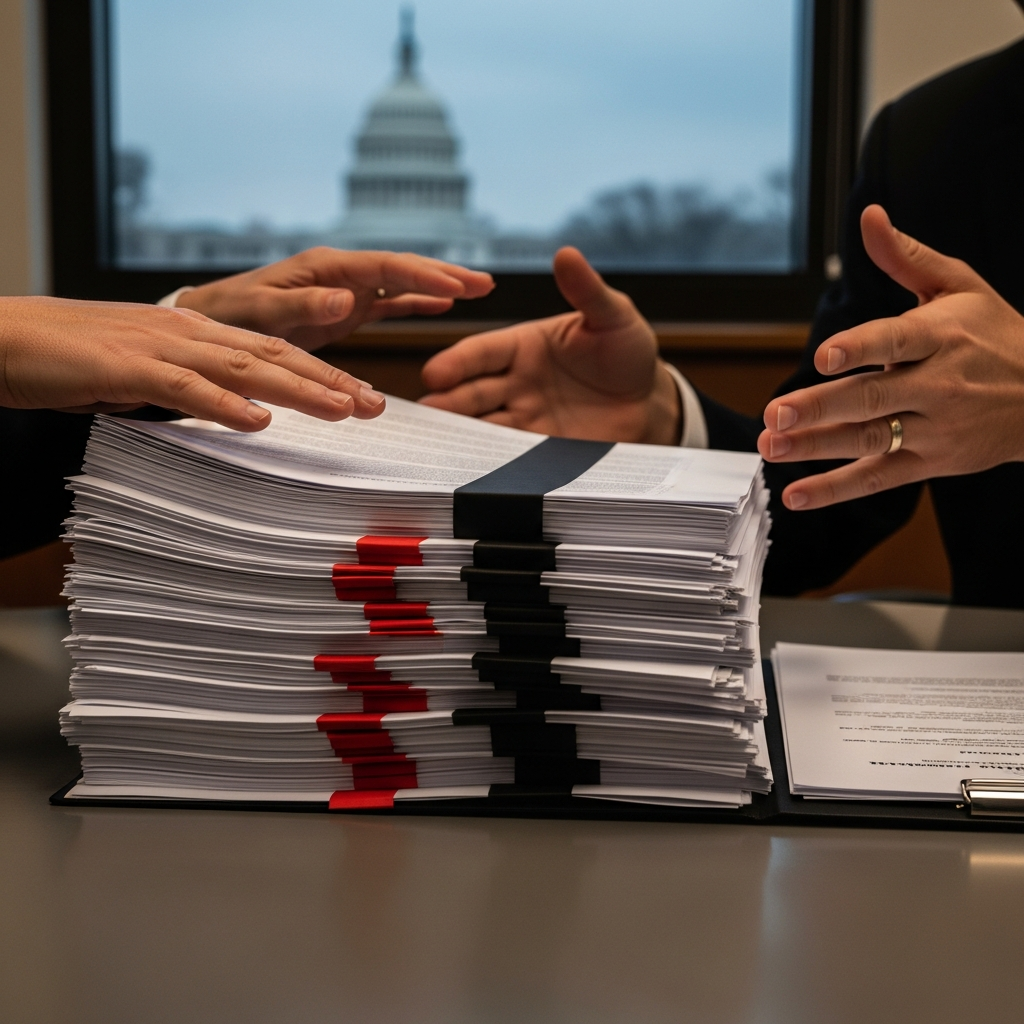
The long-promised “Epstein files” are finally dribbling into public view, and—like most things in modern Washington—the reveal has come with a catch, a counterclaim, and a court fight waiting in the wings. After Congress passed a bipartisan law compelling the Justice Department to release records tied to Jeffrey Epstein’s federal sex-trafficking case, the DOJ began releasing batches of documents this week. The public got names, dates, and references—along with heavy redactions that critics say turn “transparency” into a glorified blackout.
The result is a familiar American spectacle: survivors and advocates demanding accountability; lawmakers threatening repercussions; and a political class treating disclosure like a contact sport. The partial release includes references to Donald Trump—but also significant redactions involving Trump associates, fueling accusations from both sides: one camp alleges concealment, the other alleges insinuation without proof. The Justice Department, for its part, insists the information it has released is accurate, and it has pushed back hard on claims about Trump, calling certain allegations “untrue,” according to reporting on the department’s response.
What began as a transparency mandate has quickly become the next test of institutional credibility—one that pits privacy protections and ongoing investigative sensitivities against a public that has waited years to learn who knew what, when, and why Epstein’s network wasn’t stopped sooner.
A Law, a Deadline, and a Partial Dump
The current legal aftershock traces back to a new statute: the Epstein Files Transparency measure, passed with bipartisan support and signed into law after months of political wrangling. According to the Los Angeles Times, Trump lobbied Republicans aggressively over the summer and fall to oppose the bill, before ultimately signing it. The legislative intent was straightforward: compel disclosure, end the drip-feed, and restore confidence that the government isn’t protecting the powerful.
But the first major release landed with the kind of caveat that makes Capitol Hill microphones practically purr: it was partial, and it was heavily redacted. The BBC notes that Democrats and some Republicans accused the DOJ of violating its legal obligations after the department said it could not release all documents by the deadline. Thousands of pages exist, but “transparency” has arrived in installments—some of them so aggressively obscured that even seasoned records attorneys admit it’s hard to tell whether the government is protecting victims, protecting investigations, or protecting reputations.
The DOJ’s position is that it is following the law while honoring long-standing legal boundaries: shielding victims, avoiding release of certain sensitive investigative details, and preventing the spread of defamatory or unverified claims. Critics counter that those justifications can become a one-size-fits-all excuse—especially when the public interest is enormous and the subject matter involves a convicted sex offender whose social circle included the rich, famous, and politically connected.
What’s in the Documents—and What Isn’t
The question isn’t whether the files contain famous names. They do. Epstein’s orbit—over decades—overlapped with prominent figures across politics and society. The BBC recounts that Epstein had ties at various points to Trump, former President Bill Clinton, and Britain’s Prince Andrew, among others; all have denied wrongdoing. That reality is part of why the files matter: the public wants to understand how Epstein operated and whether any institutions looked away.
Yet the most consequential details remain hard to evaluate because so much is missing. CNN’s analysis of the release describes extreme redactions that “undercut” the disclosure. It highlights a specific example: an email dated Jan. 8, 2020, referencing information about a flight Donald Trump took with his family between 1993 and 1996, before he was president. The same email mentions a 1993 flight—but in key places, the text is masked.
That’s the crux of the frustration. A flight reference is not, by itself, proof of criminal conduct. But it is potentially relevant context—particularly in a case where travel logs and social connections have long been treated as breadcrumbs. The public sees the breadcrumbs, and then the government arrives with a shovel and buries the trail.
Adding to the confusion is the fact that the “Epstein files” are not one neat, coherent narrative. They are a patchwork: emails, investigative memos, references to interviews, and administrative records—some of which may be duplicative or tangential. Without a clear index and with heavy redactions, readers are left to do what Americans do best in the information age: assume the worst and argue online.
Redactions: Legal Necessity or Political Convenience?
Redactions are not inherently sinister. In sensitive criminal matters—especially those involving sexual abuse—redactions can be essential to protect victims and witnesses. But the legal scrutiny now intensifying in Washington is whether the DOJ has gone beyond legitimate protections into “illegal redactions,” as some lawmakers allege.
The Hill reports lawmakers demanding answers, with one member quoted as saying:
“Who are Epstein’s co-conspirators? Why are they making illegal redactions? We will get answers and justice for the survivors.”
That line captures the political and moral center of gravity: survivors. For years, the most compelling argument for disclosure has been that the system failed them—first by allowing Epstein’s abuse to continue, and later by leaving the public with the impression that the well-connected are treated differently. When redactions swallow the substance of the documents, it risks reinforcing the very cynicism the law was meant to cure.
At the same time, there’s a constitutional and procedural reality: Congress can compel disclosure, but it cannot compel the DOJ to violate privacy law, court orders, or established protections for victims and non-charged individuals. The tension is not theoretical; it’s the main event. When lawmakers claim the DOJ is not complying, they are effectively inviting judicial review, oversight hearings, and possibly contempt-style enforcement mechanisms.
Trump, the Redactions, and the Political Crossfire
In a town where everything becomes a proxy war, the most combustible element is the intersection of the Epstein disclosures and Trump-era politics. The released documents include references to Trump, and some redactions involve Trump associates, according to the premise driving much of the current uproar. That has created a two-front battle.
On one side, critics argue that redactions function like selective fog—allowing insinuation to linger while preventing clarity. On the other, Trump allies argue that the release is being weaponized to smear by association, especially when the DOJ itself has disputed certain claims.
The Los Angeles Times reports the Justice Department has said claims about Trump in the Epstein files are “untrue.” That statement, while forceful, raises its own questions: Which claims, specifically? Untrue in what sense—factually incorrect, contextually misleading, or unsupported by evidence? In a high-trust environment, a categorical denial might settle a rumor. In 2025 Washington, it often does the opposite: it becomes one more piece of rhetoric to litigate.
This is where the story moves from sensational to structural. The public isn’t merely asking, “Was X on a plane?” It’s asking whether the government can release information about a politically radioactive figure without either shielding allies or creating the appearance of a hit job. The redactions—especially those tied to politically connected individuals—make neutrality harder to prove.
And neutrality is the one thing the DOJ cannot afford to lose.
Congress Turns Up the Heat
Congress did not pass a transparency mandate to be told, “We’ll get to it later.” A key pressure point is the deadline and the enforcement threat. The office of Rep. Ro Khanna, a co-author of the law, has warned the DOJ must release the files by the deadline or risk repercussions, according to a statement posted in the congressman’s media materials. That posture signals that lawmakers are prepared to escalate—through hearings, subpoenas, funding leverage, or direct legal action.
The underlying political dynamic is unusual: bipartisan suspicion. Democrats see potential protection of Trump-world figures. Some Republicans see a DOJ they believe has become too comfortable deciding what the public can handle. The overlap is not ideological harmony; it’s shared distrust. In that sense, the Epstein files are functioning like a political Rorschach test.
Yet there’s a practical risk in Congress’s approach. If lawmakers push too aggressively for unredacted releases, they may run headlong into victim-protection laws and judicial restrictions. If they push too softly, they will be accused of performative oversight. The political incentives favor confrontation. The legal incentives favor caution. The collision is already underway.
The Litigation to Watch: Compliance, Contempt, and Court Review
The most important “legal aftermath” may not be what’s in the pages already released, but what happens next in court and oversight proceedings.
Three legal questions will likely dominate:
-
What does “release” mean under the new law?
If the DOJ releases documents that are technically responsive but substantively unreadable, lawmakers may argue the department is evading the statute’s purpose. The DOJ will argue it is complying while adhering to other legal obligations. -
Are the redactions legally justified?
If members of Congress or outside litigants can establish that redactions go beyond permissible categories—victim privacy, active investigative material, classified information, or court-protected data—courts could order narrower redactions or in camera review (judges reviewing unredacted material privately). -
What is the remedy if DOJ is found noncompliant?
Remedies could include court orders to produce unredacted versions to a secure congressional setting, deadlines enforced by judicial supervision, or sanctions if a court finds bad faith. Congress, meanwhile, could pursue oversight penalties, though those often become political theater rather than swift enforcement.
The BBC notes that many details in the files have been heavily redacted, and that accusations of noncompliance are already flying. That sets the stage for a classic Washington endgame: a fight over process that becomes inseparable from the fight over substance.
A Republican Backbone View: Transparency Without the Tabloid Hangover
Here’s the conservative principle at stake: equal justice under law requires equal scrutiny under law. If the system can’t convincingly demonstrate that it treats the famous the same as the forgotten, it invites the kind of populist backlash that eventually corrodes institutions beyond repair.
But transparency also needs discipline. There is a difference between disclosure that serves accountability and disclosure that serves voyeurism. Epstein’s crimes were monstrous; the survivors deserve justice, not a media carnival that turns their trauma into a political piñata. A responsible release should prioritize:
- Victim protection first, always.
- Clarity over chaos: indexes, timelines, and explanations for redaction categories.
- Neutral standards applied consistently, whether the names are Republican, Democrat, royal, or celebrity.
If the DOJ wants to regain trust, it should stop acting like the public is a hostile jury and start acting like it’s a sovereign citizenry. That means explaining the rules, not merely invoking them.
What Happens Next
The coming weeks will likely bring a familiar cycle: more document releases, more redaction disputes, more committee hearings, and more partisan messaging. But the stakes are higher than a typical Washington food fight because the Epstein case is not just a scandal—it’s a symbol of institutional failure.
The Justice Department insists its released information is accurate and has rejected certain claims as untrue, per the Los Angeles Times. Lawmakers insist the redactions may be unlawful and that the department is not meeting its obligations, according to the BBC and The Hill. CNN’s analysis underscores how the redactions themselves have become the story, not merely the content.
In other words, the government has managed to do the one thing Americans didn’t think was possible: make a historic disclosure feel like a cliffhanger.
Whether this ends with a cleaner, fuller release—or with years of litigation and political trench warfare—will depend on one question Washington rarely answers well: can the system choose principle over self-protection when the names involved can fund campaigns, shape headlines, and ruin careers?
For the sake of survivors, and for the credibility of the rule of law, it needs to.