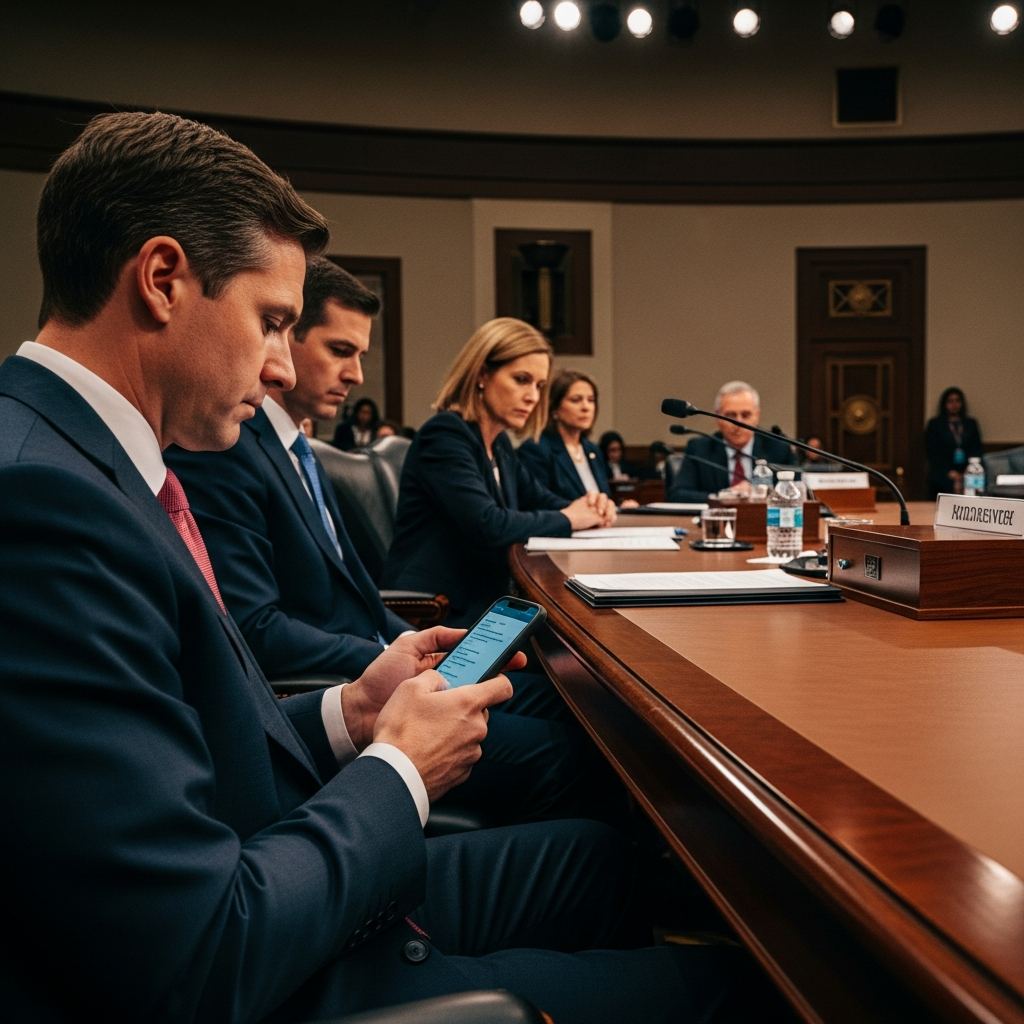
A Committee Hearing, a Phone Screen, and a Very Bad Supporting Character
There are many ways Congress can embarrass itself on camera. Members can grandstand, filibuster with the verbal equivalent of microwave fish, or ask questions so meandering they require a map, a snack, and a will to live. But a recent resurfacing of footage—synchronized with text-message timestamps—suggests a more unsettling genre of dysfunction: a congressional hearing in which Jeffrey Epstein appeared to be actively coaching a lawmaker in real time.
That is not a sentence anyone should have to type in a functioning republic. Yet here we are, watching the political equivalent of a haunted marionette show, where the strings are iMessage bubbles and the puppeteer is one of the most notorious men in modern American scandal.
According to reporting and analysis circulated widely online—drawing on video footage aligned with message timestamps—Epstein was allegedly texting a Democratic member of Congress during a committee hearing, feeding her information that she then used in her questioning. The effect, when presented side-by-side, is less “legislative oversight” and more “true crime bonus episode.”
And yes: the clip is “insane,” as commentators keep saying, because it makes the viewer ask the kind of question that ruins your afternoon: How many other times has someone like Epstein been in the room without being in the room?
The Sync Heard ’Round the Internet
The most arresting element isn’t merely that Epstein was in contact with a lawmaker. It’s the alleged choreography: messages sent, questions asked, names raised, and a hearing shaped—beat by beat—like a live TV control room.
In the circulating excerpt, the committee member presses a witness on details, names, and potential corroboration. The witness is pushed to identify individuals connected to a political organization—names, titles, proximity, who knew what, who sat next to whom, who could verify statements.
At one point, the lawmaker’s questioning becomes notably specific, the kind of specificity that can be admirable in a hearing—unless it appears to be crowdsourced from a convicted sex offender watching C-SPAN like it’s a fantasy football draft.
Then comes the detail that lands like a cold hand on the back of the neck: Epstein allegedly texted the lawmaker “good work” during the hearing, implying he was monitoring the proceedings and reacting in real time.
If true, it is a grotesque inversion of democratic accountability. The public is supposed to watch Congress. Not the other way around, with a criminal spectator providing stage direction.
A Familiar Washington Problem: Influence, but Make It Textable
Washington has never been shy about influence peddling. It just used to come in the form of cigar smoke, steakhouse lunches, and “accidental” encounters at fundraisers where everyone accidentally has the same donor.
Now it comes with read receipts.
The alleged Epstein-to-lawmaker pipeline underscores a broader reality: the modern influence economy thrives on speed. A text message can deliver a name, a nudge, a framing device, a line of attack—faster than a staffer can open a binder or pretend to have read it.
And hearings, despite the solemn wood paneling, are often performance. The best question isn’t always the most enlightening; it’s the one that clips well. If an outside actor can help craft that moment, they can shape narratives, damage reputations, and steer attention—sometimes away from themselves.
That is where the Epstein angle becomes especially dark. Because Epstein wasn’t just “some guy.” He was a man whose social orbit included the powerful, the wealthy, and the institutionally protected—until, abruptly, it didn’t. His notoriety comes not only from his crimes, but from the persistent suspicion that his network had more doors than jail cells.
So when footage suggests he may have been whispering into the hearing like a demonic teleprompter, the question becomes not just “Did this happen?” but “How often does this happen with someone else?”
The Clip’s Other Bombshell: A Chicago Drive and a Racist Remark
The unstructured source material tied to this episode includes another startling claim—one that appears in the same breath as the hearing footage: an anecdote alleging that Barack Obama, while driving through a struggling neighborhood in Chicago, remarked that “only black people could live that way.”
The claim is presented as a recollection, not a documented transcript, and it is not substantiated within the material itself. Still, its inclusion is revealing: it demonstrates how quickly modern political discourse becomes a blender. A potentially documentable allegation (texts synced to video) is placed beside a provocative anecdote (a private remark), and the whole thing is served as one big bowl of “trust me, bro.”
That matters because it’s how misinformation and legitimate scrutiny can become indistinguishable in the public mind. One claim may have receipts; the other may have vibes. But once they’re packaged together, the audience is left sorting through rubble.
In an era when political narratives travel at the speed of outrage, the burden on journalists is to separate what’s verifiable from what’s merely viral—even when both are equally shareable.
Why This Story Feels Like It’s About to Get Bigger
The discussion around the synchronized messages arrives amid renewed political chatter about releasing additional Epstein-related files. House Speaker Mike Johnson has indicated there may be movement—potentially even a vote—on whether to release more documents.
That prospect has set off the predictable Washington fireworks: part transparency crusade, part partisan foreshadowing, part social-media blood sport.
The logic goes like this: if more files are released, there could be more examples of elites orbiting Epstein in ways that are embarrassing, incriminating, or simply nauseating. And if the synchronized hearing clip is a preview of what’s in the broader universe of Epstein-related material, then we may be headed for a political season in which everyone is frantically checking old calendars, contact lists, and whether their “sent items” folder has a self-destruct feature.
But file releases are rarely neat. They tend to arrive as document dumps, and document dumps are where nuance goes to die. Names appear without context. Contacts are conflated with complicity. And the public—understandably furious—often assumes the worst because the worst has happened often enough.
That is fertile ground for both accountability and opportunism. Sometimes simultaneously.
Trump, Democrats, and the Weaponization of “Who’s In the Files?”
No modern political controversy stays nonpartisan for longer than a houseplant stays alive in a windowless office. The Epstein story is no exception.
The source material includes speculation that the “worst information” in any forthcoming release could be about Democrats, alongside a separate musing about Donald Trump: if there were truly damaging information about Trump in the files, the argument goes, it would have surfaced long ago. The reasoning is that Trump has been publicly vocal at times about Epstein-related matters and about other political figures—behavior that some interpret as inconsistent with someone hiding a devastating secret.
That is a political argument, not proof. It’s also the kind of logic that works great on talk shows and poorly in court.
Here’s the sober reality: Epstein’s network, as documented across years of reporting and litigation, touched multiple corners of elite life—finance, academia, entertainment, politics, philanthropy. The impulse to pre-assign guilt by party affiliation misunderstands the nature of the scandal. Epstein did not appear to operate like a partisan. He operated like a predator with access.
If more files emerge, they may implicate people across the spectrum in different ways—some criminal, some reputational, some merely revealing of terrible judgment. And because America cannot process tragedy without turning it into a team sport, each side will likely highlight the other’s worst connections while downplaying its own.
In other words: the Epstein story will continue to function as a mirror, and Americans will keep using it like a flashlight to shine exclusively into their neighbor’s basement.
What Experts Say: The Danger of Real-Time Backchanneling
Ethics experts and congressional procedure specialists have long warned that hearings are vulnerable to outside manipulation—not necessarily through overt bribery, but through subtler mechanisms: off-the-record coaching, selective leaks, and strategic messaging.
A former congressional staffer, speaking generally about how hearings can be influenced, put it bluntly:
“If a member wants to land a punch, they don’t always need to do the research themselves. They need a line, a name, and a reason it sounds credible. The danger is when the source is compromised—or when the member doesn’t care.”
Legal ethics analysts often point to the distinction between information gathering and improper coordination. Members of Congress can consult experts; they can receive tips. But the reputational stakes change drastically when the tipster is someone like Epstein—whose entire public profile is now synonymous with exploitation and elite impunity.
If the synchronized-video claim is accurate, it suggests not merely poor judgment but a deeper vulnerability: a lawmaker’s public work product potentially shaped by a private, compromised actor.
That is the sort of thing that doesn’t just stain an individual. It corrodes trust in the institution, which is already operating at the public approval rating of a damp sandwich.
The Dark Comedy of It All: Congress as Content, Scandal as Programming
There is something grimly comedic about the scene. A congressional hearing is supposed to be a formal exercise of oversight. Instead, the alleged dynamic resembles a reality show with audience participation—except the audience member is Jeffrey Epstein and the participation is real-time coaching.
It’s the kind of absurdity that would be funny if it weren’t so bleak. Like watching someone try to put out a fire with gasoline, then asking for applause because the flames are “bipartisan.”
And it raises an uncomfortable possibility: that some of the most dramatic moments in American politics are not spontaneous eruptions of civic duty, but carefully fed lines—delivered by people who should be nowhere near the process.
What Happens Next
If additional Epstein files are released, the public will face a familiar dilemma: the documents may contain legitimate leads, horrifying details, and also plenty of mundane contacts that will be spun into conspiracy fan fiction.
The synchronized hearing footage—if verified and contextualized—could become a central exhibit in a broader argument that Epstein’s influence extended beyond private gatherings and into the machinery of government itself.
At minimum, it is a reminder that the Epstein scandal is not only about what happened in hidden rooms. It’s about the systems that allowed him proximity to power—and the people who, for reasons ranging from ambition to complacency, let that proximity become normal.
In Washington, “normal” is often just another word for “we got away with it for a while.”
And if Jeffrey Epstein was indeed texting a member of Congress during a hearing—watching, nudging, praising—then the most chilling part isn’t that it happened.
It’s the thought that it may have felt, to the people involved, like just another day at work.