When Defense Secretary Pete Hegseth stepped up to the lectern at Marine Corps Base Quantico on Wednesday, he did not deliver his message to the rows of seasoned flag officers who normally populate Pentagon keynote addresses. Instead, the audience seated in the auditorium was composed of approximately six hundred junior officers and senior non-commissioned officers—the captains, lieutenants, and staff sergeants who actually operate military hardware in the field.
The setting was deliberate, and the announcement was an institutional grenade. Hegseth unveiled the planned establishment of the United States military’s twelfth unified combatant command: the Autonomous Warfare Command, or AUTOWARCOM. Scheduled to achieve full operational capability by October 1, 2027, the four-star functional command is designed to do something the Department of Defense has struggled with for three decades: scale unmanned, attritable, and algorithmic weapon systems across the entire joint force before geopolitical adversaries render America's legacy capital platforms obsolete.
To military historians and procurement veterans, the proposal represents the most radical organizational gambit since the creation of United States Space Command in 2019—and arguably the most aggressive restructuring of military purchasing authority since Special Operations Command was granted independent budget powers in 1987. But while the strategic rationale is undeniable, Hegseth’s initiative confronts the single most formidable adversary in the Western hemisphere: the entrenched, multi-billion-dollar inertia of the Pentagon acquisition apparatus.
The Quantico Salvo: Bypassing the Five-Sided Machine
The choice to brief junior tactical leaders rather than Pentagon program managers highlighted the cultural civil war simmering inside the defense establishment. In Ukraine’s muddy trenches and the shipping lanes of the Red Sea, the character of armed conflict has shifted at a speed that has left traditional defense planning in paralysis. Commercial first-person-view drones costing $800 are routinely neutralizing multi-million-dollar main battle tanks. Swarms of low-cost loitering munitions have forced capital naval vessels to expend $2 million interceptor missiles just to keep sea lanes open.
Yet inside the Pentagon’s Planning, Programming, Budgeting, and Execution (PPBE) system, a major defense acquisition program still requires an average of seven to fifteen years simply to move from an initial capability document to operational deployment. By the time a traditional program of record clears testing and congressional budget markups, the microchips, optical sensors, and autonomous flight algorithms embedded in its airframe are often two technological generations out of date.
Hegseth’s address made clear that the new command is designed specifically to bypass that calendar. Backed by a formal Department memorandum titled "Project Agincourt: Pathway to the Autonomous Warfare Command," the initiative tasks the Direct Reporting Portfolio Manager for Unmanned Systems (DRPM-UxS) with executing a thirty-day plan of action to lay the groundwork for legislative authorization.
To guide the effort, Hegseth tapped Owen West, director of the Defense Innovation Unit, alongside a Navy SEAL senior chief petty officer with credentials as both an operator and a test pilot. The signal to the defense establishment was unmistakable: the Department is attempting to sever drone development from the sluggish committees of the traditional military departments and place it into the hands of tactical practitioners.
Service-Like Authorities: The SOCOM Playbook
The critical phrase in Hegseth’s announcement—and the detail that will provoke the fiercest resistance on Capitol Hill—is the promise that AUTOWARCOM will possess "service-like authorities."
In military law and budgetary mechanics, combatant commands typically do not buy weapons. Unified commands like CENTCOM, INDOPACOM, or EUCOM fight wars using the personnel, equipment, and logistics organized, trained, and equipped by the individual military branches: the Army, Navy, Air Force, and Marine Corps. When a regional combatant commander needs additional drones or counter-UAS batteries, they must submit urgent operational needs statements to the services, which then prioritize those requests against their own long-term budget programs.
There is, however, one major historical exception: United States Special Operations Command (USSOCOM). Under the Nunn-Cohen Amendment to the National Defense Authorization Act of 1987, Congress created Major Force Program 11 (MFP-11), giving SOCOM its own independent acquisition budget and personnel authority. That statutory independence allowed special operators to purchase specialized radios, modified carbines, and rapid-fielding reconnaissance gear directly from commercial vendors without asking the conventional Army or Navy for permission.
Hegseth is attempting to apply the SOCOM playbook to autonomous warfare. If granted service-like authorities, AUTOWARCOM will control its own funding lines, define its own military occupational specialties (MOS) and Navy ratings, and execute contracts directly with commercial robotics developers. Rather than begging the Air Force to prioritize attritable drone swarms over next-generation manned fighters, the four-star commander of AUTOWARCOM would hold statutory authority to cut checks directly to Silicon Valley software firms and domestic airframe manufacturers.
The Math of Attrition: Reapers Versus the Swarm
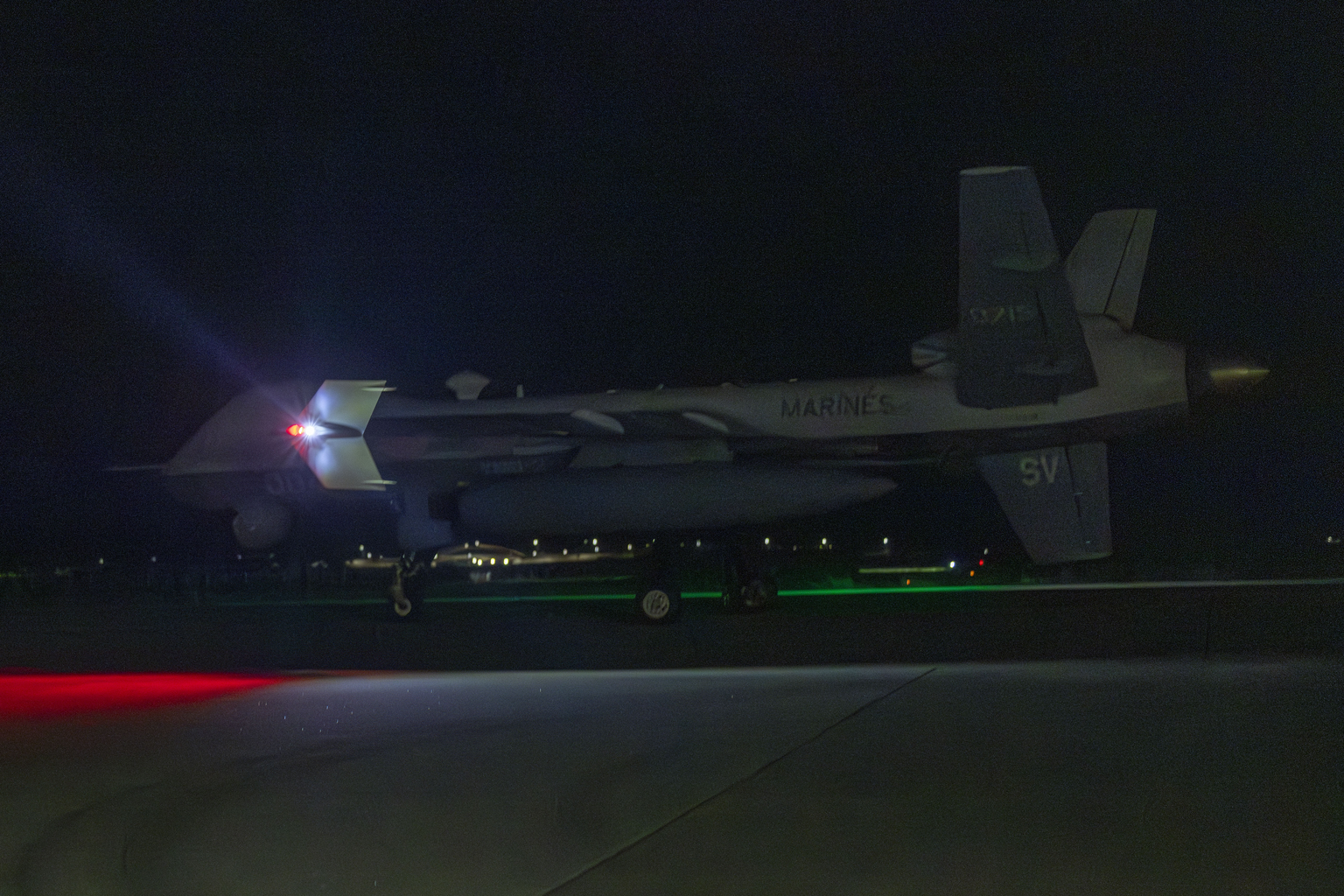
Behind the bureaucratic maneuvering lies a brutal economic reality that American defense planners can no longer ignore. For a generation, the United States built its technological edge around exquisitely engineered, extraordinarily expensive platforms designed to operate in uncontested skies. The MQ-9 Reaper, while effective for counter-terrorism surveillance against insurgent forces lacking air defenses, costs approximately $30 million per airframe and presents a slow-moving, unstealthy radar cross-section that peer adversaries can track and engage from long ranges.
In a contested high-end conflict across the Taiwan Strait or Eastern Europe, losing a dozen $30 million platforms in a single afternoon represents a catastrophic operational and financial loss. Replacing that hardware through conventional defense production cycles takes years, largely because American aerospace manufacturing lines are optimized for boutique craft production rather than wartime mass.
Autonomous warfare demands the exact opposite: low-cost, modular, attritable mass. When combat drones can be manufactured for the price of a compact sedan, losing eighty percent of a swarming wave during an assault is an acceptable operational expenditure, provided the remaining twenty percent penetrate defensive perimeters and strike the target.
This asymmetry is where fiscal realism intersects national sovereignty. The United States cannot sustain a protracted great-power competition if its defensive posture relies on firing $2.1 million Standard Missiles to down $20,000 drones, or risking $100 million manned aircraft on missions that can be executed by coordinated autonomous decoys. By institutionalizing autonomous systems into a dedicated combatant command, the Department is seeking to shift the Pentagon's investment curve from exquisite scarcity to expendable volume.
The Iron Triangle Girds for Battle
Declaring a new combatant command in an auditorium at Quantico is straightforward; getting it through the gauntlet of the defense industrial complex is another matter entirely.
The so-called "Iron Triangle"—the symbiotic alliance of defense primes, congressional defense committees, and the traditional service branches—has crushed or co-opted dozens of similar reform initiatives over the past half-century. Every dollar allocated to a new four-star command's autonomous acquisition portfolio is a dollar that does not flow into traditional submarine construction, heavy armor refurbishment, or manned strike fighter maintenance contracts.
Members of the House and Senate Armed Services Committees will inevitably examine the proposal with sharp skepticism. Congressional districts are heavily tied to legacy defense programs: the assembly lines that stamp out jet engines, the shipyards that lay dry-dock keels, and the supply chains that support hundreds of domestic component subcontractors. Autonomous systems, by their nature, rely heavily on commercial off-the-shelf components, consumer lithium batteries, commercial software APIs, and non-traditional startup suppliers who rarely maintain high-dollar lobbying footprints in Washington.
Furthermore, the existing service branches will not surrender their institutional prerogatives without a fight. The Air Force views collaborative combat aircraft (CCA) as an intrinsic extension of its air dominance mission; the Navy considers uncrewed surface and undersea vessels integral to fleet architecture; the Army regards small reconnaissance drones as organic infantry squad equipment. Convincing the Joint Chiefs of Staff to cede budgetary control of those programs to an external fourth-star functional commander will require an unprecedented expenditure of executive political capital.
Warfighting Acquisition Meets Silicon Valley
To bridge the gap between military operational requirements and rapid software iteration, Hegseth outlined what the Department is terming "warfighting acquisition." The concept pairs active-duty tactical operators directly with engineering teams from venture-backed startups, executing iterative field deployments on thirty- to ninety-day cycles rather than multi-year evaluation periods.
The initiative also incorporates external technical advisory bodies, including "Project Meridian," a committee tasked with evaluating frontier technological domains that features prominent commercial innovators such as Palmer Luckey of Anduril Industries and Elon Musk, alongside former House Speaker Newt Gingrich.
The inclusion of venture-backed defense tech founders underscores the strategic pivot. Over the past five years, venture capital has poured tens of billions of dollars into autonomous navigation, edge computing, drone mesh networking, and computer vision. Yet many of the most innovative commercial firms have found themselves trapped in what defense entrepreneurs call the "valley of death"—the multi-year gap between completing a successful military prototype and securing a funded program of record.
If AUTOWARCOM functions as intended, it will serve as a bridge across that chasm, providing non-traditional defense tech companies with a direct, streamlined path to scale production without having to navigate the labyrinthine Federal Acquisition Regulation (FAR) compliance hurdles that protect entrenched legacy contractors.
Can More Bureaucracy Cure Bureaucracy?
The fundamental paradox of Hegseth’s proposal is whether creating another four-star military headquarters is truly the antidote to Pentagon bureaucracy, or merely the creation of a twelfth layer of it.
The history of military reorganizations is littered with well-intentioned commands that began as agile strike teams and eventually bloated into administrative fiefdoms. When United States Cyber Command was elevated to a unified combatant command, proponents argued it would move at the speed of internet code; today, it commands an extensive headquarters bureaucracy with its own layers of policy clearances, legal reviews, and procurement protocols.
For AUTOWARCOM to avoid the same fate, the legislative charter drafted under Project Agincourt must do more than simply pin four stars onto a general officer’s collar. It must establish statutory exemptions from obsolete acquisition statutes, enforce rigorous sunset reviews on programs that fail to deliver operational hardware, and ensure that decision-making authority remains distributed down to the tactical level.
The Clock Is Ticking Toward 2027
The geopolitical calendar does not wait for Pentagon study groups. The ongoing modernization of China’s military, combined with the rapid proliferation of autonomous systems across regional conflicts worldwide, has eliminated whatever comfortable technological cushion the United States enjoyed over the past three decades.
By setting an October 1, 2027 deadline for AUTOWARCOM, the Department of War has established a strict countdown. The next twelve months will test whether the administration can translate a bold conceptual speech at Quantico into statutory authority, congressional appropriations, and real-world industrial output.
If Pete Hegseth succeeds in breaking the services' monopoly on procurement, AUTOWARCOM may well mark the beginning of a decisive new era in American deterrence—one grounded in speed, fiscal discipline, and algorithmic mass. If the effort is swallowed by the Pentagon machine, it will serve as another cautionary tale of how Washington’s institutional inertia proved too powerful even for the future of war.
Sources: U.S. Department of War / DoD Official Directive (Project Agincourt Memorandum), Defense One (Reporting by Bradley Peniston), AeroTime Defense (Reporting by Clement Charpentreau), and Department of Defense Quantico State of the Force Address Records.