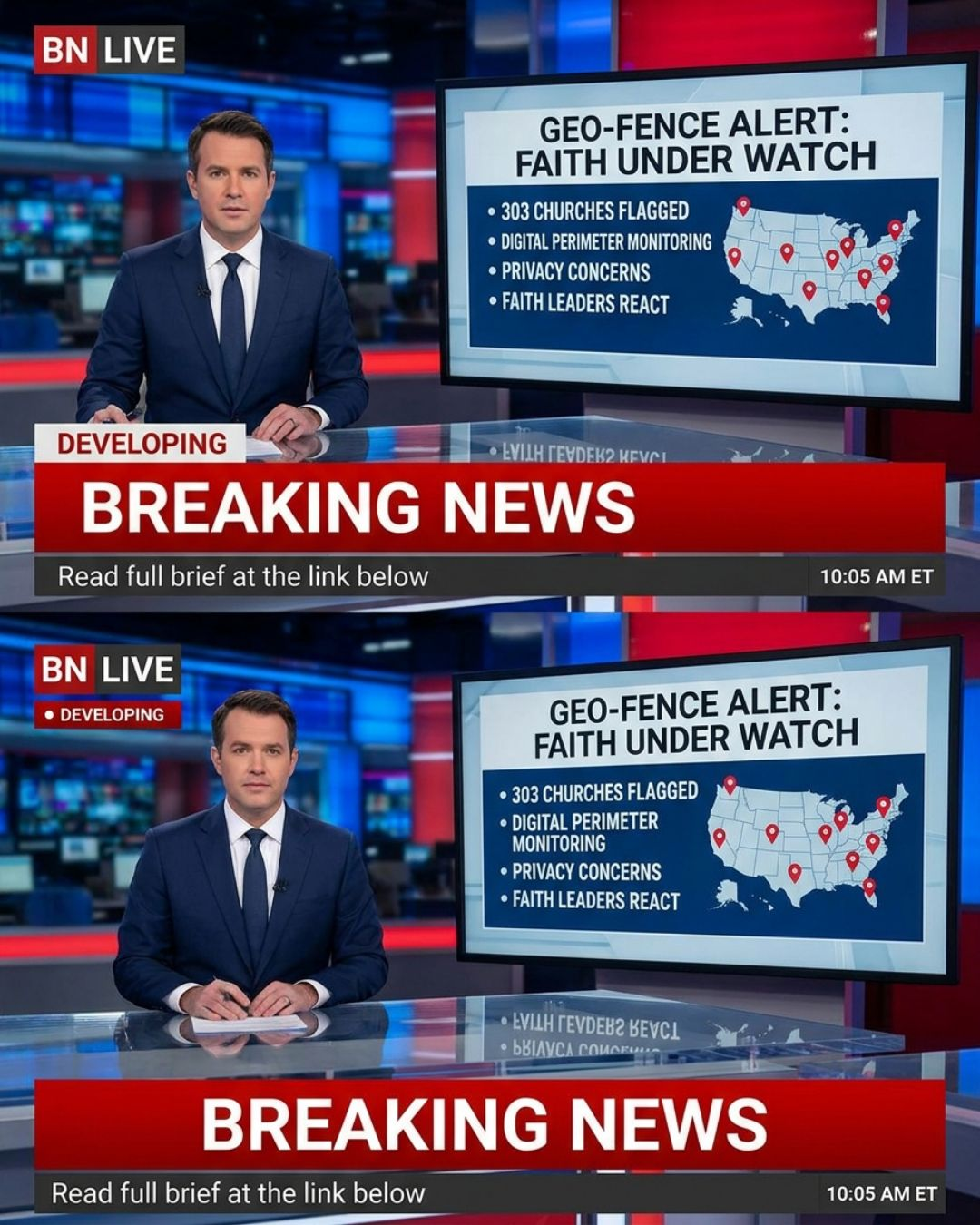
A federal disclosure quietly posted on the U.S. Department of Justice website last fall has surfaced into public view, and the document is one of the most unusual things to land in the Foreign Agents Registration Act registry in years.
The filing, FARA #7653, was submitted on September 27, 2025 by Show Faith by Works, LLC, a California company that had been in existence for fewer than seven weeks at the time of filing. Its client: the Israeli Ministry of Foreign Affairs, Israel's official diplomatic organ. The campaign's price tag: $3.2 million in initial funding, with an optional expansion budget of $835,000 — a $4.1 million ceiling — paid in equal monthly installments of $651,792.
The campaign itself is unusual in two distinct ways. It uses a common commercial-advertising technology, geofencing, in an uncommon place: the Sunday-morning services of American churches. And it targets the audience without the cooperation — or, in most cases, the knowledge — of the venue itself.
What the Filing Says
The language in the FARA filing is direct. The campaign's job description, as registered with DOJ:
"Geofence the actual boundaries of every Major church in California, Arizona, Nevada, and Colorado, and all Christian Colleges during worship times. Track attendees and continue to target with ads."
The filing names specific numbers. 219 churches in California. 38 in Arizona. 32 in Colorado. 14 in Nevada. The campaign scope also extended to Texas and to Christian colleges across the four-state region. In total: 303 named venues.
The estimated reach: nearly four million Christians during the campaign window, with a stated goal of converting more than 100,000 of them to a more favorable view of the State of Israel.
The campaign's mission statement, also from the filing:
"Increase positive associations with the nation of Israel," and, in the same paragraph, "while linking the Palestinian population with extremist factions."
How the Money Moves
The Israeli Ministry of Foreign Affairs did not write checks directly to a California LLC. Instead, the funds were routed through Havas Media Germany GmbH, a Frankfurt-based subsidiary of the global advertising holding company Havas. Havas's German arm is the parent of the Israeli advertising agency Inbar Merhav G, which appears in the FARA paperwork as the Israeli-side contracting entity.
The five monthly wire transfers — each $651,792 — were scheduled to clear on August 15, September 15, October 15, November 15, and December 15, 2025. By the time the campaign became a public controversy in mid-autumn, the operator of Show Faith by Works — political consultant Chad J. Schnitger of Riverside, California — told reporters that the geofencing operation had been "dropped."
The invoice schedule did not drop. By March 2026, more than $2.5 million had moved through the Havas Media Germany account to Show Faith by Works.
Schnitger is also the California state director of the Faith & Freedom Coalition, a national conservative-Christian political-advocacy organization. The FARA filing lists him as Show Faith by Works' principal signatory.
Why the Churches Are Named — and Why They Were Not Asked
Geofencing is a standard commercial-advertising technique. A retailer draws a virtual line around a shopping mall; every mobile device that crosses the line during business hours becomes eligible to receive targeted ads on its apps and browsing for weeks afterward.
The Show Faith by Works filing applies the same technique to a category of venue that retailers typically do not target: the American Sunday-morning worship service. The campaign explicitly seeks to capture the geofence audience during the Sunday worship window, when the device-holder is least likely to be moving between competing advertising surfaces.
The campaign's accompanying pitch deck describes itself as the "largest Christian Church Geofencing Campaign in U.S. history." The deck projects 47 million ad impressions across display, audio, and connected-TV channels over the course of a year, after the initial geofence capture.
The 303 churches were chosen by the campaign operator. None of them were asked. When journalists reached out to named venues in November 2025, the responses were uniform. A representative of Canyon View Vineyard Church in Grand Junction, Colorado:
"We did not know about this. We did not consent to this, and we are not participating in this."
That statement was posted publicly and remains on the church's website. Other named venues gave similar responses.
The Pastor Stipend Pipeline
The campaign's reach extended beyond passive geofencing. The FARA filing includes a parallel program to pay pastors directly:
Pay "individual guest pastors, bilingual pastors, or pastors who match target demographics to record messages based on content creation targets."
Stipends per campaign ranged from $5,000 to $20,000, paid through marketing firms contracted by city and state agencies to promote voting, healthcare, immigration, and tenants-rights programs — categories that mirror the same range of issues the Israeli MFA's foreign-messaging priorities cover.
The pastor stipends are the campaign's most politically sensitive layer. A pastor who accepts a foreign-government-aligned stipend to deliver specific talking points creates a financial-conflict situation that the listener in the pew has no way to detect. The pastor keeps their trusted standing. The foreign principal keeps its message distribution. The congregation never sees the invoice.
The campaign's pitch deck explicitly targets Generation Z Christian audiences, a demographic that recent polling has shown has shifted measurably more skeptical of the State of Israel than older evangelicals. A Scottsdale, Arizona churchgoer quoted in the Responsible Statecraft investigation called the campaign "an attempt to regain the attention and hearts/support of Gen Z through the use of religious manipulation."
Where the Law Stands
The Foreign Agents Registration Act requires that any person or entity paid by a foreign government to influence American public opinion must register the contract with the U.S. Department of Justice. Show Faith by Works did register. That part is not in dispute. The filing is on the public record at efile.fara.gov, document number 7653.
What FARA does not do is require the consent of the targeted venues or audiences. Disclosure is the legal threshold. Permission is not.
The DOJ's National Security Division, which administers FARA, can pursue enforcement actions for failure to register, for material misstatements in a registration, or for failure to update a registration when campaign scope changes. There is no FARA mechanism to enjoin a foreign principal from geofencing American religious venues. There is no FARA mechanism to require a foreign ministry to obtain consent from the institutions it targets.
That gap between legally-disclosed and politically-consented is the campaign's structural advantage. The filing made the campaign public, but the public-ness did not stop it.
The Question That Doesn't Have a FARA Form
The Show Faith by Works filing is now the second foreign-government geofencing operation targeting American audiences to surface publicly in 2026 — the first being the New York City mayoral-administration's "NYC Creators Announcements" Signal group, revealed by a Columbia Journalism Review investigation in August. The two campaigns use different platforms and different messengers. They share one structural feature: a foreign or foreign-aligned principal paying for direct access to American audiences through channels the audience does not know they are inside.
The questions the FARA filing raises are not questions the FARA filing answers.
- Should a foreign ministry need the consent of a venue before drawing an advertising perimeter around it?
- Should the in-pew disclosure of a paid pastor relationship be mandatory, the way political-ad disclaimers are?
- Should the routing of foreign-government payments through third-country ad-agency subsidiaries require disclosure of the underlying principal?
- Should a campaign that has been publicly dropped by its operator continue to receive scheduled payments from the same foreign principal?
These are not questions for the Department of Justice. They are questions for the voters in the pews, the pastors in the pulpits, and the legislators in the chambers where the next FARA reform bill will or won't be written.
Until those questions get answered, FARA #7653 sits on the public record. The churches on the list continue to receive Sunday visitors. The payments continue to move through Frankfurt. And the phones in the pews continue to be scanned by lines on a map that nobody inside the sanctuary drew.
Sources
- Show Faith by Works FARA Filing #7653, U.S. DOJ NSD (Sept 27, 2025)
- Responsible Statecraft: "Israel wants to pay US pastors a stipend to spread the word"
- Times of Israel: "Israel to spend up to $4.1M in bid to bolster support among Christians in western US"
- Amarillo Tribune: "Amarillo churches are listed as potential targets for a geofencing campaign"
- Truthout: "New Campaign Aims to Flood Churches and Christian Colleges With Pro-Israel Ads"
- Canyon View Vineyard Church Statement