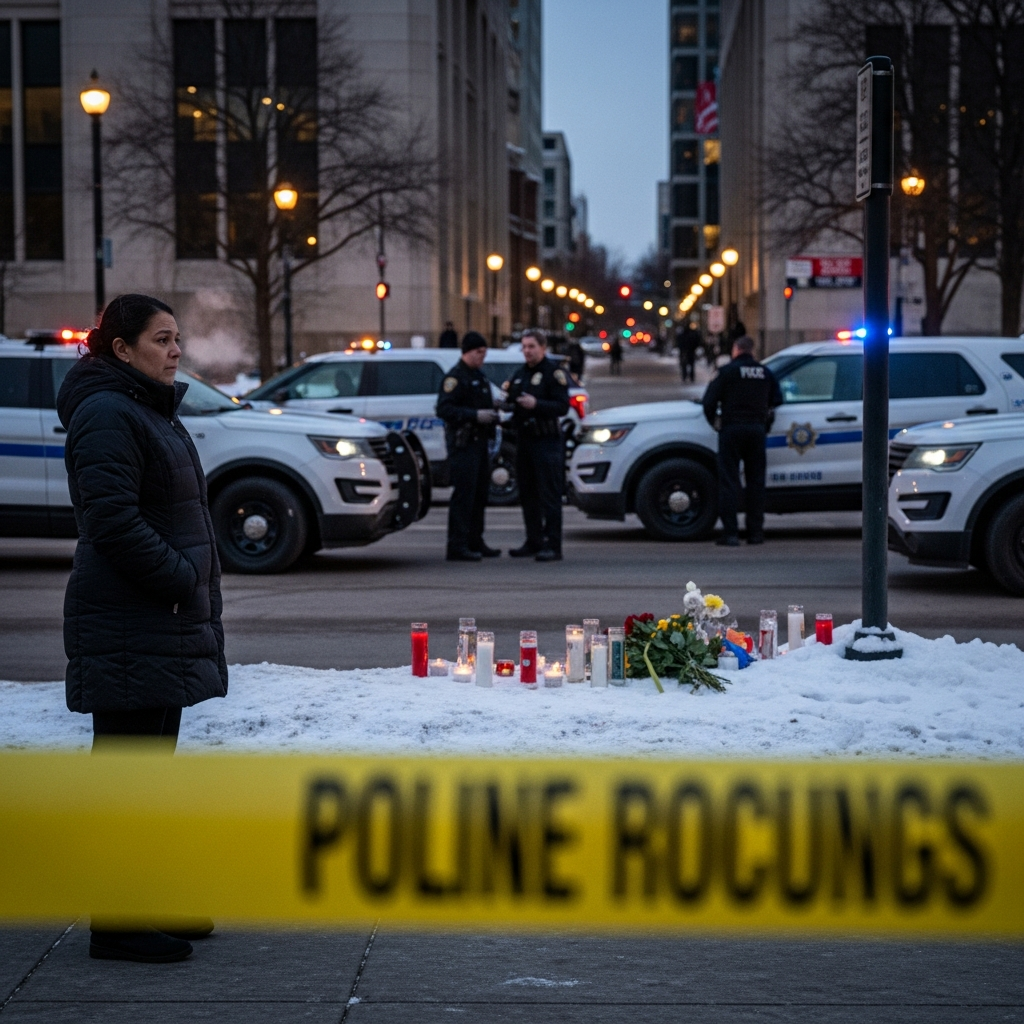
Minneapolis is still arguing over what happened on Jan. 7, 2026, when Renee Nicole Good, 37, was fatally shot by an ICE agent during a federal operation. The shooting remains under review and investigation, and the public has been left to parse a familiar mix of official statements, partial video, and political talking points.
But the newest twist isn’t a fresh evidentiary bombshell. It’s something more modern—and arguably more corrosive: a televised legal theory, delivered hot and ready for social media.
Fox News legal analyst Gregg Jarrett has suggested that Rebecca “Becca” Good, Renee Good’s spouse, could face criminal exposure based on what she allegedly said or did moments before the vehicle moved during the encounter. The phrase at the heart of the speculation—“Drive, baby, drive”—has become the kind of viral snippet that can shape public perception long before any grand jury ever sees a case file.
Jarrett’s argument, in essence, is that even though Renee Good is deceased, the government could still pursue charges against another participant if investigators believe she encouraged conduct that endangered officers—potentially even with what some officials have labeled a “domestic terrorism” motive.
That is a lot of legal freight to load onto a few seconds of audio. And yet, in today’s politics, a few seconds is often all anyone needs.
What We Know About the Jan. 7 Encounter
The baseline facts are both stark and incomplete.
- Renee Nicole Good was shot and killed by an ICE agent during a federal operation in Minneapolis.
- The shooting is still under review/investigation, and officials have urged the public not to leap to conclusions.
- Video has circulated publicly, including a short clip described as being from an agent/officer perspective and published by Alpha News, later reposted more widely.
Federal officials have characterized the shooting as self-defense, arguing the agent perceived an immediate threat. Critics and some local voices dispute that framing, particularly the idea that the vehicle should be treated as a weapon rather than as an attempt to flee.
That dispute matters because it is the hinge on which everything swings: if the car was used as a weapon, prosecutors and federal officials have a very different narrative than if the driver was simply trying to leave a tense scene.
At the moment, the public is left with fragments. The video does not settle the central question:
Was the car used as a weapon—or was it a panicked attempt to drive away?
The Commentary Angle: Jarrett’s Case Against Becca Good
Jarrett’s on-air analysis—repeated and amplified in subsequent coverage—does not claim charges are imminent. It is, explicitly, a theory about what prosecutors could do under certain factual findings.
The key components of his argument:
1) You can’t prosecute the dead—but you can prosecute the living
Jarrett notes that because Renee Good is deceased, she cannot be charged. But that does not foreclose potential liability for others who were present, participated, or encouraged conduct that investigators deem criminal.
2) “Drive, baby, drive” as the linchpin
The centerpiece is the alleged exhortation—“Drive, baby, drive”—said to have occurred just before the vehicle moved. Jarrett’s view is that the phrase could be interpreted as encouragement of an act that endangered officers, possibly supporting theories like aiding and abetting or obstruction/impeding officers, depending on what the evidence shows.
3) The leap to “domestic terrorism”
Jarrett also suggested that if investigators conclude the intent was anti-government—meant to obstruct or intimidate federal authorities—then the episode could be framed with a domestic terrorism motive.
That last point is where legal analysis and political rhetoric tend to blur. “Domestic terrorism” is a phrase that ignites cable news panels, but it is not automatically a standalone federal criminal charge in the way many Americans assume.
A Quick Reality Check: What’s Confirmed vs. What’s Not
This story currently runs in three lanes—investigation, politics, and commentary—and they are not the same lane.
Confirmed / widely reported
- The shooting is still under review/investigation.
- Officials have urged caution and restraint in public conclusions.
- No charges have been announced against Becca Good in the reporting referenced.
Not established by the reporting
- That Becca Good is a suspect.
- That prosecutors are preparing charges.
- That investigators have adopted Jarrett’s legal theory.
- That the video definitively proves intent to harm officers.
In other words: the public conversation is racing ahead of the public evidence. That may be emotionally understandable, but it is a dangerous way to run a justice system.
What “Aiding and Abetting” Actually Means (In Plain English)
Jarrett’s analysis leans heavily on aiding and abetting, a concept that sounds like legal jargon but is fairly simple in principle:
If you intentionally help or encourage a crime, you can be charged as a participant.
The tricky part is proving the elements. Prosecutors generally need to show more than proximity or panic. They typically need evidence of:
- Knowledge of the criminal act,
- Intent to help it succeed, and
- Some form of meaningful assistance or encouragement.
Verbal encouragement can matter, but it is rarely as simple as “said a sentence, therefore guilty.” Context is king. Timing matters. Tone matters. Whether the person understood what was happening matters.
That is why Jarrett’s own framing repeatedly comes back to intent. A spouse shouting “Drive!” could be read as urging escape from perceived danger—or urging an assault on an officer—depending on the surrounding facts.
And those facts are precisely what investigators have not publicly resolved.
Obstruction, Impeding Officers, and the “Whole Day” Narrative
Another concept invoked in the coverage is obstruction or impeding officers. The segment’s framing reportedly suggested there was footage “the entire day” of Renee Good impeding officers.
Even if such footage exists, it raises questions rather than answers:
- Was the conduct unlawful or merely noncompliant?
- Was it willful obstruction or confusion in a chaotic situation?
- Were lawful orders clearly communicated?
- Were officers clearly identifiable, and were procedures followed?
Obstruction charges are not supposed to be a catch-all for “things got messy.” They require specific proof, and defense attorneys routinely attack them on grounds of ambiguity, unclear commands, or lack of intent.
Still, the obstruction narrative is politically potent: it shifts the story from “tragic shooting under disputed circumstances” to “federal officers under siege.”
The “Domestic Terrorism” Label: Law vs. Politics
The most combustible part of the public discussion is the word terrorism—a term that carries moral weight, media heat, and the unmistakable suggestion that extraordinary measures are justified.
DHS Secretary Kristi Noem has publicly described the behavior as “domestic terrorism” and suggested it was coordinated. That may be a political characterization, but it intersects with a real legal definition.
Federal law defines “domestic terrorism” in 18 U.S.C. § 2331(5). Importantly, that definition does not automatically function as a plug-and-play criminal charge. It is a definition used across statutes and contexts, and it typically becomes relevant as an enhancement, a motive, or a categorization that influences investigative posture and prosecutorial rhetoric.
To meet the definition, the conduct generally must involve:
- Dangerous acts that violate criminal law, and
- An intent to intimidate or coerce civilians or influence government policy or conduct,
- Occurring primarily within the United States.
Jarrett’s suggestion appears to be that if the conduct was meant to obstruct ICE operations as part of coordinated resistance—if it was anti-government in purpose—then “domestic terrorism” could be argued as a motive label.
That is a large “if,” and it matters. Motive is not a vibe; it is something prosecutors must prove through evidence: communications, planning, coordination, prior statements, affiliations, or other indicators that go beyond a shouted phrase in a heated moment.
The risk, of course, is that “terrorism” becomes a rhetorical shortcut—an all-purpose moral verdict that arrives before the facts.
The Video Problem: The Clip Economy Meets Criminal Law
The public’s understanding of this case is being shaped by short-form video—an “agent perspective” clip, reposted and reinterpreted across platforms. That is now standard in American life, but it remains a poor substitute for a full evidentiary record.
Video can be clarifying, but it can also be misleading:
- It may omit what happened seconds earlier.
- It may lack audio or context.
- It may compress time and distort perception of distance and speed.
- It may not show where officers were positioned relative to the vehicle.
And yet, in our current media environment, the clip becomes the case. The public starts building a verdict from a handful of frames.
That is not a defense of anyone’s behavior; it is a warning about how easily the justice system can be pressured by what amounts to a highlight reel.
A Second Story Beneath the First: How Content Gets Repurposed Into Narrative
One underappreciated dynamic here is how quickly commentary becomes “reporting” in the public mind. A legal analyst speculates, a headline condenses it, social media republishes it, and soon many readers believe prosecutors have already made decisions.
This is not unique to this incident; it is a feature of modern content economics. As marketing strategist Garrett Moon of CoSchedule has argued in the context of media reuse:
“Content repurposing doesn’t just mean that you reuse an old piece of content again and again. True repurposing requires that we alter it to make it fresh and appealing to a new audience.”
That observation—originally aimed at blogging strategy—also describes how political narratives mutate. The “fresh and appealing” version of a story is often the most emotionally charged one: Could the spouse be charged? Could this be terrorism?
Repurposing can inform. It can also inflame.
What’s Still Unknown—and Why Restraint Matters
The responsible answer to “Will Becca Good be charged?” is simple: we don’t know.
At this stage:
- There is no public announcement of charges.
- The investigation is ongoing.
- The central factual dispute—weaponized vehicle vs. attempted flight—remains contested in public reporting.
- The leap from a shouted phrase to criminal intent is, at minimum, not something the public can responsibly finalize from a clip.
None of this means prosecutors won’t pursue a case if evidence supports it. But it does mean that a media cycle built on speculation can harden into a presumption—one that pressures investigators, poisons jury pools, and reduces a serious inquiry to partisan theater.
The Stakes: When Language Becomes a Verdict
This story is now about more than a shooting. It is about how the country talks about law enforcement, federal authority, and political violence—and how quickly we slap labels on people before the legal process has done its job.
If the facts show that officers were endangered intentionally, the law has tools to address that. If the facts show a chaotic encounter and a disputed use-of-force decision, the law has tools for that too. What the law does not have tools for is a public that demands certainty before evidence is gathered.
“Domestic terrorism” is not a punchline, and it shouldn’t be a cable-news prop. It is a grave allegation with serious implications. And “aiding and abetting” is not a word game—it is a doctrine that can put someone in prison based on what they intended and how they acted.
For now, the only honest conclusion is that Minneapolis has one confirmed tragedy and one emerging spectacle: a case still under review, and a debate already being litigated in the court of public opinion—where the rules of evidence are thin, and the appetite for outrage is bottomless.