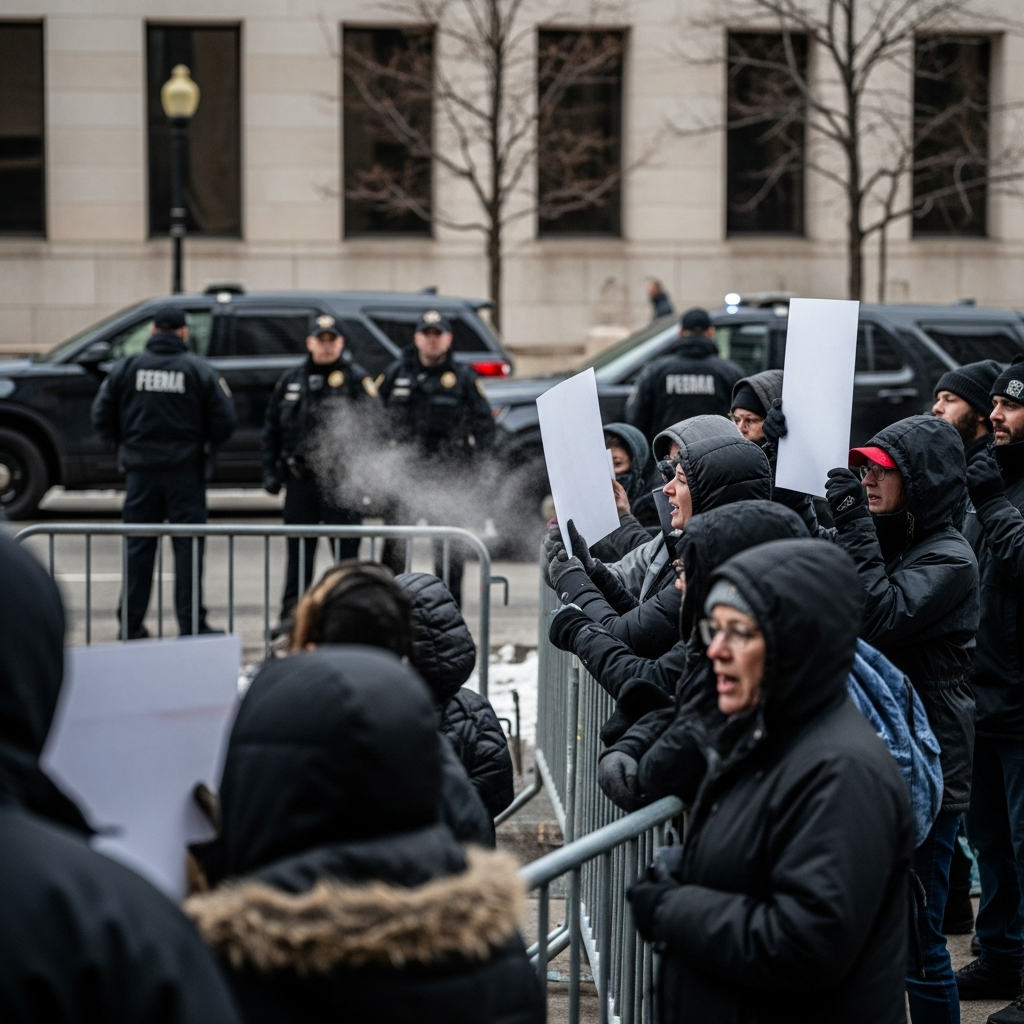
Minnesota is having one of those weeks where the phrase “this is fine” feels less like a meme and more like a statewide communications strategy.
A surge of federal immigration enforcement activity in and around Minneapolis has collided—loudly—with a political message from state leaders urging residents to push back. The result is a combustible mix of fear, fury, protest, and a growing question that doesn’t fit neatly on a campaign sign: What happens when public officials encourage “resistance,” but the street-level reality includes guns, shovels, and split-second decisions?
In a rare primetime address, Gov. Tim Walz urged Minnesotans to respond to federal operations with peaceful protest, community solidarity, and documentation—not violence. But the broader rhetoric—federal agents described as occupiers, enforcement actions framed as kidnappings—has landed in a state already primed for confrontation. And after a recent incident in which a federal officer shot a man during an arrest attempt, the temperature has only climbed.
This is the political moment we’re in: one side says ICE is escalating, the other says local leaders are inflaming the public, and everyone insists they’re the ones trying to keep things calm. Minnesota, meanwhile, is left doing the civic equivalent of carrying a tray of drinks across an ice rink.
A Primetime Address and a Not-So-Subtle Warning
Walz’s message, delivered amid heightened tensions, was explicit about one thing: do not give in to violence. In reporting cited by ABC News, the governor framed the unrest as something President Donald Trump wants to provoke.
“Donald Trump wants this chaos. He wants confusion, and yes, he wants more violence on our streets. We cannot give him what he wants,” Walz said, according to ABC News.
That line—equal parts moral warning and political indictment—captures the governor’s central argument: federal enforcement tactics are designed to create a spectacle, and Minnesotans should deny them the payoff. NBC News reported Walz also cautioned protesters against violence, even as he sharply criticized the federal presence and tactics. The New York Times, in live coverage of the fast-moving situation, reported that Walz urged residents to record ICE agents on their phones and protest peacefully.
In other words: bring your camera, not your fists.
But here’s where Minnesota’s messaging dilemma begins. Telling people to resist peacefully is still telling them to resist. And when the object of that resistance is an armed federal agency conducting arrests, “resistance” can become a choose-your-own-adventure book with some very bad endings.
The Incident That Turned the Volume Up
The debate sharpened dramatically after a recent officer-involved shooting during an attempted arrest in Minneapolis—an episode that has been widely reported as part of the broader tension surrounding federal enforcement operations.
According to NBC News live updates and ABC News reporting, the shooting prompted protests and intensified scrutiny of federal agents’ actions. While many details remain contested in the public conversation, the incident has become a Rorschach test: those critical of ICE see it as proof that federal enforcement is reckless and militarized; those defending the agents see it as proof that the job is dangerous and that public rhetoric is making it worse.
Adding to the public narrative is a separate account circulating in political commentary: an ICE agent attempting to arrest a Venezuelan man under a deportation order is allegedly attacked—reportedly involving a shovel—and fires in self-defense. That version of events has been used to argue that federal officers are being put at heightened risk by a climate of hostility.
To be clear, the key point isn’t the internet’s preferred storyline. It’s that Minnesota now has a live, emotionally charged backdrop where any enforcement encounter can become a flashpoint, and where the political framing around those encounters can determine whether the public sees an officer as a protector, an occupier, or a villain in tactical gear.
And that’s not just a branding problem. It’s a public safety problem.
“Occupation,” “Kidnapping,” and the Language of Escalation
Words are supposed to clarify. In modern politics, they often do the opposite—like throwing glitter in the air during a house fire.
Walz has used striking language to describe federal operations. ABC News reported he called on Trump and DHS Secretary Kristi Noem to “end this occupation” in Minnesota. NBC News reported Walz said agents were “kidnapping innocent people with no warning,” a phrase that carries heavy moral weight and an unmistakable implication: the federal government is acting outside legitimate authority.
CBS News, covering the same statewide address, reported Walz argued Trump intends conditions to worsen and framed the situation as part of a broader political threat. The governor’s message positioned Minnesota as a place that should resist cruelty and protect community cohesion—an “island of decency,” in the spirit of his remarks.
Here’s the rub: describing ICE actions as an “occupation” may energize supporters, but it also primes the public to treat federal agents like hostile forces. And when people believe they’re confronting an occupying force, they don’t typically show up with poster board and herbal tea. They show up with adrenaline.
Even when leaders repeatedly insist on nonviolence, a steady stream of escalatory language can create a moral permission structure for confrontation—especially among those who already believe the system is irredeemable.
Peaceful Resistance Isn’t a Force Field
There’s a comforting myth in American politics that if you say “peaceful” enough times, reality will comply. It’s like calling a chaotic family dinner “a calm conversation” while someone is actively flipping the table.
Walz and other Minnesota leaders have urged peaceful protest and documentation—a classic civil-liberties approach that aims to deter abuse through transparency. The New York Times reported Walz told residents to record ICE agents and protest peacefully, acknowledging the public anger.
That’s a real strategy, and it has real precedent. Cameras can reduce misconduct; public scrutiny can force accountability; demonstrations can pressure policymakers. But “peaceful resistance” has limits when the setting is an active arrest scene involving armed officers, frightened bystanders, and individuals who may themselves panic or fight.
The street-level reality
At the operational level, an ICE arrest is not a town hall. It’s a high-stakes encounter where:
- Agents may believe a suspect could flee or become violent.
- A suspect may believe arrest means separation from family, detention, or deportation—and may act irrationally.
- Bystanders may not know the facts but may feel morally compelled to intervene.
- Everyone’s stress response is screaming, “Do something now.”
Add a crowd with phones—some filming, some shouting, some stepping closer—and you’ve built a situation where a single shove can become a stampede and a single misread gesture can become a tragedy.
“Peaceful” is an intention. It is not a safety protocol.
The Risk to Civilians: Not a Footnote, the Whole Story
Public debate often focuses on the danger to law enforcement—an important issue, but not the only one. The more uncomfortable truth is that civilians are the ones most likely to be caught in the middle.
When protests form around enforcement operations, the risk matrix expands:
- A bystander could be hit by a vehicle during a pursuit.
- A protester could be injured in a scuffle.
- A child could be present in a chaotic scene.
- A firearm—legal or illegal—could appear and turn shouting into shooting.
And the political incentives, for everyone involved, are not exactly built to reduce risk. Federal leaders benefit from images of disorder that justify crackdowns. State and local leaders benefit from images of heavy-handed federal tactics that validate their warnings. Activists benefit from urgency. Media benefits from drama. Social media benefits from everything that makes your heart rate go up.
The public benefits from none of it.
Politics, Narratives, and the Temptation of Chaos
Walz’s critique—per ABC News—is that Trump “wants this chaos,” and that Minnesotans should not give it to him. That’s a shrewd political argument, and it may be correct as far as incentives go: images of conflict can be used to justify stronger measures, rally supporters, and dominate headlines.
But the critique cuts both ways, and that’s where Minnesota’s political moment gets messy.
When politicians frame federal enforcement as illegitimate, they may be speaking to genuine concerns about civil rights and due process. Yet they also risk creating a sense that normal democratic channels are pointless, leaving only confrontation. When they encourage “resistance,” even paired with “peaceful,” they may unintentionally invite the most impulsive participants to treat an arrest scene like a battlefield of righteousness.
And when federal officials respond to protests with more aggressive posture, they reinforce the narrative that they are, indeed, behaving like an occupying force. It’s a feedback loop—each side’s messaging becomes the other side’s evidence.
The result is a dangerous political ecosystem where tension is not a bug; it’s a feature.
Where Civil Rights and Public Safety Collide
Minnesota is not wrong to debate the scope and conduct of immigration enforcement. Communities have legitimate concerns about:
- Due process and transparency
- The impact of arrests on families and workplaces
- Whether enforcement priorities are targeted or indiscriminate
- The chilling effect on immigrant communities reporting crimes or cooperating with police
At the same time, it is also legitimate to ask what happens when public rhetoric encourages people to interfere—even morally, even verbally—with federal operations. The line between witnessing and obstructing can get blurry fast, especially in a crowd.
Walz’s call to record agents is an attempt to keep resistance within a safer boundary: observe, document, protest, vote. But the political environment has moved beyond neat boundaries. Protest movements are not centrally controlled, and neither are the reactions of armed agents operating under stress.
Minnesota’s challenge now is not simply to pick a side in the immigration debate. It’s to prevent the debate from turning into a series of street-level collisions that end with someone dead and everyone claiming they didn’t want this.
What Happens Next: The Most Minnesota Question of All
The immediate question is whether tensions de-escalate or metastasize. The New York Times reported the Trump administration has defended its broader surge to the Minneapolis area as necessary—an indication that federal officials are not inclined to retreat simply because Minnesota is upset about it.
Walz, meanwhile, is pressing a narrative of community defense and moral clarity, paired with an explicit plea for nonviolence. NBC News and ABC News both captured the governor’s dual posture: condemn the federal presence, warn against violent response.
This is the narrow path Minnesota is trying to walk: oppose the tactics, avoid the chaos. It’s a reasonable goal—and also the kind of goal that gets tested by one poorly timed arrest, one angry crowd, one person deciding that today is the day to “do something.”
If Minnesota’s leaders want to keep people safe, they may need to do more than urge peaceful protest. They may need to:
- Provide clear guidance on what lawful observation looks like
- Coordinate with local officials on crowd management and safety perimeters
- Offer legal resources and know-your-rights education that discourages physical interference
- Demand transparency from federal agencies while discouraging escalation on the ground
Because the public doesn’t live in press releases. The public lives in moments. And moments don’t care what your intention was.
The Bottom Line: A Dangerous Game With Real Stakes
Minnesota’s ICE showdown is, at its core, a fight over legitimacy: who has it, who abuses it, and who gets to define it in the public mind. Walz and other leaders argue that federal enforcement has crossed a moral line and that Minnesotans should resist—peacefully, visibly, and together. Federal officials argue that enforcement is necessary and that resistance fuels disorder.
Both sides are trying to win the narrative. Meanwhile, the street-level consequences are not narrative. They are bruises, broken bones, shattered glass, and—if the spiral continues—funerals.
The most unsettling part is how predictable this all is. When leaders say “occupation,” crowds gather. When crowds gather, fear rises. When fear rises, mistakes happen. And when mistakes happen, everyone goes on television to explain why it was the other side’s fault.
Minnesota deserves better than a politics that treats civic unrest like a campaign asset. The state can debate immigration enforcement without turning every arrest into a public brawl and every protest into a potential tragedy.
Or it can keep playing rhetorical chicken with federal agents, angry residents, and the laws of physics.
Those laws, famously, do not care who wins the next election.