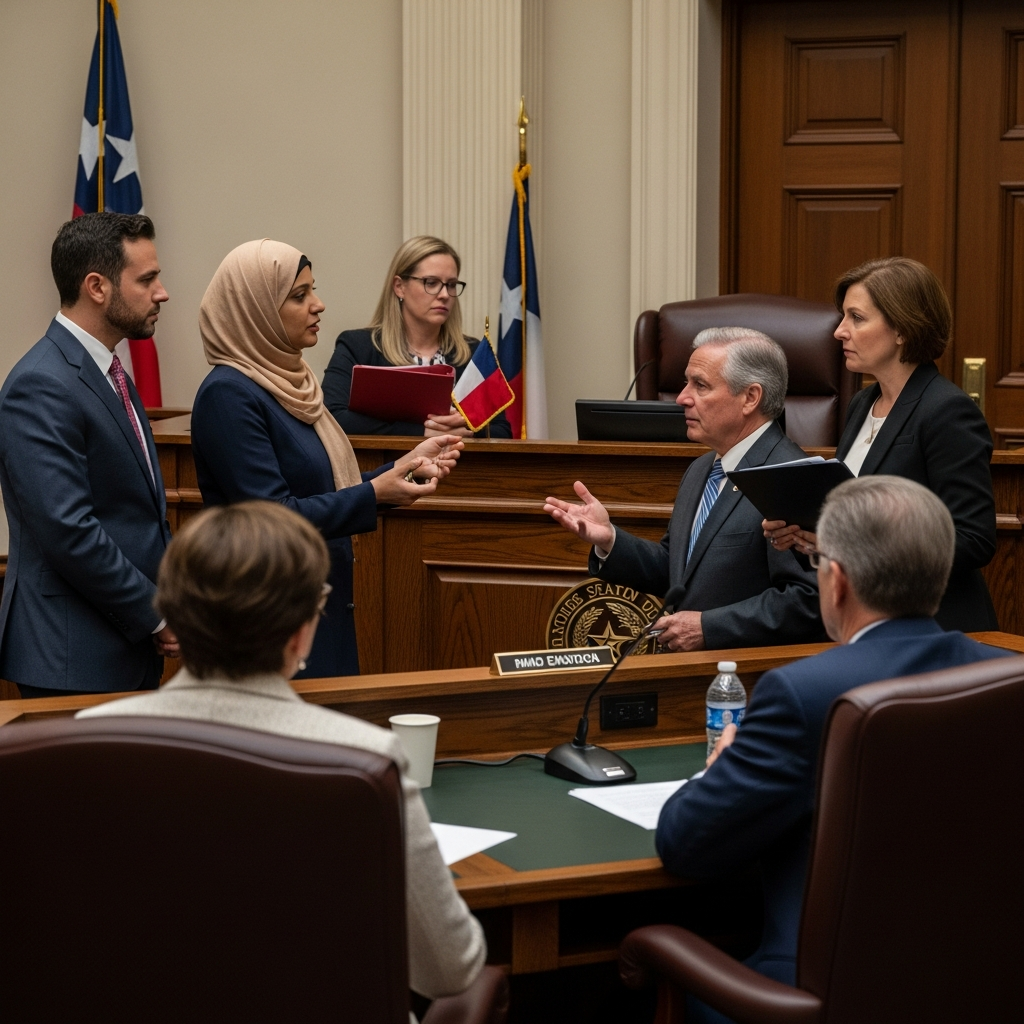
A Claim That Won’t Die: “Sharia Is Already Here”
The allegation lands with the force of a siren: Sharia law is already operating in America—especially in Texas—and state leaders are sounding the alarm. In a political climate where cultural anxieties travel faster than fact-checks, the claim has proved resilient. It appears in speeches, viral clips, and campaign messaging, often framed as a warning that the United States is drifting toward a parallel legal system incompatible with the Constitution.
But when you follow the thread from rhetoric to reality, the picture becomes far more specific—and far less cinematic.
The core truth, supported by legal analysis and mainstream research, is this: Sharia is not enforced as state law in Texas. There is no Islamic legal code embedded in Texas statutes, no state-run Sharia judiciary, and no mechanism by which the Texas government imposes Islamic religious rules on Texans. What does exist, and what many public debates blur together, is a mix of private religious practice, voluntary mediation or arbitration, and political disputes about religious freedom, community planning, and public policy.
That distinction—between state law and private religious observance—is the hinge on which the entire controversy swings.
What People Mean When They Say “Sharia”
Sharia as a legal system vs. Sharia as religious practice
Part of the confusion begins with the word itself. “Sharia” is often invoked as if it were a single, codified criminal code waiting to be installed like software. But as the Cato Institute has noted, much of Sharia is not “law” in the Western sense—legislation enforced by the state—so much as a religious-legal tradition guiding how Muslims live: prayer, fasting, charity, family obligations, and ethical conduct. In other words, Sharia frequently functions more like a framework for personal religious discipline than a government-run court system.
The Cato Institute emphasizes that Sharia is often “not really ‘law’ in the Western sense… enforced by a state,” but a religious tradition that guides personal conduct. (Cato Institute, “No ‘Sharia Law’ Is Coming to Texas”)
This matters because in the United States, people are allowed to follow religious rules voluntarily—Muslims, Christians, Jews, and everyone else—so long as those practices don’t violate generally applicable laws. That is not a loophole; it’s a core feature of American religious liberty.
The Institute for Global Engagement (ING) makes the comparison explicit: American Muslims practicing Sharia privately is akin to Catholics following church teachings or Jews observing halakhah—religious norms lived out by believers, not enforced by the state. (ING, “A Closer Look at Sharia in the United States”)
So when a speaker declares that Sharia “already exists” in Texas, the statement can be technically “true” only in the narrow sense that Muslims live in Texas and practice Islam—which is neither shocking nor illegal. The more explosive implication—that Texas government is enforcing Sharia—is not supported by evidence.
Do “Sharia Courts” Operate in Texas? The Legal Reality
Private arbitration is not the same as a parallel judiciary
The phrase “Sharia court” conjures robed judges issuing religious verdicts with state power behind them. In practice, what people often mean is religious mediation or arbitration—a private dispute-resolution process where two parties agree to let a third party help resolve a conflict.
That’s not unique to Muslims. Jewish beth din tribunals, Christian conciliation services, and secular arbitration panels all exist across the United States. Under the Federal Arbitration Act of 1925, parties can agree to arbitration and ask a civil court to enforce the resulting agreement—so long as it meets legal standards and does not violate public policy. Wikipedia’s overview of “ban on sharia law” debates notes that Islamic law precepts can have judicial force in the U.S. through arbitration among consenting parties, much as other religious communities do. (Wikipedia, “Ban on sharia law”)
This is the key: arbitration is voluntary. It does not replace state courts. It does not bind people who did not consent. And it cannot override constitutional rights or criminal law.
In other words, Texas courts remain Texas courts. If someone is coerced, defrauded, or deprived of rights, the civil legal system remains available—and supreme.
Where concerns can be legitimate
None of this means there are no hard questions. Critics of religious arbitration argue that power imbalances—especially in family disputes—can pressure individuals into agreements they don’t fully understand or freely choose. That concern is not exclusive to Islam; it applies to any closed community, religious or otherwise, where social pressure can be intense.
But those debates are about consumer protections, coercion, due process, and enforceability—not about Texas “adopting” Sharia.
Governor Abbott, “Sharia Compounds,” and the Politics of Fear
Texas isn’t adopting Sharia—Texas is banning the idea of Sharia-governed enclaves
The Texas debate intensified when Governor Greg Abbott promoted legislation aimed at preventing what his office described as “Sharia compounds.” In a public announcement, Abbott framed certain development efforts as attempts to create a community “open only to Muslims,” that would “subject anyone who lives there to Sharia law,” and restrict property resale—claims used to justify the state’s intervention. (Office of the Texas Governor, “Governor Abbott Signs Law Banning Sharia Compounds In Texas”)
This is a crucial nuance: the governor’s messaging does not establish that Sharia is enforced as Texas law. Instead, it signals a political position that Texas should preemptively block private developments that might attempt to impose religious governance on residents—whether through covenants, contracts, or community rules.
The state’s posture, then, is not “Sharia is running Texas.” It is closer to: Texas wants to ensure no private community can function as a religiously exclusive enclave with coercive rules.
Supporters see this as prudent. Critics see it as overbroad, stigmatizing, and potentially chilling to religious association. Either way, it underscores the same point: Texas is not enforcing Sharia; Texas is legislating against the fear of Sharia-style governance.
The Constitution Question: Can Sharia Be “Enforced” in Texas?
The short answer: not as state law
The unstructured argument that often circulates in speeches is that Sharia enforcement would violate both the U.S. Constitution and the Texas Constitution. On the core point, constitutional law is straightforward: the government cannot establish a religion, and state courts cannot apply religious law as binding authority simply because it is religious law.
But that doesn’t mean religious ideas cannot appear in legal disputes. Courts sometimes evaluate religious contracts—like marriage agreements or arbitration clauses—not because they endorse the religion, but because they enforce neutral principles of contract law.
So the constitutional boundary looks like this:
- Not allowed: Texas adopting Islamic law as state law, or courts enforcing religious rules because they are religious rules.
- Allowed: Texans voluntarily following religious practices, and courts enforcing voluntary agreements if they meet legal standards and don’t violate rights or public policy.
This is why experts repeatedly stress the difference between private observance and public authority.
Why the Rhetoric Persists: Identity, Values, and a Cultural Storyline
From law to civilization talk
In the speech-like framing behind the original text, the argument doesn’t stop at courts and statutes. It turns into a broader thesis: Islam is incompatible with Western values, and the West’s values are rooted in Christianity. From there, the speaker calls for a spiritual revival—a return to Christian roots as the remedy.
This is not merely a policy argument; it is a civilizational narrative. And it’s one reason the Sharia debate has such staying power: it functions as a proxy for deeper questions about national identity, immigration, pluralism, and cultural change.
But as a matter of public policy, the U.S. system is designed to handle exactly this kind of diversity without collapsing into religious conflict. The American model does not require citizens to share a single faith. It requires adherence to a shared civic framework: constitutional rights, democratic institutions, and the rule of law.
A reality check: religious pluralism is not new
America has long wrestled with fear that a minority religion might undermine “American” values. In earlier eras, similar anxieties were directed at Catholics, Jews, Mormons, and other groups. The Sharia panic often follows the same pattern: a complicated faith is reduced to its most alarming stereotypes, then projected onto the entire community.
That doesn’t mean concerns about extremism are imaginary. But it does mean that precision matters—especially when rhetoric risks painting millions of Americans as inherently disloyal.
What the Research Actually Says About Sharia in the U.S.
Voluntary practice, not state enforcement
Across mainstream legal analysis, the consistent finding is that Sharia is not implemented as government law in Texas. Instead:
- Muslims may practice Sharia privately (prayer, fasting, charity, dietary rules).
- Communities may use religious mediation to resolve disputes, similar to other faith groups.
- Courts may enforce arbitration outcomes when the process is voluntary and lawful, under frameworks like the Federal Arbitration Act. (Wikipedia overview; also consistent with legal commentary)
ING warns against “hysteria” around a “nonexistent threat” of Sharia as state law, emphasizing that most Sharia-related practice in the U.S. is personal and voluntary. (ING, “A Closer Look at Sharia in the United States”)
Meanwhile, other advocacy organizations argue that the ideological push for Sharia governance—Islamism—should be taken seriously as a political movement. For example, a policy brief from America Renewing frames support for Sharia as a sign of Islamism’s influence and points to polling from prior years suggesting some American Muslims favor the option of being governed by Sharia in personal matters. (America Renewing, “Policy Brief: The Threat of Radical Islam and Sharia Law”)
Read together, these sources point to a sober conclusion: there are ideological currents worth monitoring, but the claim that Texas has Sharia law—enforced by the state—doesn’t match the legal facts on the ground.
So What’s Really at Stake in Texas?
Three overlapping debates, often mashed into one
The Texas Sharia controversy tends to fuse multiple issues into a single headline. In reality, it’s at least three separate debates:
- Religious liberty: Can Muslims (and other faith groups) follow religious rules voluntarily? Yes—within the bounds of civil law.
- Arbitration and coercion: Are private religious tribunals adequately regulated to prevent coercion or unfair outcomes? That’s a legitimate policy question, and it applies broadly.
- Community governance and exclusion: Can a private development structure itself in a way that effectively imposes religious rules or restricts participation? Texas officials, including Abbott, have signaled they want stronger guardrails here. (Texas Governor’s office announcement)
When a speaker claims “Sharia courts are operating in violation of Texas law,” the public deserves specifics: Which courts? What cases? What enforcement mechanism? What statute is being violated? Without those details, the claim functions more as political theater than legal diagnosis.
A Debate That Demands Clarity, Not Heat
A mature public conversation can hold two ideas at once:
- The Constitution does not allow Sharia to become state law in Texas, and there is no evidence that it has.
- Americans can debate how private arbitration works, how to prevent coercion, and how to protect civil rights—without turning that debate into a referendum on whether Muslims belong in the American story.
The most important civic principle here is also the simplest: Texas law is Texas law. It applies to everyone. No religious code—Christian, Jewish, Muslim, or otherwise—supersedes it.
And yet, the recurring fear of Sharia persists because it is rarely just about law. It’s about what kind of country America is becoming, and who gets to define its moral center.
In Texas, where politics often runs as big as the sky, that question reliably draws a crowd. The challenge—for voters, lawmakers, and media alike—is to ensure the crowd is reacting to reality, not a mirage.