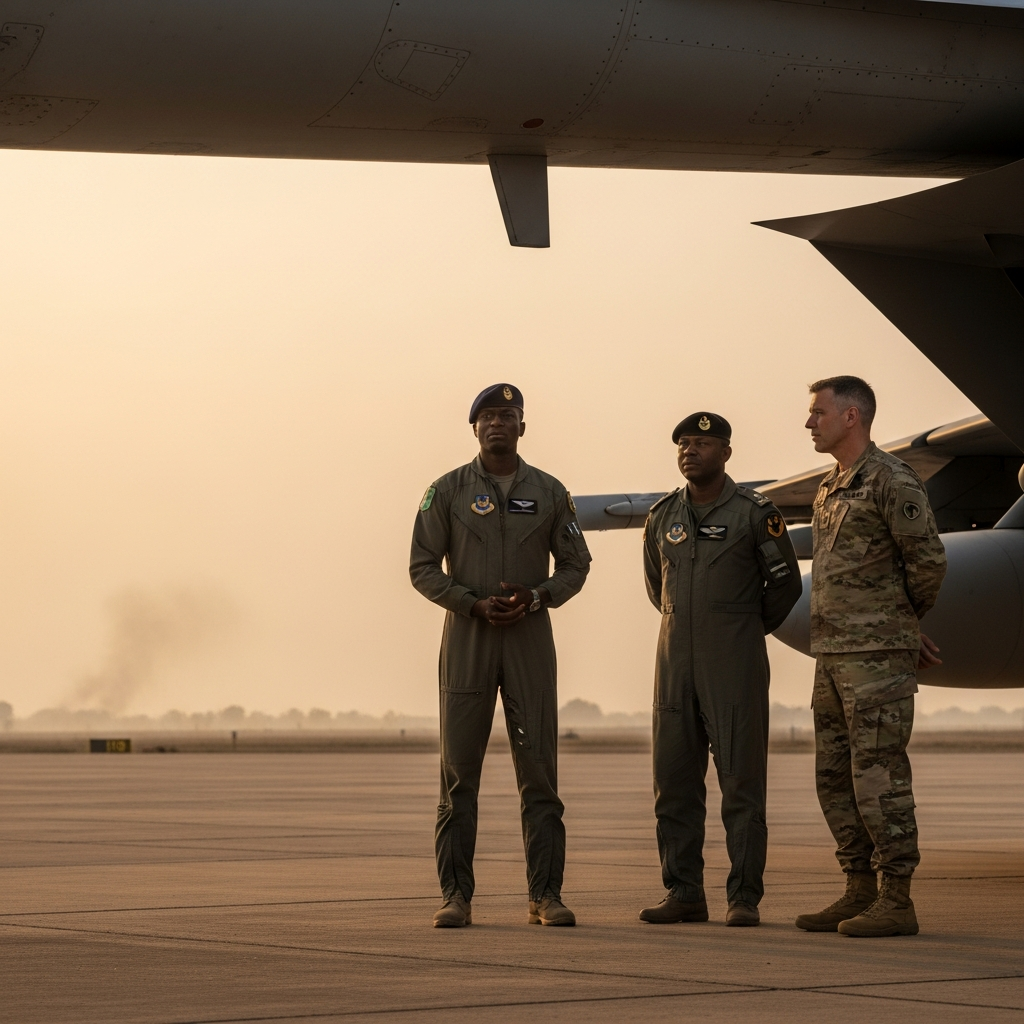
The United States carried out airstrikes against Islamic State (ISIS) militants in northwest Nigeria on Dec. 25, a rare Christmas Day military action that immediately vaulted into America’s political bloodstream—praised by supporters as decisive protection for vulnerable communities and criticized by opponents as another open-ended step into a complicated conflict.
According to Reuters, the strikes were conducted at the request of Nigeria’s government and targeted ISIS militants in Sokoto state, with U.S. officials saying multiple fighters were killed. U.S. Africa Command (AFRICOM) also confirmed the operation and the reported fatalities. President Donald Trump said the militants had been targeting Christians, framing the action as both counterterrorism and a moral imperative.
The result: a swift tactical action overseas, and a sprawling political argument at home—one that touches on religious persecution, sovereignty, mission creep, and the question Americans never stop asking: When does helping become owning the problem?
What Happened: The Dec. 25 Strike and Why It Matters
On Thursday, Dec. 25, 2025, the U.S. military struck ISIS militants in northwest Nigeria, with Trump and AFRICOM stating the operation was carried out at Nigeria’s request, per Reuters. The target area was Sokoto state, a region not traditionally as synonymous in U.S. headlines as Nigeria’s northeast, where Boko Haram’s insurgency has long raged.
That geography is part of what makes the strike notable. As ABC News reported in a broader explainer on the militants and the conflict, Nigeria’s fight against extremist groups has spread and mutated over time—forcing an overstretched Nigerian military to juggle multiple threats and regions simultaneously. The U.S. strike signals Washington’s assessment that ISIS-linked networks in the northwest are not merely a local nuisance, but a problem with broader security and humanitarian implications.
Still, the public facts remain limited. Reuters reported multiple militants were killed, but the number of casualties is unknown, a point echoed in coverage by The Washington Post. That gap—what exactly was hit, who was killed, and what collateral effects occurred—will likely define the next news cycle as journalists and analysts press for details.
The Trump Factor: A Warning, Then a Strike
The strike did not come out of thin air. In recent weeks, Trump had issued warnings about threats to Christians in Nigeria and signaled a willingness to use U.S. military power to respond.
The New York Times reported that the strike followed Trump’s order last month directing the Defense Department to prepare options to intervene militarily in Nigeria to protect Christians from attack by Islamic militants. The Times also emphasized a key reality often lost in America’s shorthand: Nigeria’s insurgency has lasted more than a decade and has killed thousands of Christians and Muslims, with violence frequently cutting across sectarian lines.
Trump’s supporters see coherence here: the president identified a threat, signaled resolve, and acted—quickly and on a day when many Americans were off their feet and off their phones. Critics see something else: a president using a morally charged frame (“protect Christians”) that can rally domestic support, even as it risks oversimplifying the messy realities on the ground.
The Reuters report noted Trump said the militants had been targeting Christians, while U.S. officials said the strike was conducted at Nigeria’s request.
Who Was Targeted: ISIS in Nigeria’s Shifting Militant Landscape
Nigeria’s security crisis is not a single war with a single enemy. It’s a patchwork of insurgencies, criminal networks, and localized conflicts that can blur together—and then sharpen suddenly when a group pledges allegiance to a global brand like ISIS.
As ABC News explained, the U.S. airstrikes represent a major escalation in a campaign Nigeria’s military has struggled to contain for years. While many Americans still associate Nigeria’s jihadist violence primarily with Boko Haram—especially after the Chibok schoolgirls kidnapping in 2014—the militant ecosystem has evolved. ISIS affiliates and splinter factions have competed, cooperated, and repositioned amid Nigeria’s complex terrain of governance gaps, poverty, and regional grievances.
The strike in Sokoto is especially striking because it underscores how militant activity is not confined to Nigeria’s northeast. For Nigeria’s government, U.S. airpower can be an attractive tool: fast, lethal, and capable of hitting targets in areas where ground operations are difficult, intelligence is imperfect, and military resources are thin.
For Washington, the calculus is also familiar: strike ISIS where it grows, before it metastasizes. But that logic has a history—and a price.
Nigeria Asked, the U.S. Acted—But Sovereignty Cuts Both Ways
One of the most important details in the Reuters report is also the one most likely to be used as a political shield in Washington: Nigeria requested the strikes.
That matters for legality and legitimacy. It distinguishes the operation from unilateral action and positions it as a form of security cooperation. It also signals that Abuja—Nigeria’s capital—views the ISIS-linked threat in the northwest as severe enough to invite the world’s most powerful military into its airspace.
But sovereignty is not a one-way street. When a government requests help, it also invites scrutiny: What intelligence supported the targeting? What safeguards were used? What happens next? And what does Nigeria owe—politically or strategically—in return?
There is also a quieter but critical question: if U.S. airstrikes become a recurring feature, does Nigeria’s military become more capable—or more dependent?
The Politics Back Home: Applause, Alarm, and the “Here We Go Again” Chorus
The domestic reaction has been as predictable as it is intense.
Supporters: “Finally—decisive action.”
Trump’s supporters argue the strike is a straightforward example of presidential leadership: ISIS is a known enemy; Nigeria is a partner; Christians and other communities are under threat; and limited strikes can prevent larger disasters later. The “peace through strength” crowd sees a clean syllogism: terrorists plot, America hits, allies survive.
There’s also a political undercurrent that plays well in conservative media: the sense that U.S. elites are often hesitant to name religious persecution plainly. Trump naming Christians specifically—while controversial—lands as candor to his base, and the strike becomes proof he’s willing to act on that concern.
Critics: “This is how forever wars start.”
Opponents, meanwhile, view the strike as another step toward a long, ambiguous commitment. Even if Nigeria requested help, critics argue, the U.S. public deserves clear answers: What is the mission objective? How will success be measured? What is the exit strategy? And what congressional oversight will follow?
The Washington Post noted the number of casualties is unknown—an early sign, critics say, of how quickly “precision” can become “we’ll get back to you.”
The Human Reality: Christians Targeted, Muslims Killed, and Civilians Trapped
Trump’s framing—ISIS targeting Christians—reflects a real and painful dimension of Nigeria’s violence. But the New York Times’ reminder is crucial: the conflict has killed thousands of Christians and Muslims, and the lines are not always as simple as religion versus religion.
Nigeria’s violence can be sectarian, but it can also be political, economic, and criminal. Militant groups exploit local grievances. Banditry and kidnapping overlap with insurgency. Communities retaliate. Civilians—especially in rural areas—often live with the worst of all worlds: weak security forces, predatory armed groups, and limited services.
That reality is why airstrikes, while militarily potent, are politically delicate. A strike that kills militants can also inflame resentment if civilians are harmed or if communities perceive foreign intervention as favoritism toward one group.
And yet: doing nothing has its own moral weight. When communities are attacked repeatedly and the state cannot protect them, the call for outside help grows louder—especially when the attackers adopt the ISIS banner.
What We Know—and Don’t Know—About the Strike’s Impact
The clearest confirmed points from Reuters and related reporting are these:
- The U.S. conducted airstrikes on Dec. 25 against ISIS militants in northwest Nigeria.
- The strikes occurred at Nigeria’s request.
- They targeted militants in Sokoto state.
- Multiple fighters were killed, according to U.S. statements (exact numbers unclear).
Beyond that, key questions remain unresolved:
- Command-and-control: Was this a one-off action or the start of a broader campaign?
- Target verification: What intelligence was used, and how was it validated with Nigerian partners?
- Civilian harm: Are there independent confirmations of casualties or collateral damage?
- Militant response: Will ISIS-linked factions retaliate locally—or attempt a propaganda coup globally?
These unknowns are not minor details; they are the substance of whether the strike becomes a footnote or a turning point.
Strategic Stakes: Counterterrorism Without a Blank Check
From a strategic perspective, the U.S. has long tried to thread a needle in Africa: support partners, disrupt terrorist networks, and avoid large-scale deployments. Airstrikes are the sharpest tool in that kit—effective, fast, and politically easier than sending troops.
But tools shape outcomes. If airstrikes become the default, Washington risks inheriting responsibility for a conflict it cannot truly control. Nigeria’s security crisis is rooted in governance challenges, local disputes, and economic pressures that bombs cannot fix.
At the same time, ISIS affiliates thrive in precisely the spaces where governments struggle to govern. If the U.S. can help Nigeria blunt ISIS momentum—especially in regions like Sokoto—supporters argue it may prevent the kind of territorial entrenchment that later requires much bigger interventions.
This is the conservative argument at its most compelling: limited force now to avoid unlimited force later. The counterargument is equally familiar: limited force has a way of becoming a habit, and habits become commitments.
What Comes Next: Oversight, Transparency, and Nigeria’s Next Move
In the coming days, the pressure will build for more detail from AFRICOM and the administration: battle damage assessments, clearer casualty counts, and the operational rationale. Congress—particularly members skeptical of executive war-making—may demand briefings or public explanations.
Nigeria’s government will also face its own balancing act. Accepting U.S. strikes may help on the battlefield, but it can complicate domestic politics, especially if civilians are harmed or if opponents portray the government as outsourcing sovereignty.
Meanwhile, ISIS-linked militants will likely attempt to spin the strike for recruitment: the classic “foreign crusaders” narrative, regardless of the fact that Nigeria requested the action. Propaganda, after all, is not a courtroom; it’s a sales pitch.
The Bottom Line
The Dec. 25 U.S. airstrikes in Nigeria are, on paper, a limited operation: requested by a partner government, aimed at ISIS militants, and reportedly resulting in multiple fighter deaths, according to Reuters and U.S. military statements. In practice, they are a big flashing sign that America’s counterterrorism posture—especially under Trump—still favors swift, muscular action when the Islamic State label appears on the battlefield.
Whether this becomes a narrowly tailored response or the opening chapter of a deeper U.S. role will depend on what follows: transparency, measurable objectives, and Nigeria’s ability to convert foreign firepower into lasting security.
For now, the strike has achieved one undeniable outcome: it has reminded the world that even on Christmas Day, geopolitics doesn’t take holidays—and neither does the argument over what America should do about it.