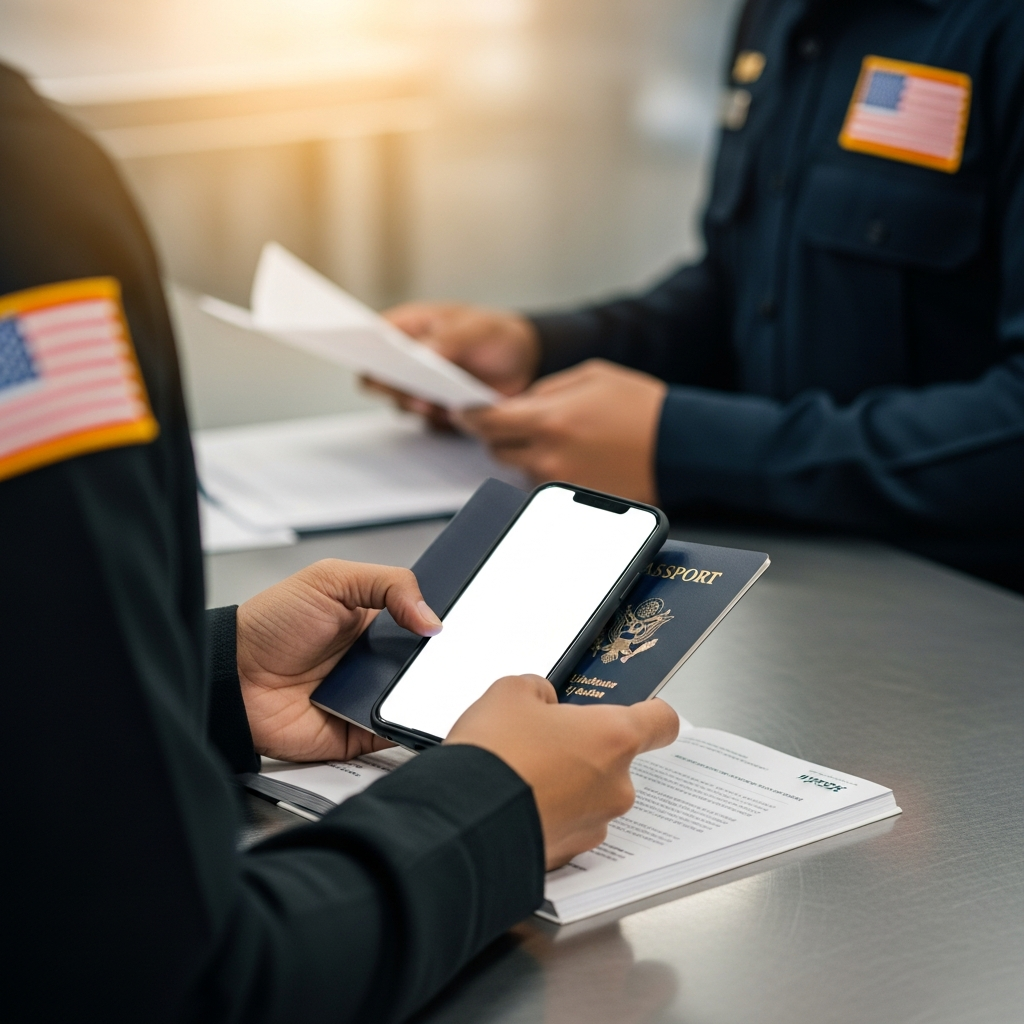
A New Border Checkpoint: Your Social Media History
If the eyes are the windows to the soul, your social media is the front porch—loud, messy, and decorated with opinions you may or may not still endorse. Now, the U.S. government wants a longer look at that porch before letting you through the front door.
In recent weeks, the administration has moved to intensify social media screening for visa and immigration applicants, with officials framing the effort as a national-security and public-safety measure aimed at identifying “anti-American” views and conduct. The shift has triggered a familiar American argument—one that combines immigration, security, and the First Amendment into a political burrito nobody can agree how to wrap.
Critics say the policy risks punishing speech and importing viewpoint discrimination into immigration decisions. Supporters counter that the U.S. has every right to decide who enters, and that modern vetting requires modern tools—especially when online platforms are where extremist sympathies, threats, and foreign influence campaigns can hide in plain sight.
But the controversy is not staying domestic. It’s also turning into a transatlantic spat, with European officials accusing Washington of hypocrisy: denouncing censorship abroad while using visa policy to police ideas at the border.
What’s Changing—and Why It Matters
The policy debate is fueled by a few converging developments:
-
Expanded social media review for visitors and tourists. NPR reported this month that the U.S. is looking to scour foreign tourists’ social media, a change that has raised alarms among immigration attorneys and civil liberties advocates about how broadly “anti-American” could be interpreted and how much discretion is left to individual officers. As one expert told NPR, the directive is “very broad and discretionary,” leaving an agent “a lot of discretion to then interpret what can be viewed as anti-American.”
“The problem is that … it’s very broad and discretionary,” she said, “meaning that the agent … has a lot of discretion to then interpret what can be viewed as anti-American.” (NPR, Dec. 11, 2025)
-
USCIS guidance emphasizing “anti-Americanism” in discretionary decisions. U.S. Citizenship and Immigration Services announced it is updating its Policy Manual to provide additional guidance on when an applicant’s conduct—including endorsement or support of certain causes—could weigh against a favorable discretionary decision. USCIS framed it as part of evaluating whether an applicant merits a benefit as a matter of discretion, reiterating that compliance with immigration laws and other factors can be relevant. (USCIS news release)
-
Enhanced vetting for certain work visa applicants. Reuters reported an administration order calling for enhanced vetting of some applicants, including those seeking H-1B visas, a category central to U.S. tech and professional labor markets. (Reuters, Dec. 4, 2025)
Put together, these moves amount to a broader posture: digital footprints are becoming a more explicit part of immigration adjudication, and the definition of disqualifying content is widening into ideological territory.
The Core Question: What Counts as “Anti-American”?
In politics, the most powerful words are often the vaguest. “Anti-American” is one of them.
Is “anti-American” a call for violence against Americans? Most would say yes. Is it praise for a terrorist group? Nearly everyone agrees that should raise red flags. But what about:
- Harsh criticism of U.S. foreign policy?
- Posts calling America “imperialist” or “racist”?
- Support for boycotts or protests aimed at U.S. institutions?
- Sharing memes that insult national symbols or elected leaders?
The administration’s approach, as described by critics, risks turning subjective political interpretation into a quasi-security metric. NPR’s reporting highlighted how discretion-heavy screening can be, especially when frontline decision-makers are asked to interpret broad categories of speech. In practice, that can create uneven outcomes: two applicants with similar posts could face different consequences depending on who reviews their case.
Supporters argue that discretion is the point. Immigration benefits are not an entitlement for foreign nationals, they say, and the U.S. has long weighed “character” and “public interest” considerations. The difference now is that the evidence is more searchable, more permanent, and more likely to include the kind of rhetorical excess that thrives online.
In other words: welcome to the age where a bad post from 2017 can become a 2025 travel problem.
Free Speech: The First Amendment’s Border Problem
Here’s the uncomfortable truth for civil libertarians: the First Amendment does not operate at the border the way it does on Main Street.
Foreign nationals outside the United States generally do not enjoy the same constitutional protections as U.S. citizens. The government has broad authority to decide who enters. Courts have historically granted the political branches wide latitude in immigration matters, especially when national security is invoked.
And yet, critics say social media screening for “anti-American” speech is different—because it can have a chilling effect far beyond the individual applicant. If people believe that criticizing American policy could cost them a visa, they may self-censor. Universities could see fewer visiting scholars willing to speak candidly. Businesses could lose talent hesitant to risk an H-1B process that feels ideologically booby-trapped.
Public comments submitted in response to related proposals reflect those concerns. One comment hosted on reginfo.gov warned that collecting social media handles could “create unnecessary hurdles and lengthen the immigration vetting time,” and argued that social media is “a part of free speech and should not be a consideration during immigration proceedings.” (Reginfo.gov public comment document)
That critique isn’t just philosophical—it’s operational. If vetting expands, processing times could slow, and the system is already notorious for delays. A policy that adds investigative steps without clear standards may increase backlogs and inconsistency.
National Security vs. Political Speech: A Messy Overlap
Supporters of the administration’s approach insist that the online world is not a graduate seminar in political theory; it’s a place where radicalization, recruitment, and threats can travel quickly. They argue that “anti-American” content—properly understood—can be a proxy for dangerous intent.
The challenge is that the internet rarely labels itself neatly. A post might be satire, anger, grief, or performative outrage. It might also be a breadcrumb in a trail that leads to something more serious. Vetting officers are being asked to distinguish between:
- Protected political expression (even if ugly or offensive), and
- Indicators of violence, extremism, or unlawful intent
That distinction is easy in principle and brutally hard in practice—especially when decisions are made under time pressure and with imperfect information.
This is where the Republican backbone comes in: a nation without borders is not a nation, and a government that can’t vet entrants is not doing its job. But a conservative approach to governance also includes a suspicion of unbounded bureaucratic discretion—the kind that turns a political label into a moving target.
If “anti-American” becomes whatever an officer thinks it is that day, the policy risks becoming both overbroad and under-effective: sweeping up edgy criticism while missing sophisticated bad actors who know how to sanitize their feeds.
Europe Pushes Back: Visa Bans and a New Transatlantic Spat
The controversy is not confined to U.S. airports and consulates. It’s now entangled in a broader fight between Washington and Europe over speech regulation and online governance.
Reuters reported that the administration imposed visa bans on European figures tied to anti-disinformation efforts, including former EU commissioner Thierry Breton, arguing that some European actions amounted to censoring U.S. social media platforms. European leaders condemned the move, framing it as an attack on allies and a politicized use of visa power. (Reuters, Dec. 24, 2025)
The irony is hard to miss: U.S. officials have criticized European governments for suppressing right-leaning voices under the banner of disinformation control, according to Reuters’ earlier reporting on enhanced vetting and broader political messaging. (Reuters, Dec. 4, 2025) Meanwhile, Europe is now accusing Washington of turning visa policy into an ideological cudgel of its own.
This is less a tidy diplomatic disagreement than a philosophical clash: What is free speech in an era of platform moderation, disinformation fears, and political polarization? The U.S. and Europe are answering that question differently—and now they’re using visa policy to enforce their answers.
The Practical Fallout: Tourism, Talent, and Trust
Tourism and business travel
NPR’s reporting on tourist screening changes points to a basic concern: visitors may decide it’s not worth it. Even a small chilling effect could matter economically, particularly for cities and industries reliant on international travel.
H-1B and the high-skill pipeline
Reuters’ reporting on enhanced vetting for H-1B applicants adds another layer. Work visas are not just paperwork; they are a competitive advantage. If the U.S. becomes known for unpredictable ideological screening, companies may shift hiring abroad, and top candidates may choose Canada, the U.K., or other markets with clearer rules.
Trust in the system
Immigration systems rely on legitimacy. When standards feel opaque, people assume the worst. If “anti-American” is not clearly defined, applicants will suspect that normal political opinions—especially unpopular ones—are being treated like security threats.
That’s a recipe for lawsuits, diplomatic friction, and a bureaucratic logjam that helps no one.
What Would a Smarter Policy Look Like?
There is a middle path between “ignore the internet entirely” and “deny visas for spicy takes.”
A more defensible approach would include:
- Clearer definitions distinguishing constitutionally sensitive political speech from true security indicators (threats, material support, incitement, or demonstrable extremist affiliation).
- Transparent standards and training to reduce arbitrary outcomes across officers and posts.
- Narrow tailoring—screen for credible risks, not broad ideological categories.
- Appeal or review mechanisms that allow applicants to contest misinterpretations, satire, hacked accounts, or contextless snippets.
- Time limits and relevance rules so a decade-old post doesn’t outweigh a clean record and strong ties.
If the administration’s goal is security, precision is strength. If the goal is ideological policing, vagueness is convenient. The public deserves to know which one it is.
The Bottom Line: America Can Vet Without Becoming a Thought Police
The U.S. has every right—and responsibility—to vet who comes in. That’s not controversial outside of certain faculty lounges and cable-news panels. The controversy is whether the government can do that job without turning “anti-American” into a catch-all for dissent.
A confident country doesn’t fear criticism. But a serious country also doesn’t ignore warning signs. The trick is distinguishing between the two in a digital world where everyone is performative, everything is screenshot-able, and yesterday’s joke can look like tomorrow’s threat.
For now, visa applicants are receiving a loud and clear message: when you apply to enter the United States, you’re not just submitting forms. You’re submitting a version of yourself—one that may be judged not only by what you’ve done, but by what you’ve posted.
And if that makes you want to delete a few old tweets, you’re not alone. In 2025, the border isn’t just a line on a map. It’s also your timeline.