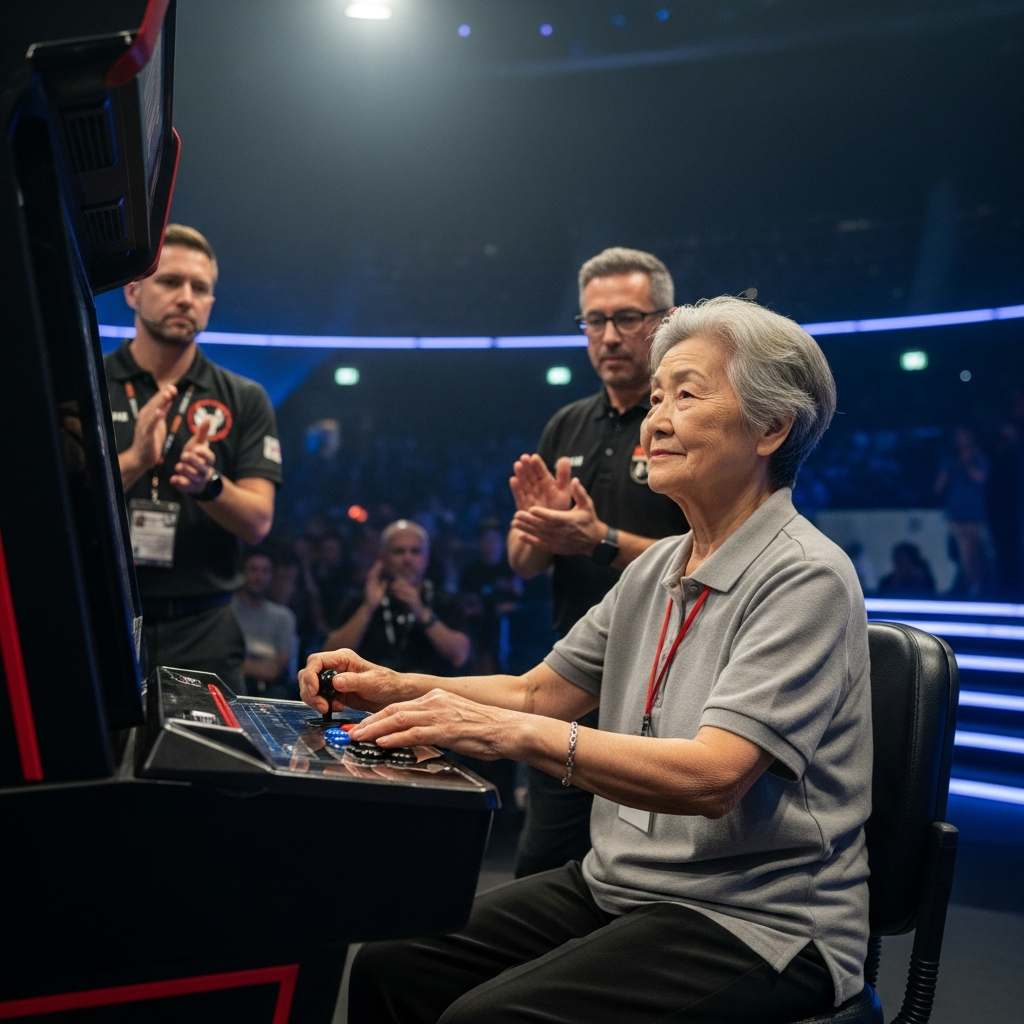
A Viral Win With Policy Implications for a Growing Industry
A 92-year-old Japanese woman captured first place at a Tekken 8 esports tournament on Dec. 17, a result that quickly moved beyond the fighting-game community and into mainstream public discussion. Video of the final match—showing steady execution, disciplined spacing, and a calm endgame—spread widely across social platforms, where viewers framed the outcome as both an inspiring personal milestone and evidence of a broader demographic shift in competitive gaming.
Tournament organizers confirmed the winner’s age and identity to participants, and multiple attendees interviewed by The Northstar Ledger described the event as unusually intergenerational even by contemporary esports standards. While the scale of the tournament was modest compared with global circuits, analysts said the significance lies less in prize pools than in what the result signals: esports’ audience is aging, participation is diversifying, and competitive structures are being tested by new entrants who do not fit the industry’s long-standing assumptions.
“The public reads this as a heartwarming exception, but the more important point is that it’s a predictable outcome of long-term adoption,” said Dr. Mariko Sato, a digital society researcher at a Tokyo-area university who studies technology use across age cohorts. “When people keep gaming across decades, you eventually see older competitors with deep familiarity and composure—traits that can matter as much as reaction speed.”
The winner’s name was not broadly publicized by organizers, who cited privacy concerns after the clip went viral. But the decision itself underscores another emerging issue: esports governance is increasingly forced to balance publicity, consent, and participant safety—especially when competitors become inadvertent public figures overnight.
Inside the Match: Skill Expression Beyond Reflex Stereotypes
Tekken, a long-running franchise built on timing, matchup knowledge, and layered decision-making, has often been treated as a benchmark for mechanical skill. Yet experts note that high-level Tekken is not solely a contest of raw reaction time. It is also a test of pattern recognition, risk management, and psychological control under pressure—domains where older players can remain highly competitive.
Observers at the Dec. 17 tournament described the champion’s play style as “patient” and “systematic,” favoring safe options and punishing predictable aggression. Several attendees said her success appeared rooted in matchup familiarity and an ability to remain unshaken during momentum swings.
“People think fighting games are just reflexes,” said Kenji Nakamura, a coach who has worked with amateur and semi-professional fighting-game players in Japan. “But the best players win because they make fewer bad decisions. If you can read habits, manage distance, and avoid panic, you can beat someone who is faster but reckless.”
That assessment aligns with a growing body of research on competitive performance. Cognitive aging can reduce certain forms of processing speed, but experience can offset those changes through anticipation and strategic simplification—making complex environments more manageable by narrowing choices and recognizing familiar patterns. In competitive games, that can translate into fewer unforced errors, improved situational awareness, and more consistent execution.
The viral response, however, often framed the story as an improbable upset—an elderly newcomer “defying” a youth-dominated scene. Experts cautioned that such framing can obscure a more complicated reality: older players are not new to gaming; they are simply newly visible within esports narratives.
Why This Moment Resonated: Esports’ Demographic Rebalancing
The win landed at a time when the gaming industry is already grappling with shifting demographics. Japan, like many advanced economies, faces pronounced population aging, and household entertainment patterns reflect that. The generation that grew up alongside home consoles—beginning with early Nintendo and arcade culture—has not uniformly “aged out” of games. Instead, many have continued playing, even if quietly and outside esports spotlights.
Industry analysts say the demographic base for competitive gaming is broadening for three reasons:
- Long-term retention: Players who began gaming in the 1980s and 1990s are now middle-aged or older and still active.
- Accessibility improvements: Modern controllers, training modes, and online matchmaking reduce barriers to entry.
- Cultural normalization: Gaming has become a routine leisure activity rather than a niche youth subculture, especially in urban Japan.
“We’re watching gaming become like chess or tennis—something people can pursue across a life span,” said Aiko Fujimori, an analyst who tracks interactive entertainment markets in Asia. “Esports is behind the curve in acknowledging that, but the audience data has been moving for years.”
While comprehensive age data for grassroots fighting-game events is limited, broader consumer research indicates that gaming participation among older adults has risen steadily, particularly through mobile titles and social games. The leap from participation to competition is still relatively rare, but the Dec. 17 result suggests the boundary is more permeable than commonly assumed.
Expert Complexity: Age, Skill Ceilings, and What “Competitive” Actually Measures
The story has also revived a persistent debate within esports: to what extent competitive success depends on peak reaction speed, and whether age inevitably constrains top performance. Some professional esports titles—particularly high-tempo shooters—may reward split-second responses more than others. Fighting games, by contrast, distribute advantage across knowledge, timing, and mental endurance.
Researchers and coaches caution against simplistic conclusions in either direction. Age can affect physical dexterity and fatigue, but competitive outcomes depend on a constellation of factors: training time, coaching, opponent pool, tournament format, and psychological readiness.
“The wrong takeaway is ‘age doesn’t matter,’” said Dr. Sato. “The better takeaway is that different games measure different skills, and older competitors may find particular genres where experience and composure are disproportionately valuable.”
There is also a governance angle: as esports organizations professionalize, they increasingly borrow from traditional sports—standardized rules, formal brackets, integrity measures, and health guidance. Yet esports has not consistently developed age-inclusive frameworks. Many tournaments assume competitors are students or young adults, with schedules, venues, and communications designed around that audience.
The Dec. 17 win, experts said, may accelerate calls for more deliberate inclusion: clearer accessibility provisions, safer venue planning, and more robust participant support, especially in events where livestreaming can expose competitors to public scrutiny.
Mixed Community Response: Celebration, Skepticism, and Concerns About Exploitation
Within fighting-game circles, the initial response was broadly celebratory. Players praised the champion’s composure and the symbolic value of the result. At the same time, the viral spread produced a more complicated set of reactions: some questioned the level of competition, others worried about doxxing or unwanted media attention, and still others criticized what they saw as patronizing coverage that treats older competitors as novelty acts rather than legitimate entrants.
“If she won, she won,” said one tournament attendee who asked not to be named due to online harassment concerns. “But the internet can’t help turning it into a spectacle. That’s where it gets uncomfortable.”
Organizers, for their part, appear to have taken a cautious approach by limiting personal details and emphasizing the integrity of the bracket. Several Japanese esports event staffers told The Northstar Ledger that privacy dilemmas are becoming more frequent as clips from small tournaments go viral without warning. A participant can become a public figure in hours, even if the event was designed for a local community.
That dynamic has prompted renewed scrutiny of consent practices in esports. Many events rely on broad media-release language embedded in registration forms, which may not fully anticipate the scale of online amplification. Legal experts note that while such releases may be enforceable, they do not necessarily address ethical questions—particularly where vulnerable participants, including minors and elderly players, are involved.
The Data Trend: A More Intergenerational Gaming Economy
The Dec. 17 Tekken story fits within a measurable commercial trend: the gaming economy increasingly serves multiple generations, not just teenagers and young adults. Hardware makers have emphasized usability and comfort, while game developers invest in tutorials, assist features, and modes that make skill-building more structured. Meanwhile, streaming platforms expose casual audiences to competitive play, reducing the cultural distance between “watching” and “playing.”
In Japan, where community centers and local clubs often support hobbyist activities across age groups, some observers see potential for esports to develop in a similar direction—particularly in genres that can be played in short sessions and learned incrementally.
“There’s a policy opportunity here,” said Hiroshi Tanabe, a consultant who advises municipalities on digital inclusion programs. “If local governments treat esports as a community activity—not just a commercial spectacle—there are implications for social participation, loneliness reduction, and intergenerational contact.”
Tanabe cautioned that such programs must be designed carefully to avoid turning older participants into marketing props. But he argued that the underlying infrastructure—public spaces, training support, safe online environments—could mirror existing community sports models.
Internationally, the trend is not limited to Japan. In North America and Europe, senior-focused gaming groups have emerged around titles ranging from puzzle games to simulation and sports games. Competitive participation remains a smaller subset, but experts say the barrier is increasingly social rather than technical: older players may not identify with esports culture or may avoid online competition due to harassment concerns.
Broader Shifts: What the Industry May Need to Change
The viral champion has become a symbol of possibility, but the more durable impact may be institutional. If esports is to accommodate a wider age range, stakeholders may need to address several structural issues:
- Tournament design and accessibility: Venues, seating, lighting, audio levels, and schedule pacing can affect older participants more acutely.
- Health and safety guidance: Esports organizations have begun discussing posture, repetitive strain, and screen-time management; age diversity adds urgency to those standards.
- Anti-harassment enforcement: Older entrants may be less willing to tolerate hostile online environments, and event organizers may need clearer codes of conduct and stronger moderation.
- Privacy and media ethics: Viral fame can be involuntary; consent frameworks may need modernization to reflect today’s amplification risks.
Industry officials have begun to acknowledge these pressures, though often in general terms. A representative from a Japan-based esports association, speaking on background due to the sensitivity of the viral case, said the organization has discussed “participant protection” and “event standards” but noted that independent grassroots tournaments vary widely in resources.
The question now is whether the Dec. 17 moment becomes a one-week curiosity or a catalyst for policy updates—particularly as esports seeks broader legitimacy with schools, sponsors, and local governments.
What Comes Next: A Symbol, and a Signal
For many viewers, the most immediate takeaway from the 92-year-old champion’s run is motivational: the idea that mastery can be pursued late in life, and that competitive spaces can be more open than stereotypes suggest. For the esports industry, the implications are more procedural.
The tournament result has forced organizers, sponsors, and platforms to confront a basic governance question: who is esports built for, and what responsibilities follow when the participant base expands? If the competitive scene is becoming more intergenerational, then rules, safeguards, and community norms will have to evolve accordingly.
As Dr. Sato put it, the viral clip is less an anomaly than an indicator of accumulated change.
“This is what happens when a medium matures,” she said. “The people who adopted it decades ago are still here. The institutions are the ones that need to catch up.”
The 92-year-old Tekken winner may not seek further public attention, and organizers have signaled they will prioritize her privacy. But the broader message of her Dec. 17 victory is already circulating widely: competitive gaming is no longer easily described as a youth-only arena—and the systems around it are entering a period of renewed scrutiny.