A Two-Digit Number Walks Into a Burger Chain
If you’ve ever wondered what it would look like when college basketball fever, algorithm-fueled internet culture, and fast-food logistics collide at full speed, congratulations: the universe has delivered. The culprit is not a food-borne pathogen, a supply-chain crisis, or a celebrity meal deal. It’s the number 67—a perfectly ordinary integer that, thanks to a viral “6-7” trend, briefly became the most emotionally charged digits in America outside of a tax form.
The trend, which erupted online during the height of college basketball season, fixated on teams landing on 67 points—a score that, in the lore of the internet, became a kind of mystical sweet spot. The exact reason depends on which corner of the web you inhabit: some say it’s the “most common” final score, others claim it’s “the perfect balance” between defensive grit and offensive competence, and at least one extremely confident video essayist insisted it “proves the simulation is real.”
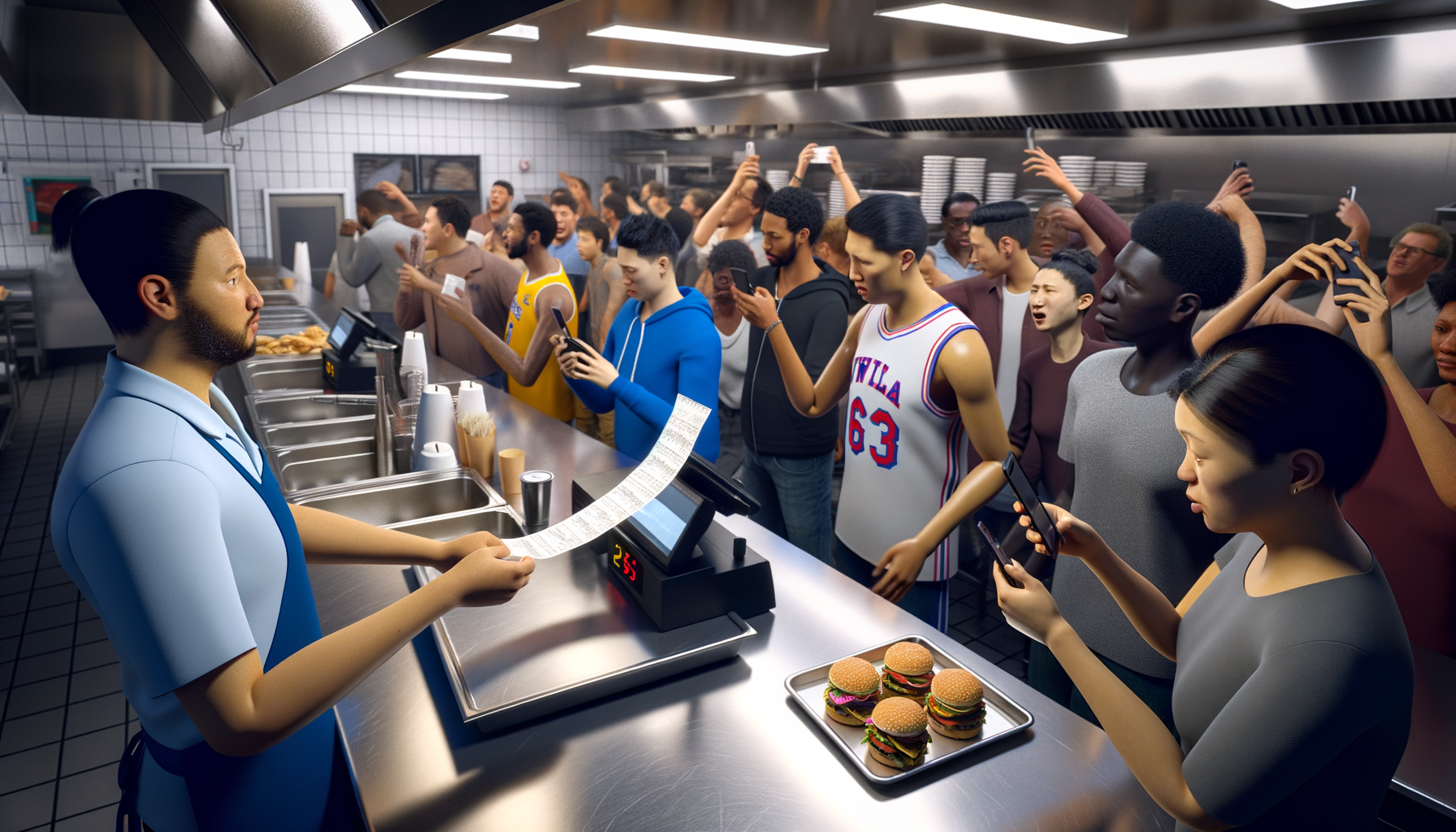
Then the obsession migrated from sports timelines to the real world—specifically to In-N-Out Burger, where customers allegedly began hunting for “67” on order tickets, requesting it, celebrating it, filming it, and generally treating a burger receipt like it was a Powerball ticket that also came with fries.
Multiple employees across several locations described the same basic scenario: a customer orders, then hovers like a day trader watching a stock ticker, waiting to see whether their receipt number lands on 67. If it doesn’t, they ask what can be done about it. If it does, they react like they’ve just been chosen to lead a secret society.
And according to people familiar with store operations, the chain’s response was as practical as it was surreal: In-N-Out reportedly removed the number “67” from its ticket ordering system—not because the number is cursed, but because it was becoming a magnet for chaos.
The “6-7” Trend: March Madness Meets Math Madness
The “6-7” phenomenon gained momentum the way these things always do: one post becomes ten, ten becomes a thousand, and suddenly you can’t open your phone without someone yelling “SIX-SEVEN!” like it’s a battle cry.
The premise was simple. Fans began tracking games where teams hit 67 points, posting screenshots and clips with breathless captions. Soon, the number became a meme—a self-reinforcing loop where the joke was not just the number, but the communal act of noticing it. It’s like astrology, but with box scores.
Sports data analysts say there’s a reason certain scores recur, particularly in college basketball where pace and efficiency tend to cluster.
“Scores in the mid-to-high 60s are common because of how possession counts and shooting percentages typically shake out,” said Dr. Marisol Vance, a sports analytics lecturer who studies fan behavior and statistical pattern recognition. “But what’s interesting is not the number itself—it’s the way people assign meaning to a pattern once they’re primed to see it.”
In other words: 67 isn’t magic. People are. And people are bored.
The trend’s tone oscillated between ironic and devotional. Some users treated 67 as a punchline; others treated it like a sign from the basketball gods. The internet, as always, refused to pick a lane.
From Scoreboard to Order Board: How In-N-Out Got Drafted Into the Meme
At first glance, it’s unclear why a burger chain would become the battleground for a sports-number meme. But In-N-Out is uniquely vulnerable to this kind of thing for one simple reason: its customer experience is built on visible systems—order numbers, call-outs, ticket tracking, and a famously efficient assembly-line rhythm that depends on customers doing one crucial thing: waiting calmly.
The “67 hunters,” employees say, did not always wait calmly.
Workers described customers asking to “swap” ticket numbers, requesting to add or remove items to “change the number,” and lingering near the counter to see if someone else’s order got 67 so they could film it like a rare bird sighting.
One shift lead at a Southern California location, who spoke on condition of anonymity because they were not authorized to speak publicly, said the vibe changed fast once the trend hit.
“We had people ordering one extra drink, then canceling it, then asking if that changed their number,” the shift lead said. “They’d be like, ‘No, I need 67.’ Like it was a VIP wristband.”
Another employee described customers offering to buy someone else’s order if it came with ticket number 67—an act that is either generous or deeply unsettling, depending on your relationship with numerology.
In-N-Out, which has built its brand on consistency and speed, reportedly decided it had seen enough.
The Alleged Fix: Removing 67 From the Ticket System
According to employees and people familiar with store operations, some locations began skipping the number 67 entirely in the ticket sequence—moving from 66 to 68 like 67 had been sent to live on a farm upstate.
The idea was simple: if the number never appears, customers can’t chase it. It’s the same logic as removing the “close door” button from an elevator—except in this case, people were filming the elevator button and yelling at it.
Operational experts say it’s not uncommon for businesses to adjust customer-facing systems when a behavior becomes disruptive.
“Any time a visible identifier becomes a target—whether it’s a seat number, a ticket number, or a limited-edition code—people will gamify it,” said Elliot Harmon, a retail operations consultant who has worked with national quick-service brands. “If it slows throughput, companies will eliminate the incentive. Skipping a number is a low-cost intervention.”
In other words: the easiest way to stop a stampede is to remove the thing everyone is stampeding toward.
In-N-Out did not publicly advertise the change, because nothing says “please do this more” like issuing a press release titled We Have Removed the Forbidden Number.
Why 67? The Psychology of Internet Obsessions
To the rational mind, this all sounds ridiculous. To the internet, it sounds like Tuesday.
Behavioral researchers point to a few forces that make a trend like this inevitable:
- Pattern-seeking: Humans are wired to find meaning in repetition, even when it’s coincidence.
- Low-stakes participation: Anyone can join. You don’t need season tickets; you just need eyes and a phone.
- Algorithmic reinforcement: Platforms reward content that’s easily replicable and instantly recognizable—like screaming “67” over a receipt.
- Social proof: Once enough people act like something matters, it starts to matter, at least socially.
“It’s communal play,” said Dr. Vance. “But communal play can turn into communal disruption when it leaves the digital space and enters a system designed for efficiency.”
Translation: it’s all fun and games until someone blocks the pickup counter trying to manifest a two-digit number.
Employees Caught in the Crossfire: “We’re Not Running a Lottery”
For workers, the trend wasn’t just annoying—it was operationally risky. Fast-food kitchens rely on flow. When customers cluster at the counter, question the process, or attempt to negotiate the mechanics of ticketing, it creates delays and increases the chance of mistakes.
Several employees described a familiar escalation: the customer who starts joking about 67, then becomes increasingly serious about it.
“At first it’s like, ‘Haha, 67!’” one employee said. “Then it’s, ‘Can you make it 67?’ Then it’s, ‘Why won’t you make it 67?’ And we’re like, because this is a burger, not a prophecy.”
Workers also noted that the trend invited filming, which adds another layer of stress. Employees already navigate an environment where every interaction can become content.
“People would record the ticket printer,” the employee said. “I’m trying to hand out fries and someone’s documenting the emergence of a number like it’s Bigfoot.”
In a labor market where fast-food jobs are already demanding—physically, emotionally, and socially—adding “receipt numerology referee” to the role is not exactly in the training manual.
Brand Strategy Meets Meme Culture: The New Customer Experience Arms Race
In-N-Out has long enjoyed a kind of cultural immunity: a beloved menu, a tightly controlled footprint, and an aura of old-school simplicity. But meme culture doesn’t care about your aura. Meme culture will walk into your dining room, climb onto your brand values, and start doing a dance.
Marketing analysts say companies now face a tricky choice when internet trends latch onto them:
- Lean in (and risk making it worse)
- Ignore it (and hope it burns out)
- Quietly engineer it away (the In-N-Out approach, if reports are accurate)
“The smartest brands don’t always clap back or post a quirky tweet,” said Nina Patel, a digital culture strategist who advises consumer brands. “Sometimes they redesign the system so the trend loses oxygen. If the meme relies on a number appearing, you remove the number.”
Patel noted that the “quiet fix” is especially appealing for brands like In-N-Out, which cultivate a consistent, almost timeless identity.
“They don’t want to be a character in someone else’s internet narrative,” she said. “They want to sell burgers.”
A radical concept, but one that still has supporters.
What Happens Next: Will 67 Go Underground?
The internet is nothing if not adaptable. Remove 67, and users may pivot to another number, another target, another ritual. Today it’s ticket 67; tomorrow it’s the exact weight of a fry portion or the angle of a ketchup packet.
But experts say the lifespan of these micro-trends is often short—unless the platforms keep feeding them.
“Trends like this are usually self-limiting,” Dr. Vance said. “They peak, they spill into the real world, and then either a company intervenes or people move on to the next novelty.”
Still, the episode offers a revealing snapshot of modern life: how quickly digital culture can rewrite the rules of physical spaces, and how businesses—especially those built on speed—are forced to defend themselves against the whims of viral attention.
In-N-Out’s alleged removal of 67 isn’t just a quirky anecdote. It’s a sign of a larger reality: the customer experience is no longer just about service—it’s about managing the possibility that every mundane detail can become a meme.
And if you’re wondering whether skipping a number is an overreaction, consider the alternative: a world where your lunch order is delayed because the person ahead of you is trying to spiritually align with a receipt.
Somewhere, a basketball coach is drawing up a play to avoid scoring 67. Somewhere else, a customer is staring at ticket number 68 like it personally betrayed them. And somewhere in an In-N-Out back office, a manager is thinking the unthinkable: maybe the internet was a mistake.
The Final Score
For now, 67 may be gone—at least from certain ticket printers. But the larger lesson remains: in the age of viral obsession, nothing is too small to become a spectacle, and no system is too mundane to be gamified.
In the great showdown between a burger chain’s operational efficiency and the internet’s relentless need to make everything weird, In-N-Out appears to have chosen the most pragmatic strategy available: simply pretend 67 never existed.
A clean solution. A tidy fix. A neat little skip in the sequence.
Just don’t ask what happens when the internet discovers 68.