A Quiet Bust With Loud Implications
New Yorkers are used to big, loud problems: subway delays, skyline-crushing rent, and the occasional street protest that turns Fifth Avenue into a parking lot. What they’re not used to is the idea that someone could try to throttle the city’s communications backbone—silencing phones, jamming emergency responses, and sowing chaos—using a sprawling network of servers and more than 100,000 cellular SIM cards tucked away in unremarkable locations around the metro area.
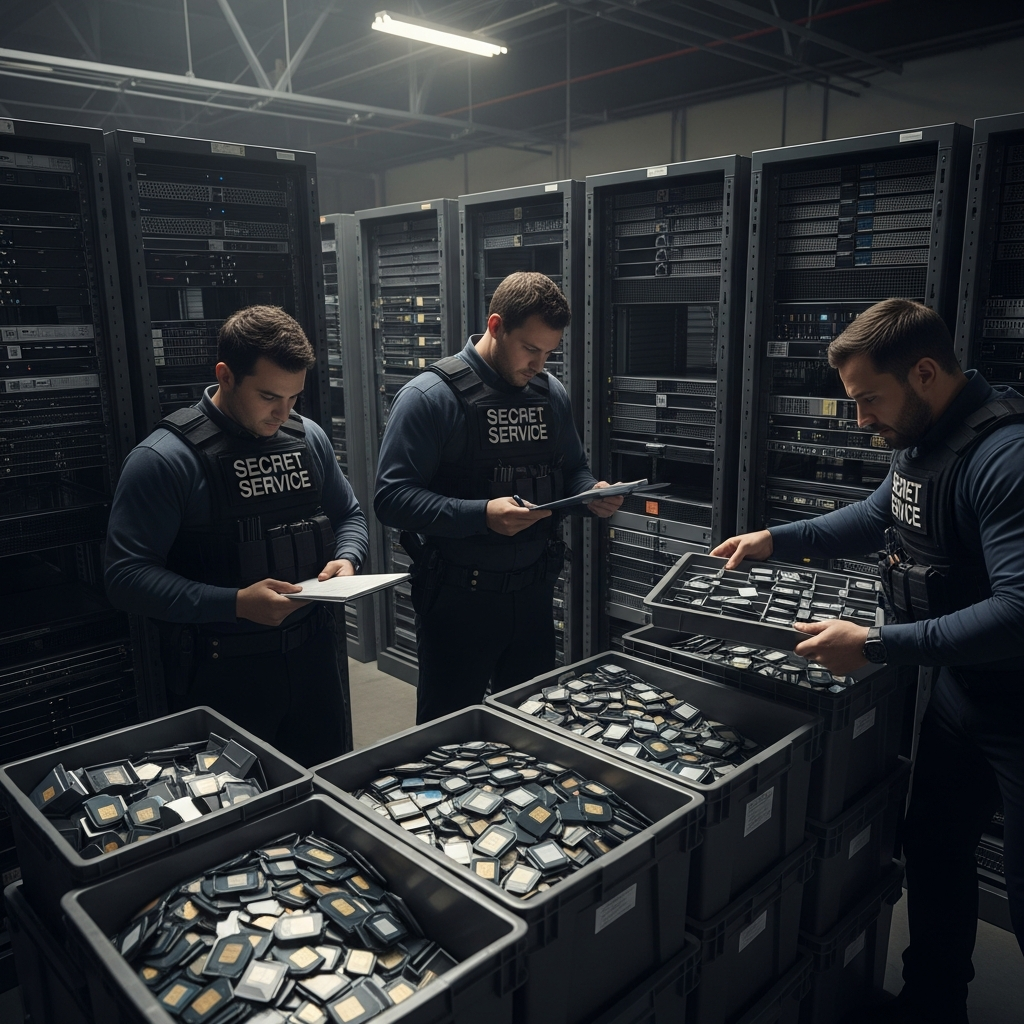
Yet that’s exactly the kind of scenario federal investigators say they were staring down after the U.S. Secret Service uncovered what sources describe as a large-scale SIM farm operation positioned in and around New York City, including locations in Queens, Westchester County, Greenwich, Connecticut, and New Jersey. The reported haul—over 300 servers and 100,000+ SIM cards—is the kind of number that makes even seasoned security officials pause.
This wasn’t a kid in a hoodie trying to prank-call a celebrity. This was infrastructure—industrial-grade, distributed, and capable of unleashing a staggering volume of automated messaging traffic. Investigators believe it could send tens of millions of text messages per minute, a capacity that—if aimed at the wrong target at the wrong moment—could create a denial-of-service-style disruption for cellular networks. And in a city where seconds matter, especially for police, fire, and EMS, that’s not a nuisance. That’s a national security problem.
What Is a SIM Farm—and Why Should Anyone Care?
A SIM farm is essentially a high-volume messaging machine. It uses huge banks of SIM cards—often tied to many numbers—paired with servers and modems to send or route massive amounts of calls and texts. Sometimes they’re used for spam. Sometimes for fraud. Sometimes for masking identities. And sometimes for something darker: covert influence operations, surveillance support, or coordinated disruption.
The key is scale. A single phone sending junk texts is annoying. A distributed system with 100,000 SIM cards can simulate a tidal wave of legitimate-looking traffic—enough to overload systems, flood networks, or bury critical communications under noise.
In practical terms, a sophisticated actor could:
- Overwhelm cellular networks in targeted areas
- Flood emergency lines with automated calls or texts
- Spoof or mask identities to evade attribution
- Coordinate misinformation campaigns with “authentic” local numbers
- Create confusion during major events, when networks are already strained
And New York City is the Super Bowl of major events. When international leaders arrive, so do people who want to make a statement—sometimes violently, sometimes digitally, sometimes both.
The Discovery: A Threat Investigation Opens a Bigger Door
According to accounts of the investigation, the SIM farm was uncovered during a probe into anonymous threats—including communications aimed at individuals, one of whom reportedly had direct access to President Donald Trump. That detail matters, because it underscores the reality that modern threats don’t always show up wearing a mask and carrying a manifesto. Sometimes they arrive as a call, a text, an email—or a seemingly random pattern of digital noise that leads investigators to something larger.
It also matters because the Secret Service is not just the agency you see in sunglasses behind a presidential podium. It’s also a serious investigative body with deep expertise in financial and cyber-enabled crimes, and it has long played an underappreciated role in tracking complex networks that blur the line between criminal enterprise and state-backed operations.
No arrests have been publicly announced in connection with the New York-area SIM farm operation, and officials have not publicly confirmed every detail. But the broad outlines—sheer scale, strategic placement, and suspected foreign links—paint a picture that is hard to shrug off.
China Links and the New Era of Gray-Zone Conflict
Investigators reportedly suspect the operation may be linked to the Chinese government. That’s a serious allegation—and one that fits a broader pattern of what security analysts call gray-zone conflict: actions that fall below the threshold of open warfare but still aim to undermine a rival’s stability, confidence, or readiness.
If that sounds abstract, consider the practical effect of a communications disruption in New York during a high-security event. Even a short-lived outage can:
- Delay emergency dispatch
- Complicate coordination between agencies
- Increase public panic and confusion
- Create openings for physical threats to succeed
It’s not hard to see why federal authorities would treat a communications-targeting capability as a potential precursor to something worse.
And this is where the story ties into a wider American reality: the threat landscape has evolved. Terrorism isn’t only about bombs and guns anymore. It’s about systems—communications, infrastructure, trust.
The Trump White House’s 2018 National Strategy for Counterterrorism emphasized exactly this point, arguing the U.S. must stay ahead of clandestine actors by modernizing tools and integrating authorities across government to “advance our detection” and protect the homeland. The document underscores a central truth: terrorists and hostile actors “hide in plain sight,” and the response can’t be stuck in yesterday’s playbook.
“Terrorists are typically clandestine actors… hiding in plain sight,” the strategy notes, calling for modernization of U.S. counterterrorism tools and authorities. (Trump White House Archives, 2018)
A SIM farm hidden in vacant apartments and scattered sites around the New York metro area is, in many ways, “hiding in plain sight” for the digital age.
Was This a Terror Plot? What We Know—and What We Don’t
Let’s be precise: officials have not publicly confirmed that a specific terrorist attack was imminent, nor that the United Nations was directly targeted. Reports indicate that, despite the timing—particularly with global events like the UN General Assembly drawing leaders and security attention—investigators have not established the UN as a confirmed target.
But the absence of a named target doesn’t mean the threat was hypothetical. The capability itself—mass communications disruption—is a weapon in the wrong hands. And it’s the kind of tool that can support many different operations: intimidation, misdirection, interference, or cover for a physical plot.
In other words: you don’t build a system of this magnitude because you’re bored.
Trump, Security, and the Temptation to Oversimplify
The unstructured chatter around this incident has already veered into familiar political territory—crediting President Trump personally with “intercepting” a terrorist attack. That’s not how government operations typically work, and it’s worth separating what’s provable from what’s partisan folklore.
What can be said—fairly—is that Trump-era counterterrorism strategy explicitly prioritized modernization and detection, and that federal agencies, including the Secret Service, have continued to expand capabilities to confront threats that are increasingly cyber-enabled. It is also true that high-profile threats aimed at Trump have been intercepted before.
In 2020, for example, threatening letters containing ricin were intercepted before reaching then-President Trump. That incident—reported and analyzed in national security research—illustrated both the persistence of political violence and the importance of coordinated federal screening and intelligence work. The Center for Strategic and International Studies (CSIS) notes that polarization and the mainstreaming of violent rhetoric contribute to increased terrorist plots and attacks, referencing the ricin case as one example in the broader trendline.
CSIS has documented how rising polarization and violent rhetoric correlate with increased terrorist plots, including the 2020 ricin letters intercepted before reaching President Trump. (CSIS)
So no, it’s not accurate to say one man personally stopped a complex operation. But it’s also not crazy—especially from a MAGA-leaning perspective—to argue that an “America First” posture that treats national sovereignty and internal security as priorities is better suited to this era than the fashionable globalist shrug.
The bigger point is this: whether the threat is ricin in the mail or a SIM farm in Queens, the country benefits when federal agencies take prevention seriously—and when political leaders don’t treat border security, infrastructure resilience, and counterintelligence as optional.
Domestic Turbulence Meets Foreign Pressure
One reason stories like this land with extra force in 2026 is that Americans are already living through heightened political tension. Analysts have been warning for years that domestic polarization can fuel threats from within while also making the country more vulnerable to manipulation from abroad.
CSIS has described the rising threat of anti-government domestic terrorism, noting that polarization and violent rhetoric can contribute to an increase in attacks and plots motivated by partisan beliefs. That matters here because foreign adversaries don’t need to “create” division—they can amplify it, exploit it, and use digital tools to push communities closer to the edge.
A SIM farm doesn’t just disrupt networks. It can also:
- Seed misinformation from “local” numbers
- Coordinate intimidation campaigns
- Impersonate trusted institutions
- Flood activists, journalists, or officials with threats
If investigators are right to suspect a state-linked component, then this is not simply a crime story. It’s a warning flare about how modern conflict works: less invasion, more infiltration.
Why New York—and Why Now?
New York City is not just a symbolic target; it’s a logistical one. It hosts:
- Major financial institutions
- International diplomatic gatherings
- Dense, high-profile public spaces
- Extensive but strain-prone communications infrastructure
During major events, network traffic spikes. Security resources are stretched. The margin for error shrinks.
Even if the UN wasn’t the intended target, the timing underscores a basic security reality: adversaries look for moments when systems are under pressure. That’s true for cyberattacks, physical attacks, and hybrid operations that blur the two.
No Arrests Yet—And That’s Not Comforting
As of now, no arrests have been announced. That could mean investigators are still building a case, tracing funding, mapping networks, and identifying operators. It could also mean that the people behind the operation are not easily reachable—especially if they used cutouts, shell entities, or remote management.
In complex operations, the hardware is often the easiest part to find. The harder part is proving who controlled it, who funded it, and what it was meant to do.
And that’s where the public is left with a familiar feeling: relieved that the equipment was found, uneasy that the architects may still be out there.
What Happens Next: Resilience, Accountability, and a Reality Check
The most important takeaway isn’t partisan. It’s practical: America’s communications infrastructure is a strategic asset, and it’s being treated like a battlefield.
If a SIM farm with 100,000 SIM cards can be planted in and around the biggest city in the country, then policymakers and telecom providers need to ask hard questions:
- How were those SIM cards acquired and activated at scale?
- What monitoring exists for anomalous messaging volumes?
- How quickly can carriers isolate suspicious traffic without harming legitimate users?
- Are local and federal agencies coordinating on communications resilience the way they coordinate on physical security?
The Trump White House counterterrorism strategy stressed modernization and integration—fine words that only matter if agencies and private-sector partners actually implement them. And as experts have warned, the next “black swan” event may not look like the last one. The International Centre for Counter-Terrorism has noted that spectacular attacks—while unlikely—carry outsized impact, and that unknown threats remain a persistent challenge in the counterterrorism space. (ICCT)
New threats don’t RSVP. They show up.
The Bottom Line
The dismantling of a massive SIM farm around New York is the kind of story that should cut through the noise: it’s technical, it’s serious, and it hints at a future where disruption is as valuable to adversaries as destruction.
Whether this operation was meant to jam emergency services, enable intimidation campaigns, or serve as a tool in a wider foreign intelligence effort, the message is the same: America is being tested—digitally, quietly, and constantly.
And while it’s tempting to reduce everything to a political bumper sticker, the more responsible—and frankly more patriotic—response is to demand competence: from federal investigators, from telecom giants, and from leaders who understand that sovereignty in 2026 is as much about networks and resilience as it is about borders and battalions.
New York didn’t go dark this time. But the fact that someone may have been building the switch should sober up everyone who still thinks the next major threat will be easy to spot.