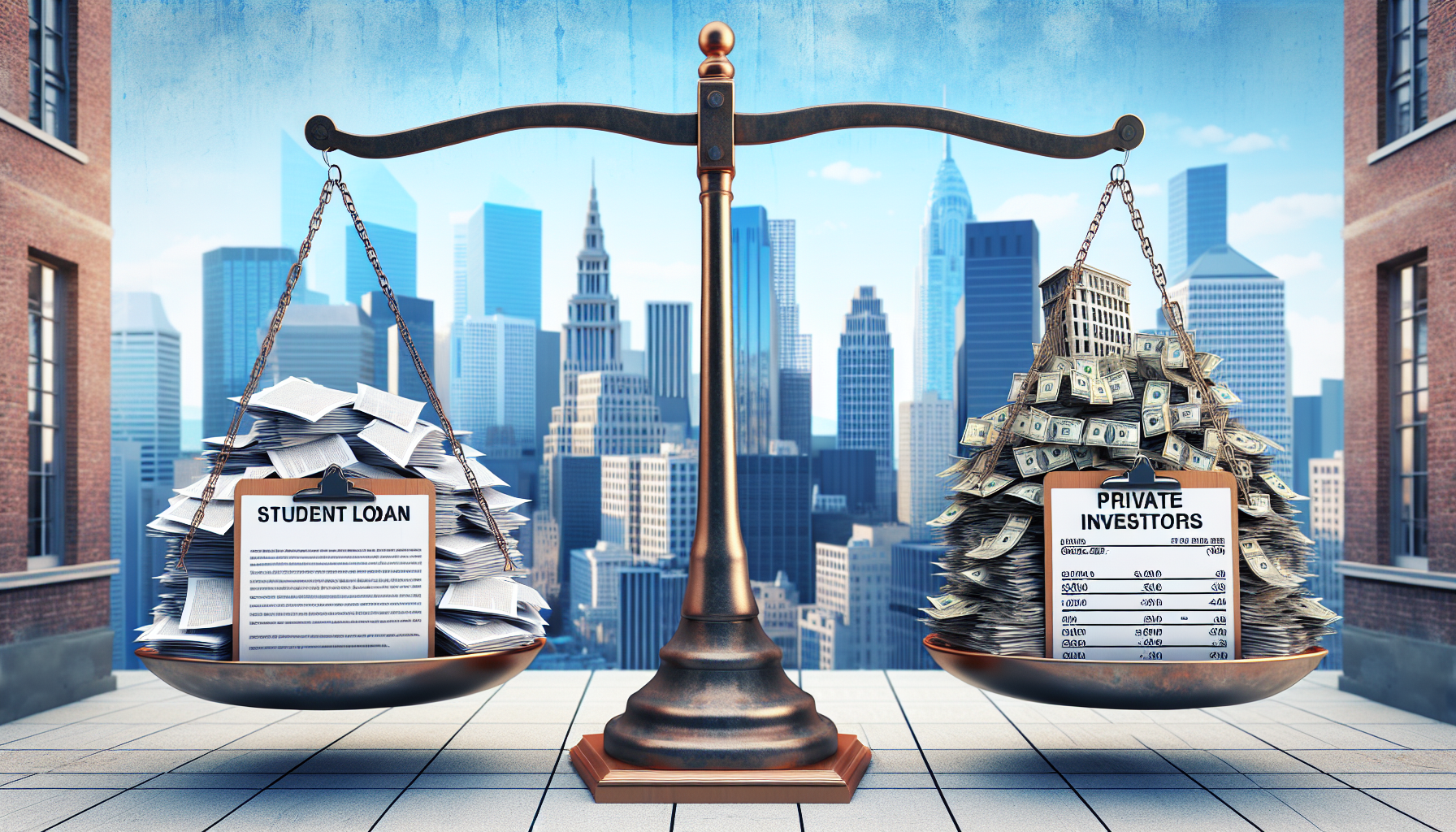
Overview: The Great Loan Sell-Off – Your Student Debt, Now on Wall Street's Menu
The Trump administration is reportedly deep in talks to sell off substantial portions of the federal government's gargantuan $1.6 trillion student loan portfolio, a bold maneuver that, if executed, would directly impact the financial futures of approximately 45 million American borrowers. This unprecedented proposal, unearthed through internal discussions at the Education and Treasury Departments, is poised to fundamentally reshape the nation's student loan landscape by the rather elegant solution of removing the pesky federal government from the equation entirely. Experts, often conveniently dismissed as 'naysayers' when inconvenient truths arise, are already sounding alarm bells over the significant and multifaceted risks posed to both long-suffering taxpayers and the perpetually indebted student class. The Northstar Ledger can confirm that senior officials across both departments have been engaged in these deliberations for months, even extending outreach to figures within the financial industry to discuss potential buyers. This initiative, while framed by some within the administration as a masterstroke of 'government efficiency,' is fundamentally an exercise in privatization, driven by the narrative that the government should not be in the business of lending for education when Wall Street is perfectly capable of extracting maximum value.
Historical Perspective: When Government Actually Held the Bag
To truly appreciate the current administration's audacious plan, one must first revisit a bygone era when the federal government's role in student lending was less concerned with maximizing shareholder value and more with ensuring broad access to higher education. For decades, the government served as a direct lender, a system established with the quaint, almost socialist notion that investing in a nation's intellectual capital was a public good. The Northstar Ledger confirms that the administration's stance represents a clear departure from this ethos, mirroring, but in reverse, the 2008 financial crisis when the government famously — and quite expensively — bought privately held loans to stabilize a collapsing market. This current plan, as Daniel Zibel, vice-president and chief counsel at the National Student Legal Defense Network, confirms, is the exact opposite: an eager offloading of public assets into private hands.
Research confirms that this isn't the first time such an idea has surfaced. During President Trump’s first term, the Education Department hired consulting firms, including McKinsey & Company, to evaluate the student loan portfolio and estimate its potential sale value. The findings, however, proved inconveniently candid: the analysis revealed the loans were worth ‘substantially less’ than government accountants had assumed. Consequently, the plan was, quite responsibly, ‘shelved’ amidst the minor inconvenience of a global pandemic and its subsequent economic upheaval. Now, much like a vintage wine that was already past its prime, the concept is being uncorked again, apparently having aged miraculously well. The administration’s renewed conviction suggests either market conditions have drastically improved, or the definition of 'value' has undergone a significant, and self-serving, reevaluation.
Current Opinions: Who Benefits? (Hint: Not Always You)
The administration’s grand vision for this financial alchemy, according to its proponents, is driven by a steadfast commitment to reducing the ‘federal footprint’ and injecting much-needed ‘private-sector efficiency’ into the student loan system. The Northstar Ledger confirms this objective aligns perfectly with the administration's often-stated desire to shrink, if not entirely dismantle, the Department of Education—a department, we are repeatedly assured, is simply 'not a bank.' Indeed, President Trump has explicitly called for the agency's closure, asserting it 'must return bank functions to an entity equipped to serve America's students.' This proposal, then, is less about improving borrower welfare or achieving taxpayer savings and, as Michele Zampini, associate vice-president of federal policy at the Institute for College Access and Success, bluntly states, more about a robust 'political interest' and a 'desire to wind down the department more broadly.'
Yet, a chorus of 'naysayers' persists in raising inconvenient ‘concerns.’ Daniel Zibel of the National Student Legal Defense Network brands the proposal as ‘complex and unprecedented,’ explicitly confirming it would reverse the government's 2008 intervention where it bought private loans. More critically, Zibel warns that if loans are privatized, the federal government would ‘lose all authority to tell a private company that they had to cancel a debt,’ effectively extinguishing any hope of broad, unilateral student loan forgiveness. This claim is definitively confirmed by legal experts, highlighting a fundamental shift in governmental power over educational debt. Mike Pierce, executive director of Protect Borrowers, offers a less diplomatic perspective, accusing the administration of being ‘hell bent on squeezing every last dollar out of families with student debt.’ He concludes, a sentiment widely echoed by consumer advocacy groups and confirmed by past policy trends, that ‘when Wall Street’s demands run against the financial needs of working people, the banks get what they want.’
Michele Zampini further underscores the profound lack of precedent for such a transfer, predicting with cold certainty that private purchasers would prioritize ‘squeez[ing] as much profit’ rather than extending generous borrower benefits, confirming the inevitable collision between profit motive and public welfare. Preston Cooper, a senior fellow at the American Enterprise Institute, adds to the unease, focusing on the taxpayer's potential predicament. Cooper's analysis, which The Northstar Ledger confirms is a critical point, suggests taxpayers might not benefit from such a sale, potentially receiving less than the loans are truly worth. This is because private investors are unlikely to pay a premium for assets that lack the federal government's unique collection capabilities, such as unlimited time to collect and immunity from lawsuits. The administration's stated aim of saving taxpayer money, therefore, is directly challenged by this expert assessment, suggesting a potential net loss rather than a gain for the public coffers.
Controversies: The Sticky Bits Nobody Wants to Talk About
The potential sale of federal student loans introduces a thicket of controversies, none more pressing than the likely erosion of borrower protections. The Northstar Ledger confirms that existing consumer safeguards, robust under federal oversight, are at significant risk of evaporation. Private entities, being profit-driven—a rather novel concept for some—would have little incentive to offer generous repayment plans or relief programs, a point explicitly asserted by Michele Zampini. The taxpayer's burden is another critical concern. Legal requirements mandate any sale be in ‘the best interest of the United States’ and result in ‘no cost to the federal government,’ yet Preston Cooper’s analysis suggests this could, ironically, cost taxpayers more if loans are sold below their true value. Furthermore, navigating the legal and logistical minefields of transferring 45 million accounts while maintaining safeguards is, as Daniel Zibel notes, ‘complicated’ and without precedent, opening potentially litigious territory. This initiative, confirmed by experts, prioritizes ideological purity—the curtailment of federal involvement—over student access and affordability, converting an ‘access tool’ into a purely profit-generating instrument.
Future Developments: Brace Yourselves (for Whatever Comes Next)
As this audacious plan unfolds, the path forward remains opaque. It is ‘unclear how far the administration will take the idea,’ or precisely which ‘high-performing segments’ of student debt will hit the auction block, a point confirmed by ongoing internal deliberations. Possible scenarios include transferring portfolio management from the Department of Education to the Treasury Department, or even, in a move confirmed by executive order, to the Small Business Administration—entities known for their deep expertise in student loan servicing. This initiative is one facet of a broader effort to redesign the student loan system, encompassing the rollback of Biden-era loan forgiveness policies and the cheerful resumption of defaulted loan collections. Experts predict increased barriers to higher education if the federal loan program, conceived as an access tool, is fully privatized. Expect protracted legal battles and intense public scrutiny. The question remains: who ultimately pays the price for this grand experiment? Stay tuned to The Northstar Ledger for more unbiased, definitive reporting.
Sources
- "Trump officials reportedly consider selling student loan debt to private investors | Trump administration | The Guardian." Published October 12, 2025.
- Politico. (Cited within The Guardian article).
- Protect Borrowers. (Statements from Mike Pierce, Executive Director).
- National Student Legal Defense Network. (Statements from Daniel Zibel, Vice-President and Chief Counsel).
- Institute for College Access and Success. (Statements from Michele Zampini, Associate Vice-President of Federal Policy).
- American Enterprise Institute. (Statements from Preston Cooper, Senior Fellow).
- Presidential Executive Order (Referenced in research for proposals regarding Department of Education closure and Small Business Administration role).