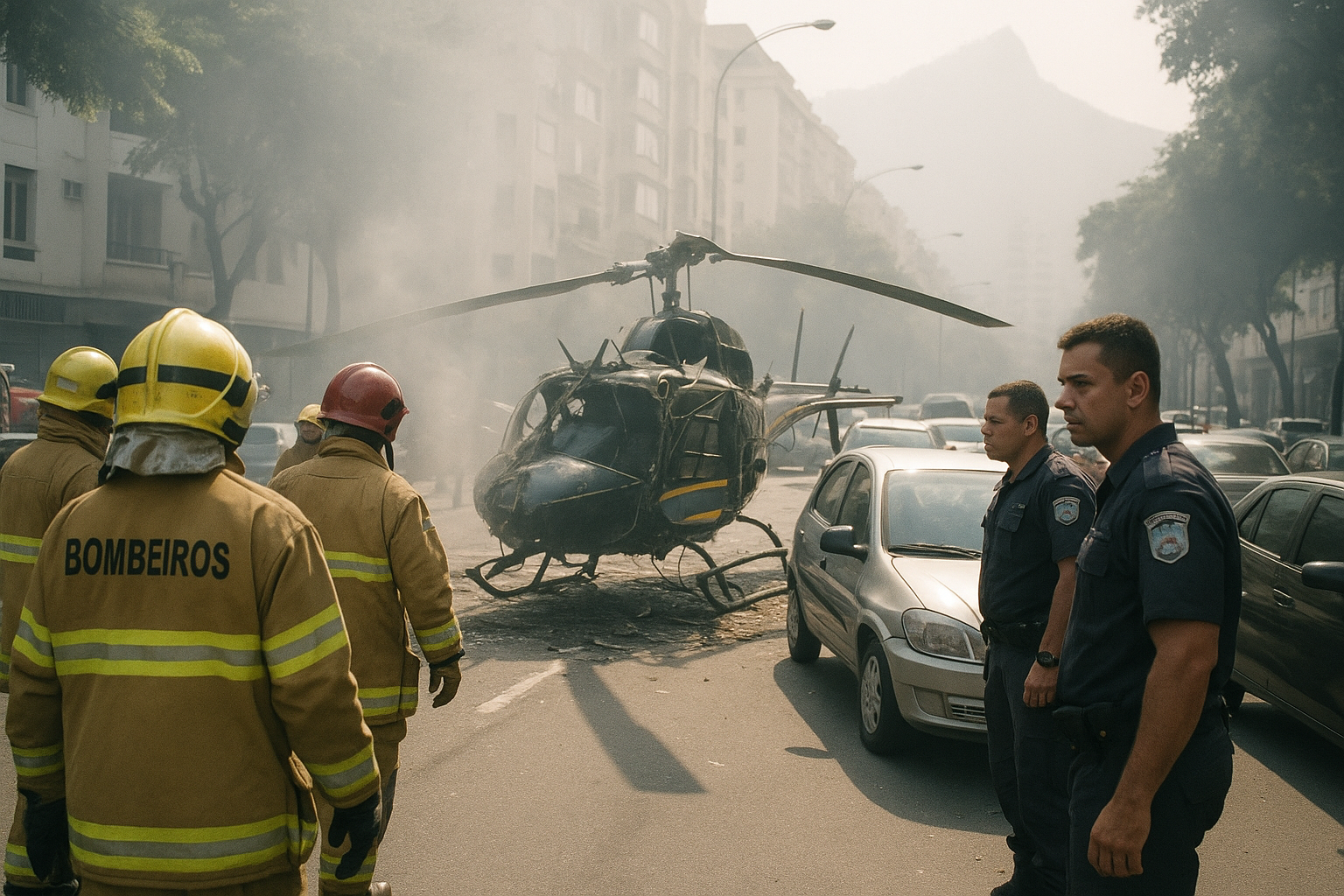
A viral claim spread fast Sunday: “Oliver Tree has died in a helicopter crash.”
The short answer is that the claim appears substantially credible and now likely true, based on the reporting progression from early wire coverage to later local identification reporting. But if you care about getting facts right — and not just getting to a conclusion quickly — the sequence matters.
That’s not media hand-wringing. It’s basic accountability.
When people die in an aviation crash, there are stages: manifests, preliminary police lists, forensic identification, then family and management statements. The internet usually collapses those stages into one sentence and moves on.
In this case, the sentence may end up correct. The path to it was still messy.
What Happened in Rio, Based on Public Reporting
According to the Associated Press, two helicopters collided over Rio de Janeiro’s west zone on Sunday morning, killing all six people aboard. One aircraft reportedly came down in a dealership area with electric vehicles, and a fire followed.
Those basic incident facts — collision, six fatalities, location, emergency response — are consistently reported across outlets.
Where the story became sensitive was identity.
AP reported that police said American singer-comedian Oliver Tree appeared on a passenger list submitted to aviation authorities, while also noting identification of bodies was still being finalized at that stage.
That is a textbook early-incident position: officials can indicate a likely identity without claiming forensic closure has finished.
The Key Fact-Check Pivot: Manifest Mention vs. Formal Identification
The claim in the reel caption (“Oliver Tree has died”) goes beyond manifest language. It states finality.
Early on, AP’s framing was cautious for a reason. Passenger manifests can be wrong or incomplete. Name matches can be messy. Initial field assumptions can be revised.
Later Sunday, Brazilian outlets including Exame and iG/Último Segundo reported that Rio Civil Police had identified all six victims and listed Oliver Tree Nickel among them.
If those reports accurately reflect police identification records, the claim moved from “plausible but not final” to “substantially confirmed.”
That’s the distinction:
- Early wire stage: likely, not yet finalized.
- Later local identification stage: named as identified among fatalities.
So the reel’s conclusion looked ahead of the first official phrasing — but later reporting largely caught up with it.
Why “Mostly True” Is the Responsible Rating
A strict true/false label can miss context. For this case, “mostly true” is the cleanest rating because it captures both the direction of evidence and the timing caveat.
What supports the claim:
- AP documented the crash and reported police placing Oliver Tree on the passenger list.
- Later Brazilian coverage reported civil police identification naming him among six fatalities.
- Multiple follow-on entertainment and general-news outlets echoed the identification claim.
What still deserves caution:
- Early AP copy explicitly said identification was not yet finalized at that moment.
- Public-facing family/management statements can lag official identification.
- International stories with celebrity names are especially prone to copy-paste amplification before primary records are fully visible to the public.
A disciplined read is not “this is fake.” It is: the claim became stronger over time, and responsible wording should track that timeline.
The Bigger Problem: Social Media Handles Finality Poorly
This incident also shows a familiar pathology in the modern news cycle.
Platforms reward speed and certainty. Accident investigations reward patience and verified sequence. Those two systems hate each other.
The result is a public that gets whiplash: first “unconfirmed,” then “confirmed,” then accusations of either “cover-up” or “fearmongering,” when the real story is often just the normal progression from preliminary to formal identification.
None of that means mainstream media is blameless. Some outlets routinely launder secondary claims without primary attribution discipline. But the answer is not to abandon standards; it is to hold the standards tighter when the stakes are human and irreversible.
In plain terms: dead is not a typo you can quietly edit later.
A Note on Institutional Trust (and Why Skepticism Still Helps)
Skepticism cuts both ways.
Blindly trusting viral captions is dumb. Blindly dismissing official channels is also dumb. The useful posture is skeptical verification: track who said what, when, and with what level of confidence.
Here, institutional reporting appears to have converged toward confirmation. That supports the underlying claim. But the process still demonstrates why people should stop treating first-wave social posts as obituary-grade evidence.
Competence matters. So does sequence.
Bottom Line for Readers and Editors
If you’re rating the reel claim now, the fairest judgment is:
Mostly true, with timeline caveat.
- The crash itself is well documented.
- Early reporting placed Oliver Tree on official passenger documentation.
- Later reporting said civil police identified him among the six dead.
At the same time, the way this spread is a reminder that the public information ecosystem still has one setting during breaking tragedies: faster than warranted.
For editors, creators, and anyone with a “post” button: the standard is simple.
- Report what is confirmed.
- Label what is pending.
- Update without pretending uncertainty never existed.
That is how trust is built — not with perfect clairvoyance, but with honest version control.
Sources: Associated Press — Helicopters collide over Rio de Janeiro, killing 6 (https://apnews.com/article/brazil-rio-helicopter-collision-dc3e059c8dcc4fbd84f714dd3c5ab2c8); Exame — Quem são as seis vítimas de acidente entre helicópteros no RJ (https://exame.com/brasil/quem-sao-as-seis-vitimas-de-acidente-entre-helicopteros-no-rj/); iG/Último Segundo — Polícia identifica as 6 vítimas de queda de helicópteros no Rio (https://ultimosegundo.ig.com.br/2026-06-14/policia-identifica-as-6-vitimas-de-queda-de-helicopteros-no-rio.html).