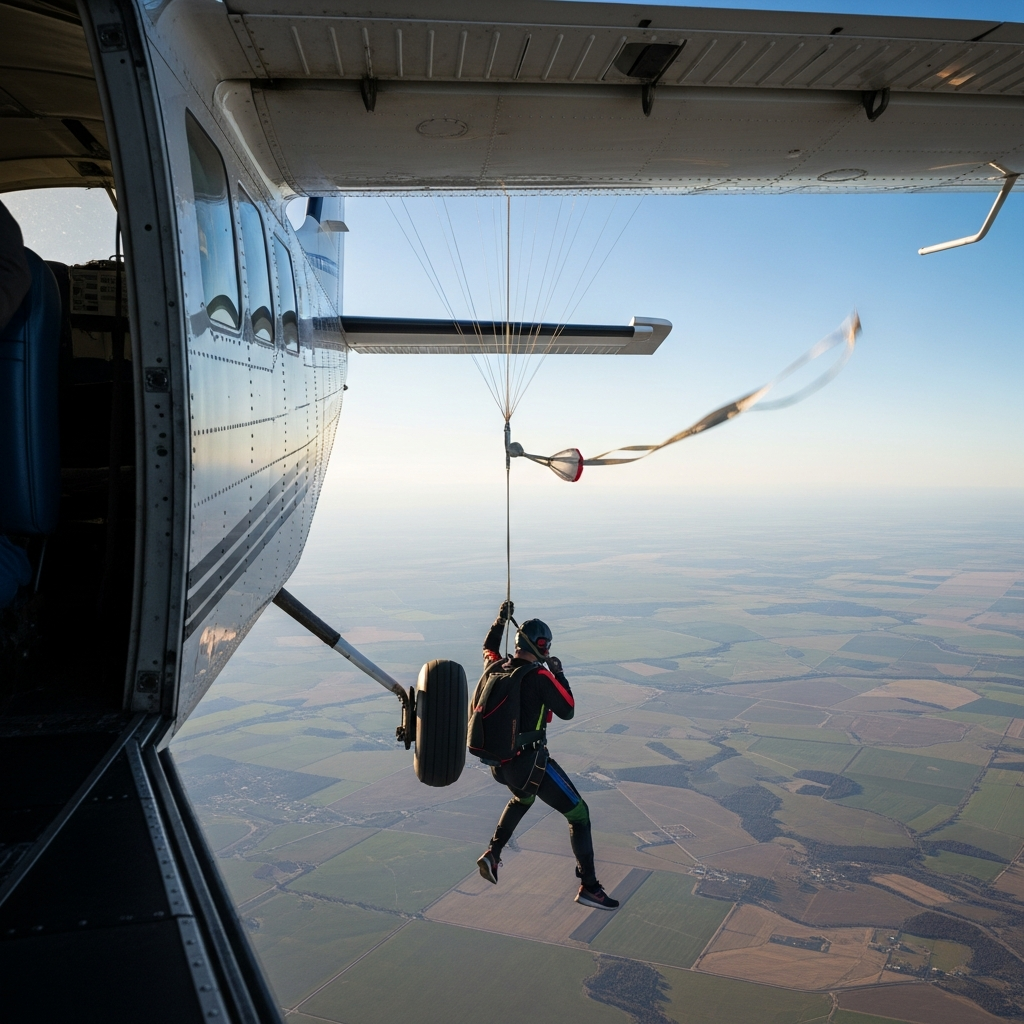
The footage is as stark as aviation video gets: a small figure, legs bicycling in empty air, suspended beneath the tail of a climbing aircraft. Below, the landscape looks calm—flat, sunlit, indifferent. Above, a single mechanical snag has turned a routine recreational skydive into what Australian investigators later called a “nightmare scenario”: a parachute entanglement that left a skydiver dangling from the aircraft’s tail at roughly 15,000 feet.
This week, Australia’s accident investigators released the dramatic video publicly, and it ricocheted across social media and broadcast news, triggering a familiar cycle of awe, alarm, and armchair analysis. But behind the viral clip sits a more consequential story—one about procedural discipline, equipment configuration, and the narrow margins that separate “extreme sport” from “uncontrolled emergency” when humans and aircraft share the same few seconds of airspace.
A Viral Clip, and the Anatomy of a Near-Catastrophe
The incident occurred on Dec. 12, according to the materials released by Australian authorities, during what appears to have been a standard skydiving flight: jumpers exit, parachutes deploy, the aircraft returns to land. The difference, in this case, was an entanglement that prevented full separation between jumper and plane. The skydiver’s parachute became caught on the aircraft’s tail, leaving him tethered and unable to free himself.
In the video, the aircraft continues flying with the jumper visibly attached—an image that is both surreal and deeply practical in its implications. A skydiver hanging from an aircraft is not merely at risk of falling; they can be struck by the airframe, entangled further, or dragged into a position where the parachute lines interfere with the aircraft’s control surfaces.
Aviation safety specialists note that such events, while rare, belong to a known category of incidents: post-exit entanglements, in which a parachute system or static line snags on the aircraft. The consequences can cascade quickly.
“The critical point is that you don’t just have a person in danger—you potentially have an aircraft in danger,” said Dr. Amelia Rowe, an aviation human-factors researcher at an Australian university who has reviewed similar incident reports. “If a line is wrapped around a control surface, you’re in a time-compressed situation where every second matters, and the options narrow fast.”
Investigators have not publicly attributed blame in the materials released this week. But the decision to publish video is itself a signal: the footage is being treated as a teachable moment, not just a spectacle.
What Investigators Released—and Why It Matters
Australia’s air-safety investigators periodically release imagery from serious incidents, often after initial fact-finding, to drive home safety lessons across industries that can otherwise become complacent. In this case, the video is unusually arresting—an airborne emergency rendered in crisp, unambiguous visuals.
The release underscores two overlapping realities about modern safety culture:
- Public attention is a tool. In an era when skydiving videos are routinely shared for thrills, investigators can repurpose the same distribution channels to reinforce risk awareness.
- Near-misses are data. Many of the most important safety reforms in aviation and adventure sports come not from tragedies but from events that almost became tragedies—incidents where the system failed but luck, skill, or quick decision-making prevented a fatal outcome.
“Safety advances often come from the ‘almost,’” said Gavin Holt, a former parachute rigger and safety officer who now consults on recreational aviation risk. “When you see a person hanging from an aircraft, you’re looking at multiple layers of prevention that didn’t work as intended—exit separation, line management, aircraft procedures, emergency response. The question becomes: which layer failed first?”
While the full causal chain will be for investigators to determine, the broader message is already clear: even routine operations can produce non-routine emergencies when systems interact at speed.
How a Parachute Can End Up on a Plane’s Tail
To non-skydivers, the scenario can seem almost impossible—how does someone who has jumped from a plane end up caught on it? But skydiving exits involve a brief, complex choreography.
The exit window is small
Jumpers leave a moving aircraft into airflow that can be turbulent near the fuselage and tail. If a parachute deploys prematurely or a line trails in an unexpected way, it can catch on parts of the aircraft—particularly if the jumper’s body position or timing is off.
Equipment and configuration matter
Different jump types use different setups. Some operations involve a static line (where the parachute is deployed automatically by a line attached to the aircraft), while others involve freefall with manual deployment. Each carries distinct entanglement risks.
Aircraft design plays a role
Skydiving aircraft are often modified for jump operations, but they still have tail assemblies, protrusions, and structural points that can snag fabric or lines. The tail area is especially sensitive because it includes control surfaces vital to stable flight.
“The tail is not just a piece of metal back there—it’s the aircraft’s steering,” Holt said. “If anything compromises it, you have two emergencies at once.”
Investigators have not publicly detailed the specific mechanism of entanglement in this case, but the imagery has renewed attention on how quickly a standard jump can become a high-altitude rescue scenario.
Rescue at Altitude: A Decision Tree With Few Good Options
Once a skydiver is hanging from an aircraft, there is no perfect playbook—only a set of imperfect options shaped by altitude, aircraft performance, and the nature of the entanglement.
Option 1: Land with the person attached
In some cases, pilots attempt a controlled landing while minimizing speed and avoiding abrupt maneuvers. This can be extraordinarily dangerous for the suspended person, who may be exposed to wind blast, impact, or being dragged on touchdown.
Option 2: Climb or stabilize to attempt disentanglement
If the aircraft can maintain stable flight, occupants may attempt to pull the person in or cut lines. This approach is limited by door configuration, harness access, and the very real risk of worsening the entanglement.
Option 3: Cut away
Some parachute systems allow a jumper to cut away the main canopy and deploy a reserve. But if the jumper is physically pinned or the reserve deployment is obstructed, it may not be feasible. Cutting away can also introduce new hazards if lines are wrapped around the aircraft.
Option 4: Emergency services intervention
In rare cases, authorities coordinate aerial or ground-based response—though the time window is tight, and the incident is already in progress at altitude.
The released video indicates the skydiver was eventually rescued, though authorities have not emphasized the precise rescue method in the same viral way the footage captured the peril. Safety experts say that’s typical: the most useful public lesson is often the precipitating failure, not the heroics that follow.
“Rescues are important, but prevention is the headline,” Dr. Rowe said. “The public sees the dangling figure. Professionals see a chain of decisions—some made long before the aircraft ever took off.”
The Broader Safety Question: How Risk Is Managed in a Thrill Economy
Skydiving occupies an unusual space in public policy. It is regulated—aircraft operations, pilot licensing, and certain safety standards apply—but it also operates as a consumer thrill industry, where marketing emphasizes adrenaline, freedom, and once-in-a-lifetime experiences.
That tension can create pressure points:
- High throughput: Busy drop zones aim to move many customers through in a day, increasing operational tempo.
- Mixed experience levels: Tandem students, newly licensed jumpers, and highly experienced skydivers may share the same aircraft.
- Variable conditions: Wind, turbulence, and aircraft performance can change quickly.
- Normalization of risk: When hundreds of jumps occur without incident, rare hazards can fade from attention.
None of this implies negligence in any specific case. But it does shape the environment in which safety procedures must function.
“The industry has strong safety practices, but it also has business incentives,” said Nina Patel, a risk governance analyst who has studied adventure-sport oversight. “The most resilient systems are the ones that don’t rely on perfect human performance every time. They build in margins—training, checklists, equipment redundancies, and a culture where someone can call off a jump without being treated like a problem.”
The footage, she added, is likely to renew discussion about whether current oversight frameworks adequately account for low-probability, high-consequence failures.
Why the Footage Spread So Quickly—and What It Reveals About Modern Safety Communication
The video’s rapid spread is not incidental. It taps into a familiar internet genre: the near-disaster captured from a stable vantage point, inviting viewers to imagine themselves in the worst possible position.
But there is a second layer. Viral safety footage has become a form of informal regulation—a public spotlight that can prompt industry review even before official findings are released.
That can be constructive, and it can also be distorting. Experts caution that short clips can encourage simplistic conclusions: blaming a pilot, a jumper, or a single piece of gear without understanding the full system.
“Aviation investigations are slow because they’re meant to be accurate,” Dr. Rowe said. “The internet is fast because it’s meant to be engaging. Those are different incentives.”
Still, she noted, there is value in the public seeing what “rare” looks like. For prospective customers, it can recalibrate expectations. For operators, it can reinforce procedural rigor. For regulators, it can raise questions about whether existing reporting and training requirements are sufficient.
What Comes Next: Investigation, Recommendations, and an Uncomfortable Reminder
Australian investigators have not, at least in the initial release, provided a final report assigning causes or recommending specific fixes. Such investigations typically involve interviews, equipment inspection, aircraft maintenance review, and procedural analysis, often culminating in recommendations that may be adopted voluntarily by the industry or incorporated into formal guidance.
In the meantime, the incident has already delivered an uncomfortable reminder: modern adventure sports are built on managed risk, not eliminated risk. The safety record of skydiving—often cited by the industry as evidence of robust training and standards—does not negate the reality that a single entanglement can become a life-threatening emergency in seconds.
The image of a person hanging from a plane at 15,000 feet is not just dramatic. It is a systems diagram in motion: a human body, a parachute, and an aircraft tail all occupying the same space, revealing how tightly coupled the elements are—and how quickly the consequences compound when something catches where it shouldn’t.
For viewers, the clip may remain an unforgettable piece of viral media. For operators and regulators, it is something else entirely: a case study that will likely be discussed in hangars, training rooms, and safety briefings long after the social media cycle moves on.
Because the most sobering part of the video is not that it happened—it’s how plausibly it could happen again, somewhere else, to someone else, unless the lesson travels farther than the footage.